Buying Guide
Choosing the best clip-on lamp shades is mainly a fit-and-compatibility exercise. A shade can look suitable in a listing but still fail to attach correctly if the bulb shape, bulb base, or available clearance does not match. The products above fall into two practical groups: small fabric or woven shades for candle-style bulbs, and larger acrylic or fabric shades for standard bulbs. Start with the fixture rather than the color or pattern.
Match the shade to the bulb
Small chandelier shades usually clip over a visible torpedo, teardrop, flame-style, or candelabra bulb. The Ruiever, Qintan, Fuloon, and TOOTOO STAR options explicitly target candelabra or candle-style bulbs. Macarrie also lists extended candle-style bulbs and excludes globe, round, spiral, and stick bulbs. These restrictions are important because a clip designed for a narrow pointed bulb may not sit correctly on a wider bulb.
The Aspen Creative 51521-2 is more flexible on bulb base: its listing identifies both candelabra and medium-base use, provided the bulb is a bare torpedo style. For standard A-type bulbs, the Dunkive and Evelots designs are better documented choices. The Evelots model says it works with standard-size bulbs, while Dunkive specifically identifies A-shaped bulbs. Do not infer compatibility from the shade diameter alone.
Measure the top, bottom, and height
Shade dimensions affect both attachment and appearance. Small options commonly measure about 3 to 3.5 inches at the top, 5.5 to 6 inches at the bottom, and roughly 5 inches high. That range describes products such as TOOTOO STAR, Ruiever, Qintan, and Fuloon. These proportions are intended to remain visually compact around chandelier arms, sconces, and small lamps.
Larger shades create more coverage around exposed bulbs. FenchelShades.com lists a 5-inch top, 8-inch bottom, and 7-inch slant height. The Evelots and Dunkive acrylic designs extend to roughly 7.75 or 8 inches across. Measure the fixture’s surrounding space, not just the bulb. On a multi-light chandelier, check the distance between bulb centers so neighboring shades do not crowd one another.
Choose fabric, hardback, acrylic, or woven construction
Fabric shades provide a traditional appearance and can soften the visual impact of a bright exposed bulb. Linen appears in the Ruiever, Qintan, and TOOTOO STAR options, while Fuloon uses cloth fabric with a PVC lining. Macarrie combines a cotton outer layer with a double PVC interior. These materials are suitable when the goal is a warm, conventional shade profile, but always follow the product’s stated bulb and wattage guidance.
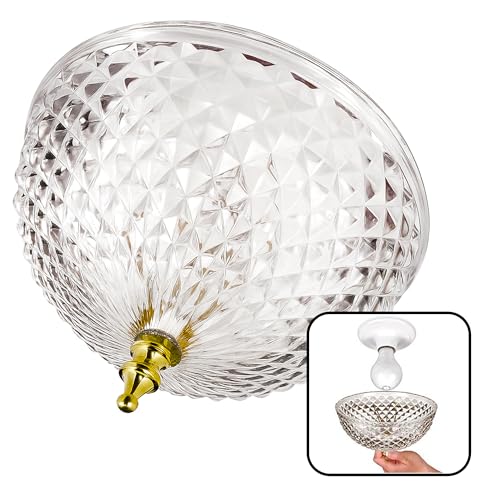
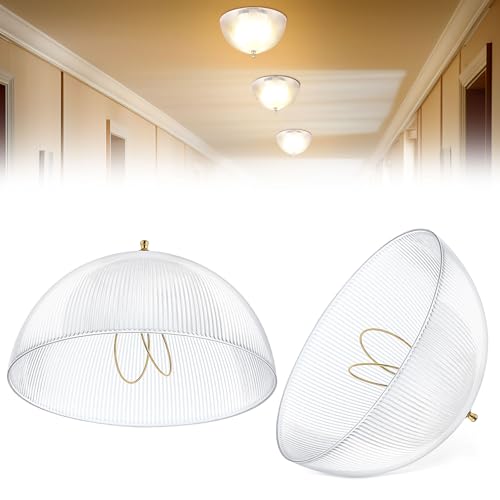
The Aspen Creative model uses pleated faux silk over a virgin styrene backing board. That hardback construction gives it a more structured profile and a documented liner material. Acrylic designs such as Evelots and Dunkive offer a different look: they cover larger areas and are described as diffusing or dispersing light. Acrylic may also be easier to wipe clean than fabric, but the supplied listings do not establish comparative longevity or performance.
Woven shades are primarily a decor choice. Lebaley uses a rattan-style rope finish with a scalloped edge, creating a natural texture suited to boho, farmhouse, coastal, and cottage-inspired rooms. Its listing explains the installation path but does not specify a bulb type, so confirm the fixture and bulb arrangement before ordering.
Consider installation and replacement needs
Clip-on shades are generally designed for direct installation over the bulb, with no tools or assembly required. That makes them useful for refreshing an existing fixture rather than rewiring or replacing it. The Evelots, Aspen Creative, Ruiever, Qintan, and TOOTOO STAR listings all provide clear clip-on attachment information.
Pack size should match the project. A two-pack works for a pair of sconces or a small matching arrangement. Six-piece sets are better suited to chandeliers, while Macarrie’s ten-piece set is aimed at larger coordinated replacements or keeping spares. A multi-pack does not eliminate the need to check dimensions: identical shades still need enough room around each bulb.
The Ruiever listing recommends a maximum 40-watt candelabra bulb, and Aspen Creative also recommends a 40-watt bulb. Those are useful documented limits. Other products identify bulb compatibility without stating a wattage. Do not transfer one model’s wattage guidance to another model. Confirm the shade’s instructions and the bulb manufacturer’s requirements before installation.
The Dunkive listing describes acrylic construction, heat resistance, and a semicircular opening around the bulb, while Evelots identifies clear acrylic construction. These details support their intended use, but they are not a substitute for following fixture and bulb safety directions. Keep fabric and woven shades matched to the bulb types specified by their listings.
Final Recommendation
Aspen Creative 51521-2 Olive Clip-On Shades ranks first overall in this specification-based comparison under the published weighted criteria.
Aspen Creative 51521-2 is the highest-scoring returned product and the first overall specification-based choice among these best clip-on lamp shades. Its combination of a brass clip-on fitter, structured backing, documented dimensions, and compatibility with candelabra or medium-base torpedo bulbs gives it the most balanced specification profile.
Choose Evelots if you need a larger cover for a standard-size bare bulb, or Dunkive if a two-piece A-type-bulb acrylic diffuser better suits the fixture. For chandelier projects, Macarrie, Ruiever, Qintan, Fuloon, and TOOTOO STAR offer compact fabric formats in different quantities and finishes. Lebaley is the decorative woven option, while FenchelShades.com is a larger handmade fabric shade for standard Edison-style bulbs. Together, these are practical examples of the top clip-on lamp shades for different bulb types, fixture sizes, and room styles.
Frequently Asked Questions
Among the best clip-on lamp shades, are clip-on lamp shades universal?
No. Compatibility depends on the bulb shape, base, shade opening, and fixture clearance. Small fabric models in this comparison generally target candelabra, candle, teardrop, or torpedo bulbs. Evelots and Dunkive document standard or A-type bulb compatibility. Check the listing and measure before ordering.
Can I use a candelabra shade on a standard bulb?
Not unless the product specifically documents that compatibility. The Ruiever, Qintan, Fuloon, and TOOTOO STAR listings focus on candelabra or candle-style bulbs. Aspen Creative is an exception in this selection because it documents candelabra and medium-base use, but still specifies bare torpedo bulbs.
How do I choose the right shade size?
Measure the bulb, the fixture’s available width, and the space between neighboring bulbs. Compare those measurements with the listed top diameter, bottom diameter, and height. Small shades around 5 to 6 inches wide suit compact fixtures, while the Evelots and Dunkive designs are about 8 inches across and need more room.
Are acrylic or fabric shades better?
They serve different purposes. Fabric and linen shades provide a traditional covered appearance and are common on chandelier fixtures. Acrylic shades provide larger dome-style coverage and are described as diffusers for standard bulbs. The better choice depends on bulb compatibility, cleaning preference, fixture size, and decor.
The selected listings generally describe direct clip-on or bulb-through-slot installation without tools or assembly. Even so, turn off power before handling a shade and follow the product’s bulb and wattage instructions. Ensure the shade is seated securely and does not crowd adjacent fixture components.