Buying Guide
The best flame incandescent bulbs are decorative bulbs whose shape is part of the lighting design. Unlike ordinary round lamps, these products are often visible in chandeliers, sconces, pendants, ceiling fans, and window candles. That makes socket fit, glass finish, output, and physical length especially important. This comparison uses listed specifications and features only; it is not a hands-on test and does not interpret customer opinions.
Start with the socket base
Base compatibility should be the first check. E12 is the small candelabra screw base commonly associated with candle-style chandeliers, sconces, and some window-candle fixtures. The Simba Lighting, Brightever, Blakapoo, KOR, Westinghouse, and Creative Hobbies selections all document E12 compatibility. Their dimensions and wattages differ, so an E12 socket alone does not guarantee that every bulb will fit inside a shade or decorative housing.
E26 is the larger medium base. Check the fixture label before ordering, especially when a listing uses terms such as “torpedo,” “flame,” or “candelabra” inconsistently. A bulb with the wrong screw base will not be a practical substitute without an adapter, and an adapter may affect clearance or appearance.
Voltage matters as well. Simba Lighting lists 110-130V, Brightever lists 120V, and Blakapoo lists 110-130V operation. Creative Hobbies identifies a 130V standard US electrical design, while KOR identifies 120V and 130V use. When the fixture documentation specifies a voltage, match it rather than relying only on the bulb shape.
Choose the flame appearance
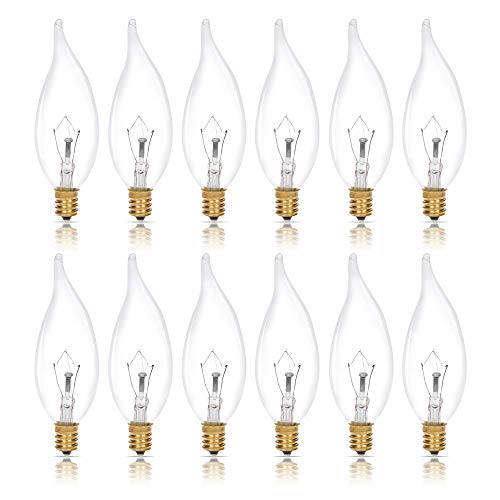
Flame bulbs are not visually identical. Clear glass exposes the internal structure and generally creates a sharper decorative look. Simba Lighting, Blakapoo, KOR, Westinghouse, and DIPEAK document clear designs. Frosted glass, represented by the Simba Lighting frosted alternative in the candidate pool but not selected here, softens the visible bulb; for this top 10, the clearest soft-appearance choice is not directly documented among the selected products, so buyers should treat finish as a key comparison point rather than assume diffusion.
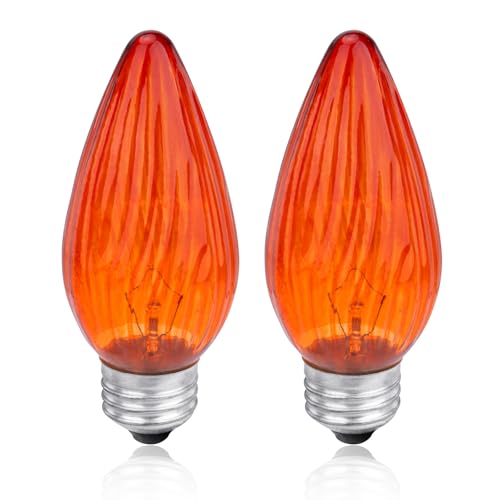
Amber and iridescent finishes change the appearance even when wattage is similar. These choices are suited to visible fixtures where the bulb is part of the room’s décor. Creative Hobbies is different again: its A101 is described as flickering with an orange glow and is only about 2.5 inches overall, making it more appropriate for candle-style accents than for general room lighting.
Also compare the tip profile and length. The selected products range from petite window-candle dimensions to roughly four-inch chandelier bulbs. Measure the available space around the socket, shade, and decorative arms. A flame silhouette can look attractive but still be unsuitable if it contacts a shade or extends beyond the fixture’s intended outline.
Match brightness to the job
Incandescent wattage is not the same as lumen output, so use the listed lumens when available. Brightever lists 380 lumens at 40W, while Simba Lighting lists 300 lumens at 40W. Blakapoo lists 180 lumens at 25W, Westinghouse lists 100 lumens at 15W, and Neowah lists 120 lumens at 25W. These differences show why a wattage-only comparison can be misleading.
For ambient chandelier light, a 15W or 25W bulb may be appropriate when several sockets operate together. KOR’s 15W design and Westinghouse’s 15W, 100-lumen bulb fit that restrained use. For a fixture with fewer sockets, the 40W Simba Lighting or Brightever products provide more listed light per bulb. Creative Hobbies’ 3W output is specifically described as ambiance rather than bright light, so it belongs in a different use category.
Color temperature also affects the atmosphere. Simba Lighting lists 2700K warm white, Blakapoo lists 2700K, and Brightever lists 2500K warm white. Lower Kelvin figures generally indicate a warmer appearance, but the actual result also depends on the glass finish and fixture. Use the documented values as a comparison aid, not as a guarantee of how every room will appear.
If the fixture is connected to a dimmer, choose a bulb whose listing explicitly supports dimming. Brightever, Blakapoo, KOR, and Simba Lighting document dimming compatibility. These are the most specification-aligned choices when adjustable brightness is a required feature.
The evidence supplied for GE Lighting, Westinghouse, Creative Hobbies, Neowah, and DIPEAK does not clearly document dimming support. That does not prove they cannot work with a particular control, but it means dimming should not be assumed from the incandescent label alone. Confirm the bulb and dimmer requirements together before installation.
Consider service life and pack size
Incandescent bulbs are consumable products, and listed life varies. Brightever states 2,500 hours, Blakapoo states 2,000 hours, and Simba Lighting states 1,000 hours. Where no rated life is supplied in the evidence, it is better to treat that as an information gap rather than estimate replacement timing.
Pack size affects convenience. Brightever, Blakapoo, and KOR come in 12-packs, which can help populate a multi-socket chandelier with matching bulbs. A larger pack can be practical for a full fixture, but a two-pack may be preferable when only one or two replacement bulbs are needed.
Final recommendation
Brightever 40W Clear Flame Tip E12, 12-Pack ranks first overall in this specification-based comparison under the published weighted criteria.
Simba Lighting Candelabra Flame Tip Clear CA10 40W E12 is the first overall specification-based choice among the best flame incandescent bulbs because it combines a clearly identified E12 base, 300 lumens, 2700K warm light, CRI 100, dimming support, and a documented flame-tip profile. Its 1,000-hour stated life keeps it from being the longest-life option, but its electrical and optical details make fixture matching straightforward.
Brightever is the stronger alternative when a 2,500-hour stated lifespan and 380-lumen output matter most. Neowah is the amber, vibration-oriented option, while GE Lighting and Westinghouse offer distinct decorative profiles for compatible fixtures. Together, these top flame incandescent bulbs cover the main combinations of base, finish, output, and decorative style documented in the listings.
Frequently Asked Questions
What should I check before buying the best flame incandescent bulbs?
Confirm the base type first: E12 candelabra and E26 medium base are not interchangeable. Then check voltage, bulb length, wattage, lumen output, and whether the fixture permits incandescent bulbs. For enclosed fixtures or shades, verify clearance and the fixture’s maximum wattage from its own label or manual.
Are E12 flame bulbs suitable for chandeliers?
Many are. Simba Lighting, Brightever, Blakapoo, KOR, and Westinghouse identify E12 candelabra compatibility and chandelier use. You should still compare the bulb’s length and diameter with the chandelier socket and decorative arms.
Which selected bulb is intended for a flickering effect?
Creative Hobbies A101 is the selected product whose listing specifically describes a flickering orange glow. It is a 3W E12 bulb with a petite size and a stated 1,500-hour average life. The listing positions it for window candles, sconces, chandeliers, and ambiance, so it should not be treated as a bright general-purpose room bulb.
Do all incandescent flame bulbs support dimming?
No. Dimming support should be documented rather than assumed. The evidence for GE Lighting, Westinghouse, Creative Hobbies, Neowah, and DIPEAK does not clearly state that feature. Check both the bulb and dimmer documentation before use.
Is a higher wattage always brighter?
No. Wattage describes electrical consumption, while lumens describe listed light output. In this selection, Brightever lists 380 lumens at 40W and Simba Lighting lists 300 lumens at 40W, while Westinghouse lists 100 lumens at 15W. Use lumens when supplied, and remember that finish, color temperature, and the number of bulbs in the fixture also affect the overall lighting impression.