Buying Guide
The best combination wrench sets are not simply the ones with the highest piece count. A useful comparison starts with the fastener systems you work on, then considers how the wrench head reaches the fastener, what the steel and finish specification says, and how easily the set can be stored. The products above are ranked from public listing evidence only. No hands-on durability, fit, comfort, or speed testing was performed.
Start with SAE, metric, or both
For a mixed garage, SAE-and-metric coverage reduces the chance that a job stops because the required system is missing. SK lists metric sizes from 6 to 32mm and SAE sizes from 1/4 to 1-1/4 inches, making it the broadest documented collection in this comparison. BULLTOOLS and HORUSDY both use an even 16-piece metric and 16-piece SAE structure, while SWANLAKE provides 15 sizes in each system.
A metric-only set can be more focused. TEKTON lists 19 continuous metric sizes from 6 through 24mm. That is useful when the equipment you service uses metric fasteners and you do not want to store a second system. Check the actual size schedule rather than judging by the number in the title; some listings describe a piece count without displaying every size.
Compare the box-end geometry
A 12-point box end provides more engagement positions than a 6-point design, and several selected sets pair it with a 15-degree offset. That combination is documented for HORUSDY, SWANLAKE, BULLTOOLS, SEDY, HITORK, and others. It can be useful when the handle must be repositioned around an obstruction, but the listing evidence does not establish real-world torque or fit for every fastener.
GEARWRENCH takes a different documented approach with 6-point box ends and off-corner loading. That design is a meaningful choice for users who prefer a six-sided fit on hex fasteners. TEKTON also states that its box end contacts the sides of a fastener rather than the corners. These are design claims, not results from independent testing, so match them to your own preference and fastener condition.
Decide whether ratcheting is useful
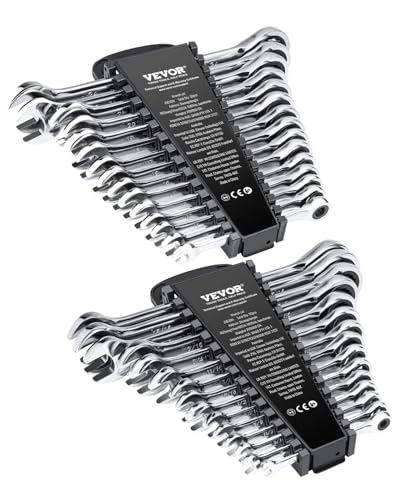
Fixed combination wrenches have a conventional open end and box end. Ratcheting combination wrenches add a ratchet mechanism to the box end, which can reduce the need to remove and reposition the tool during repeated turns. VEVOR documents a 72-tooth mechanism and a 5-degree working angle. HITORK instead emphasizes a standard-and-stubby assortment, making it a different solution for restricted access.
Ratcheting tools may be more convenient in confined areas, but they can have more mechanism-related bulk than a fixed wrench. They also should not automatically be treated as a replacement for every fixed wrench in a workshop. If your priority is a straightforward set for high-accessibility fasteners, the fixed designs from SK, TEKTON, GEARWRENCH, or BULLTOOLS offer simpler documented configurations.
Review steel and finish claims carefully
Chrome vanadium steel appears in many of the selected listings, including SK, SWANLAKE, BULLTOOLS, HORUSDY, SEDY, HITORK, and VEVOR. Several specify heat treatment, drop forging, or a chrome or mirror finish. SK documents drop-forged chrome vanadium steel and SuperKrome plating; BULLTOOLS specifies heat-treated chrome vanadium steel and a mirror polish; SEDY lists chrome vanadium steel with a mirror finish.
These details help distinguish the construction specification, but they do not prove a particular service life or resistance under your working conditions. Look for a stated finish when corrosion resistance matters, and treat broad phrases such as professional performance as marketing language unless supported by a concrete specification.
Treat storage as part of the purchase
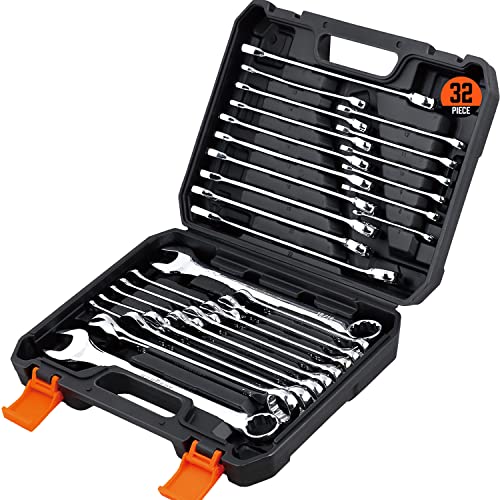
A wrench set is easier to use when the sizes are visible and each tool has a defined place. SWANLAKE documents a compact organizer with locking covers and wall-mounting capability. SEDY lists a folding rack with non-slip grippers, while HITORK specifies a tray that locks each piece in place. HORUSDY supplies a dedicated case, and VEVOR includes a rack.
A roll-up pouch can be useful for transport, while a hard case or locking rack may suit a workshop drawer or vehicle kit better. Color-coded markings are another practical feature: toolant lists bright markings on both ends, while TEKTON lists a wrench rack and hard-to-miss size information. Confirm that the storage format fits your toolbox before selecting by piece count alone.
Match the set to the work area
For broad maintenance coverage, SK, BULLTOOLS, HORUSDY, and SWANLAKE document both SAE and metric sizes. For a metric-only bench, TEKTON is the focused choice. For six-point engagement, GEARWRENCH is the clearest option. For limited swing space, VEVOR’s stated 5-degree ratcheting action is relevant, while HITORK’s combination of standard and stubby pieces addresses reach in a different way.
Before buying, identify the largest and smallest fasteners you regularly handle, count the system sizes already in your toolbox, and decide whether a rack, case, or pouch is easiest to carry. That process usually narrows the field more effectively than a generic piece-count comparison.
Final Recommendation
SK 42-Piece Combination Wrench Set ranks first overall in this specification-based comparison under the published weighted criteria.
SK 42-Piece Combination Wrench Set is the first overall specification-based choice among these best combination wrench sets because it documents the widest SAE and metric range, strong access geometry, and drop-forged chrome vanadium construction with SuperKrome plating. It is particularly suitable when one collection needs to cover both common and larger fasteners.
The top combination wrench sets are not interchangeable in design. TEKTON is the focused metric option, GEARWRENCH is the six-point choice, and toolant emphasizes color-coded identification and anti-slip teeth. SWANLAKE and BULLTOOLS provide balanced mixed-system coverage with organized storage. HORUSDY and SEDY are practical general-purpose alternatives, while HITORK and VEVOR are better suited to specialized access needs.
Use the size schedule as the deciding factor when coverage is critical. Choose the wrench geometry based on the fasteners and clearances you encounter, and select the storage style that matches your workbench, vehicle, or toolbox. These conclusions reflect listed specifications rather than independent testing.
Frequently Asked Questions
What should I check first when comparing the best combination wrench sets?
Check whether the set includes the SAE, metric, or both systems you need, then verify the individual size list. A high piece count does not guarantee that the smallest, largest, or most frequently used sizes are included. SK, BULLTOOLS, HORUSDY, SWANLAKE, TEKTON, toolant, and VEVOR provide especially useful size information in their supplied listings.
Are 12-point combination wrenches better than 6-point designs?
Neither design is universally better based on the supplied evidence. A 12-point box end offers more engagement positions, while GEARWRENCH documents a 6-point box end and off-corner loading for hex fasteners. Choose according to the fastener shapes, access angles, and wrench style you prefer. The listings support design comparisons, not a hands-on performance verdict.
When does a ratcheting combination wrench set make sense?
Ratcheting sets can make sense when repeated repositioning is inconvenient or the working arc is restricted. VEVOR lists a 72-tooth mechanism with a 5-degree working angle. Remember that a ratcheting mechanism can differ in profile from a fixed wrench, so compare the available space and the sizes you need before choosing one format.
Is a storage rack or case important?
It is useful if you regularly transport the set or want fast size identification. SWANLAKE lists locking covers and wall mounting, SEDY lists a folding rack, HITORK lists a locking tray, and HORUSDY lists a dedicated case. A pouch may take less space, while a rigid organizer may protect placement more effectively. Select the format that fits your storage routine.
Which selected set is most specialized for tight spaces?
HITORK is the clearest choice when both standard and stubby formats are useful. VEVOR targets limited swing space through its stated 72-tooth, 5-degree ratcheting design. Fixed sets such as TEKTON, GEARWRENCH, and SWANLAKE also document 15-degree offsets or angled ends, which can help with access, but the listings do not establish which design will fit a particular job.