Buying Guide
The best box-end wrench sets are not all designed for the same job. Some prioritize a broad selection of SAE and metric sizes, while others trade size count for long handles, deep offsets, or ratcheting mechanisms. The right choice depends on the fasteners you expect to encounter and how much room you have to swing a wrench.
Choose the measurement system first
Start by deciding whether your work is primarily metric, SAE, or mixed. A metric-only set can be efficient for a vehicle or machine that uses metric hardware, but it will not cover inch-based fasteners. The SK set covers 8 mm through 19 mm, while the CRAFTSMAN set supplies 15 metric pieces. The DURATECH metric options also focus on common workshop sizes, although their paired or selected-size formats leave gaps.
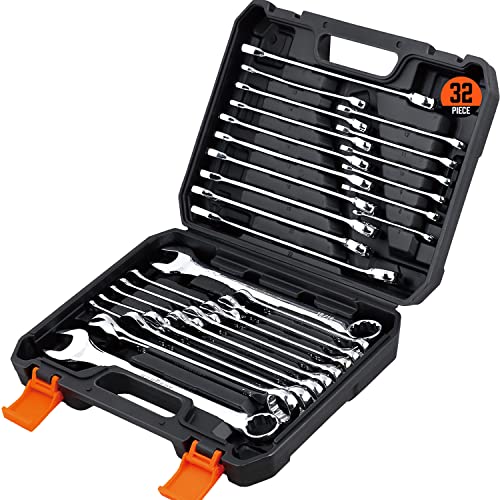
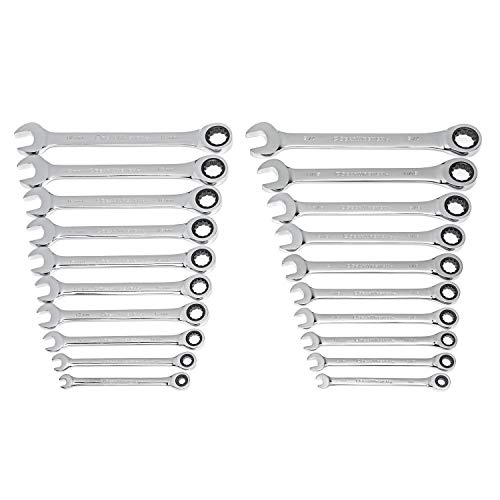
For mixed work, the WORKPRO 22-piece set and GEARWRENCH 20-piece set combine SAE and metric sizes. The HORUSDY 32-piece set goes further, listing SAE sizes from 1/4 inch to 1 inch and metric sizes from 7 mm to 22 mm. GEARWRENCH’s 28-piece set also uses both standards. Broader coverage generally means carrying more tools, but it can reduce the need to stop and find another wrench.
Match the head design to the workspace
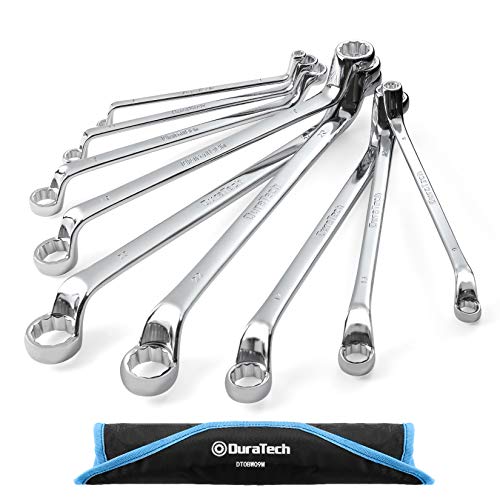
Offset matters when a straight wrench cannot clear a nearby component. A 15-degree offset, as listed on the WORKPRO extra-long SAE set and CRAFTSMAN set, provides additional knuckle clearance without radically changing the wrench angle. The DURATECH 75-degree set is more specialized: its deep offset is intended for hard-to-reach fasteners. Capri Tools takes a different approach with a zero-degree offset, extra-long handles, thin walls, and a deep profile for recessed bolts.
A long handle can improve reach and leverage, but it may be less convenient where movement is extremely restricted. The SK and DURATECH ratcheting sets document extra-long designs, while the MOUNTAIN set combines extra length with a four-degree ratcheting swing arc. Check the available clearance around the fastener before choosing the longest tool.
Decide whether ratcheting is worthwhile
Ratcheting box ends let you turn a fastener without fully removing and repositioning the wrench after each movement. This can save time when the fastener is accessible but the swing space is limited. The selected ratcheting sets use 72-tooth or 90-tooth mechanisms. MOUNTAIN lists a four-degree swing arc, while SK, DURATECH, WORKPRO, and GEARWRENCH listings describe five-degree operation for their applicable mechanisms.
A flex head adds another adjustment point. The WORKPRO 22-piece set documents 180-degree pivoting heads, which can help align the wrench with an angled fastener. Flexibility can also make a tool less straightforward to position, so it is most useful when access angles vary. Fixed double-box sets remain appealing when you want a predictable head position and a simple design.
Compare six-point and 12-point ends
Six-point box ends are shaped around the flats of a standard hex fastener. The GEARWRENCH 28-piece set specifically lists six-point ends and off-corner loading. This can be a sensible choice when your work centers on conventional hex heads and you want the wrench geometry clearly documented for that use.
Many selected sets use 12-point ends. A 12-point design offers more engagement positions, which can help when the wrench must be placed in a particular orientation. Listings for the HORUSDY, CRAFTSMAN, Capri Tools, and DURATECH sets also describe features intended to improve grip or reduce rounding. These claims are specification-based; they do not replace selecting the correct size and using the wrench squarely on the fastener.
MOUNTAIN uses universal spline ends and lists compatibility with several fastener shapes, including 6-point, 12-point, Torx, square, and rounded bolts. That broader compatibility is useful when your equipment contains mixed fastener types, but it should not be treated as a substitute for a dedicated specialty tool in every situation.
Review materials and surface treatment
Most selected sets specify chrome vanadium steel, often with heat treatment, polishing, or chrome plating. These details indicate the construction and finish described in the listings. The Capri Tools set instead specifies chrome molybdenum steel. GEARWRENCH lists alloy steel for its 20-piece and 28-piece sets. Finish descriptions include mirror chrome, black electrophoretic coating, gray nickel plating, and polished surfaces.
A finish can make grime easier to wipe away or help resist corrosion, but the listings do not establish real-world service life under a particular environment. For shop or vehicle use, also consider whether the size markings are stamped, printed on storage, or otherwise documented. Stamped markings appear on several sets, including SK and GEARWRENCH products.
Do not overlook storage
Storage is practical rather than decorative. A labeled pouch can make a compact set easier to transport, while a case or foam organizer can show where a missing wrench belongs. The DURATECH ratcheting set uses EVA foam, the HORUSDY 32-piece set includes a dedicated case, and the WORKPRO flex-head set includes a toolbox. Capri Tools, SK, and several other sets use roll-style pouches.
If your tools travel between a garage and a job site, check the storage format and the number of pieces before buying. A large case may protect organization but occupy more room. A roll pouch may carry easily but provide less rigid protection.
Final recommendation
WORKPRO 22-Piece Flex-Head Ratcheting Set ranks first overall in this specification-based comparison under the published weighted criteria.
The final choice among the best box-end wrench sets depends on the documented features that match your intended use.
WORKPRO 22-Piece Ratcheting Wrench Set with 180° Flex Head is the highest-scoring returned product and the first overall specification-based choice. It combines mixed SAE and metric coverage, flexible heads, 72-tooth ratcheting, chrome vanadium steel, and a toolbox. For the top box-end wrench sets, it offers the most balanced documented feature mix.
Choose the HORUSDY 32-piece set when coverage matters more than ratcheting. Choose SK for long-handle metric work, MOUNTAIN for the smallest documented ratcheting swing arc, or Capri Tools for recessed SAE fasteners. The DURATECH 75-degree set is a practical alternative when a deep fixed offset is the main requirement. These recommendations reflect listing specifications only, not hands-on test results.
Frequently Asked Questions
What should I look for in the best box-end wrench sets?
Look at the measurement system, individual size list, head offset, box-end point count, handle length, ratcheting mechanism, and storage. A broad mixed set suits varied maintenance, while a focused metric or SAE set may be easier to carry.
Are 12-point box ends better than six-point ends?
Neither is universally better. Six-point ends are specifically shaped for standard hex fasteners, while 12-point ends provide more placement positions. The GEARWRENCH 28-piece set documents six-point ends; many other selected products specify 12-point designs.
Do ratcheting box-end wrenches work in tight spaces?
They can be useful when the mechanism has a small swing arc. MOUNTAIN lists a four-degree arc, and several 72-tooth sets list five degrees. The available clearance, fastener condition, and head orientation still determine whether a particular wrench will fit.
Is a mixed SAE and metric set worthwhile?
It is worthwhile when you regularly work on equipment using both standards. The WORKPRO 22-piece, GEARWRENCH 20-piece, GEARWRENCH 28-piece, and HORUSDY 32-piece sets document mixed coverage. If your applications use one standard, a focused set may avoid unnecessary pieces.
What is the difference between an offset and flex-head set?
An offset changes the fixed angle of the wrench head, as seen in the 15-degree, 50-degree, and 75-degree designs selected here. A flex head pivots through a range of angles; the WORKPRO set documents 180-degree pivoting heads. Offset is predictable, while flex provides more positioning options.