Buying Guide
This guide compares the best cork wine stoppers using documented seal mechanism & fit, material & food safety, bottle compatibility, reusability & longevity, storage & fridge profile, ease of insertion & removal, and pack quantity & multi-bottle use.
Why Stopper Design Matters
A wine stopper influences how well an opened bottle resists oxygen, how easily you can reseal it, and how the bottle fits in your refrigerator. The best cork wine stoppers span several design families, each with a distinct specification profile. Traditional tapered wooden corks recreate the feel of an original bottle closure, while T-shaped wooden and rubber corks offer a reusable, low-profile alternative for standard wine bottles. Reusable silicone cone stoppers, expanding stainless steel designs, and vacuum pump systems each approach preservation differently, and the right pick depends on the bottles you open and where you store them.
Tapered Wooden Corks
Tapered corks like the Svalor and Impnit packs are made from natural soft wood and shaped into a cone that compresses as it enters the neck. They fit standard 375 ml, 500 ml, and 750 ml bottles when sized correctly, and they work for wine, beer, and liquor. Because they are a soft, natural material, they are usually treated as replaceable rather than long-term reusable, so a multi-pack like the 25-piece Impnit set can be helpful if you frequently refill or recork bottles. Tapered corks are also widely used in craft projects, which makes large packs a flexible option if you bottle homemade drinks.
T-Shaped Wooden and Rubber Corks
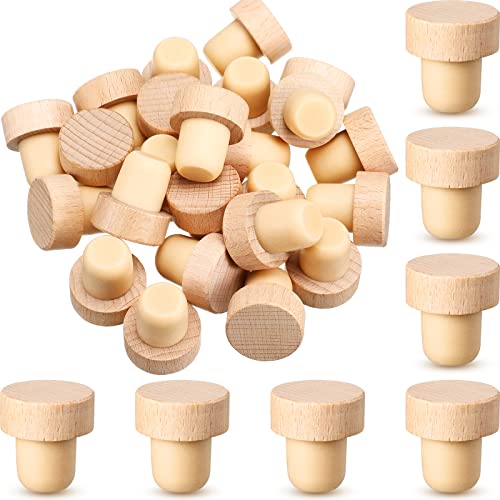
T-shaped corks such as the Yalikop, Oggi, and Eorbow designs use a wooden top with a flexible rubber or sealing tip below. The shape sits low on the bottle, which helps when storing wine upright in a refrigerator door or shelf. The diameter of the sealing tip is usually around 18.6 to 19.3 mm, suited to standard wine bottles. The wood top also keeps your hands away from the sealing material during insertion and removal. T-shaped cork designs are reusable, easy to grip, and a popular specification-friendly choice for everyday wine storage.
Reusable Silicone Cone Stoppers
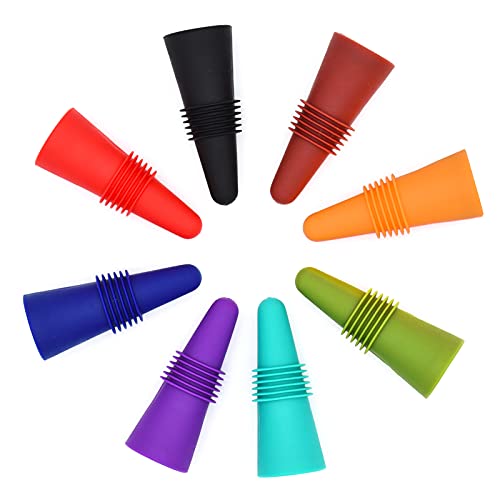
The cone shape compresses slightly as you push it in, creating an airtight seal that is simple to remove with a single pull. These stoppers are dishwasher safe, reusable, and often sold in multi-packs so you can track several open bottles by color. They fit wine bottles as well as many other beverage bottles, which makes them useful in a kitchen that handles oils, vinegars, or homemade sodas.
Press-to-Seal and Expanding Stoppers
Press-to-seal and expanding stoppers, including the OXO SteeL Leakproof Expanding Wine Stopper and the ERHIRY stainless steel press-to-seal model, use a silicone ring that expands against the inside of the bottle neck when you press the lever. The seal contracts again when you lift the lever for removal. This mechanism produces a tight seal that holds even when bottles are stored on their side in the refrigerator. Stainless steel shafts add rigidity, and the compact profile saves space on crowded fridge shelves.
Vacuum Pump Systems
Vacuum stoppers and pumps such as the WOTOR vacuum saver stoppers and the bundled WOTOR pump kit use a separate pump to actively extract air from the bottle before the stopper seals it. The WOTOR kit includes four reusable stoppers with the pump, while the 12-piece WOTOR silicone stoppers work with a separate pump. These systems are specification-oriented picks for users who want a longer post-opening freshness window than passive seals alone can provide, and they fit most standard red and white wine bottles.
Matching the Stopper to the Bottle
The key specification to check is the bottle neck diameter and the listed stopper dimensions. Standard 750 ml wine bottles typically have an inner opening near 18.5 mm, which is why so many stoppers in this guide are sized for that range. Tapered corks rely on a cone shape rather than a fixed diameter, while T-shaped and silicone stoppers rely on a listed measurement. When the listing calls out compatibility with 375 ml, 500 ml, and 750 ml bottles, the stopper is built around the standard wine bottle profile and is a safe specification pick for typical wine use.
Storage, Cleaning, and Reuse
Reusable stoppers such as silicone cones, T-shaped wooden and rubber corks, and stainless steel press-to-seal models are generally dishwasher safe and can be cleaned between uses. Tapered wooden corks are designed to be replaced rather than washed repeatedly, since water can affect their structure. Compact and low-profile stoppers help when refrigerator space is limited, especially for bottles stored on the top shelf or on their side. For vacuum kits, the stoppers are usually the reusable part while the pump itself may need occasional cleaning of its valve to keep the seal consistent.
Final Recommendation
ERHIRY Press-to-Seal Stainless Steel Wine Stoppers (2 Pack) ranks first overall in this specification-based comparison under the published weighted criteria.
The final choice among the best cork wine stoppers depends on the documented features that match your intended use.
For a specification-first pick that balances reusable sealing, broad bottle compatibility, and a compact form factor, the OXO SteeL Leakproof Expanding Wine Stopper stands out among the top cork wine stoppers and is the highest-scoring returned option for tight horizontal-storage sealing. If you prefer a low-profile T-shaped cork for everyday fridge use, the Oggi T-Shaped Wine Corks provide a simple reusable fit on standard bottles. For higher-volume households or entertaining, the Eorbow T-Shaped Wooden Wine Corks (60 Pack) and the Yalikop T-Shaped Wooden & Rubber Wine Corks (24 Pcs) deliver reusable sealing in large quantities, while the BOOMIBOO Silicone Wine Bottle Stoppers offer a colorful reusable cone design. Together these picks cover the main design families that define top cork wine stoppers for US buyers in 2026.
Frequently Asked Questions
What are the best cork wine stoppers for standard 750 ml bottles?
The best cork wine stoppers for standard 750 ml bottles are those listed as compatible with that size, including the OXO SteeL Leakproof Expanding Wine Stopper, the Oggi T-Shaped Wine Corks, the Yalikop T-Shaped Wooden & Rubber Wine Corks, and the BOOMIBOO Silicone Wine Bottle Stoppers. Each is designed around the standard wine bottle neck profile.
How does a T-shaped cork stopper differ from a tapered wooden cork?
A T-shaped cork stopper uses a wooden top with a flexible rubber sealing tip and sits low on the bottle, while a tapered wooden cork is a single piece of shaped wood that compresses inside the neck. T-shaped designs such as the Yalikop and Eorbow corks are reusable, whereas tapered corks such as the Svalor and Impnit packs are typically replaced over time.
Can silicone wine stoppers replace traditional cork closures?
Yes. They offer a reusable alternative to traditional cork, especially when you want a quick insert and removal.
Are vacuum wine stoppers worth choosing over passive seals?
Vacuum stoppers like the WOTOR vacuum saver stoppers and the WOTOR pump kit actively extract air from the bottle before sealing, which can extend post-opening freshness compared with passive seals. They are a useful specification choice if you regularly store wine for several days after opening and already use or plan to use a vacuum pump.
How should I clean reusable wine stoppers between uses?
Most reusable stoppers in this guide, including silicone cones, T-shaped wooden and rubber corks, and stainless steel press-to-seal models, are listed as dishwasher safe. Tapered wooden corks such as the Svalor and Impnit packs are designed as replaceable corks and are typically not washed for repeated sealing use.