Buying Guide
The best crystal wine decanters differ less by a single headline feature than by how their material, shape, capacity, and care requirements work together. The products selected here are all documented as crystal or lead-free crystal wine decanters, but their designs range from compact 25-ounce serving pieces to large 66-ounce bowls. Start by deciding how much wine you normally decant, then consider how much aeration surface, pouring control, and maintenance support you actually need.
Choose the crystal construction deliberately
“Crystal” is not one uniform specification in this group. The Riedel Ultra is described as full-lead crystal and mouth-blown in Austria, while the Riedel Performance uses machine-made crystal with optical blown glass. Several other products specify lead-free crystal, including the hand-blown Le Chateau, JoyJolt Lancia, YouYah, Gusto Nostro, Ravenscroft, and Amlong Crystal models.
Lead-free crystal can be the right choice when the listing’s material specification is a priority. Hand-blown construction may also appeal if you want a more artisanal presentation, but it does not by itself establish a particular pouring or cleaning outcome. For a more structured buying decision, match the material description to the shape and accessories rather than treating the word crystal as a complete performance claim.
Match capacity to the bottle you serve
A standard 750-milliliter bottle is the most useful reference point. Le Chateau documents a 750-milliliter capacity, while the Gusto Nostro listing says its 25.4-ounce decanter holds a full 750-milliliter bottle. The YouYah 1300-milliliter model, the JoyJolt Lancia at 40 ounces, and the Ravenscroft at 66 ounces provide more room around a bottle. That additional space may be useful when you want a broad bowl or serve larger pours, but it can also make the vessel more imposing on a table or shelf.
Compact models have their own appeal. The Riedel Cabernet and Schott Zwiesel Pure are both listed at 25 ounces, making them focused choices for serving rather than oversized display. The Spiegelau Definition and Riedel Performance each list 33.8 ounces, a middle-ground capacity that can accommodate a bottle while retaining a comparatively manageable footprint.
Evaluate the aeration shape
Wide bases and broad bowls are recurring design cues in the supplied evidence. Ravenscroft describes a broad base for maximum surface area, Le Chateau specifies a wide diameter for a full bottle, and JoyJolt identifies a large base area for red wine aeration. The Riedel Ultra is described as exposing wine to oxygen, while the Schott Zwiesel Pure is presented as a red-wine decanter with a compact modern contour.
Built-in aerator designs take a different approach. The YouYah includes an aerator lid, and the Gusto Nostro listing emphasizes a shape that gives a full bottle room to breathe. These features may be useful when serving speed or a guided pour matters, but the supplied listing information does not independently verify a particular time-to-result claim. Treat those statements as product-description features rather than test findings.
Look for pouring details that fit your routine
Pouring control is documented in several ways. The Schott Zwiesel Pure includes Drop Protect technology intended to prevent drips. The Spiegelau Definition has a sculpted neck and angled spout, while Le Chateau lists a wide mouth, slanted top, and spout. JoyJolt also specifies a slanted spout. The narrow-neck forms on YouYah and some other models are described as easier to grip, but a narrow neck can also make interior access more demanding.
If serving neatly is your main concern, prioritize a documented spout or drip-control feature. The selected products focus more directly on conventional decanting, crystal construction, capacity, and serving form.
Plan for cleaning and storage
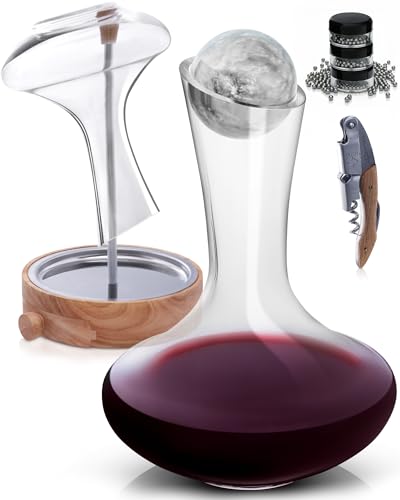
Care requirements vary. Riedel recommends hand washing for the Ultra, and Schott Zwiesel lists hand wash for the Pure. The Riedel Performance is identified as dishwasher safe, giving it the clearest machine-care specification in this group. Wide-mouth designs such as Le Chateau may be easier to access, while the Gusto Nostro and YouYah sets include dedicated drying stands. YouYah also includes stainless-steel cleaning beads.
A stopper can help cover the vessel between pours, but it does not remove the need to clean and dry the decanter. Ravenscroft includes a solid crystal stopper, Amlong Crystal includes a globe stopper with a flat base, and Spiegelau includes a matching stopper. Before choosing a tall or curved model, check whether your storage area can accommodate its listed height and diameter.
Final recommendation
Ravenscroft 66-Ounce Wide-Base Decanter ranks first overall in this specification-based comparison under the published weighted criteria.
Riedel Ultra Decanter is the first overall specification-based choice among the best crystal wine decanters because it combines full-lead crystal, Austrian mouth-blown construction, a 43.3-ounce capacity, and an oxygen-exposing form. It is best suited to buyers who accept hand washing as part of caring for a substantial crystal piece.
The Ravenscroft 66-Ounce Wide-Base Decanter is the better fit for a large presentation, with its broad base, hand-blown European construction, lead-free crystal, and crystal stopper. For a more compact and polished design, the Spiegelau Definition is a useful option because it adds a matching stopper, sculpted neck, angled spout, and documented red-and-white wine versatility. The Riedel Performance is the practical care choice among the top crystal wine decanters, thanks to its dishwasher-safe specification and optical blown-glass treatment.
Le Chateau and JoyJolt Lancia are sensible full-bottle formats with wide-base or large-area aeration details and slanted spouts. Schott Zwiesel Pure is more compact and specifically documents Drop Protect pouring technology. Gusto Nostro and YouYah make the most sense when a drying stand and cleaning accessories are important. Amlong Crystal rounds out the selection with a 58-ounce capacity and a distinctive flat-bottom globe stopper.
Frequently Asked Questions
What capacity should a crystal wine decanter have?
For a standard 750-milliliter bottle, a decanter listed around 25.4 ounces or 750 milliliters can work as a close-fit serving vessel. Models such as the Spiegelau Definition, Riedel Performance, and JoyJolt Lancia provide more listed capacity. Larger options such as Amlong Crystal and Ravenscroft leave substantially more room and create a larger tabletop presence.
Are the best crystal wine decanters lead-free?
Some selected models explicitly specify lead-free crystal, including Spiegelau Definition, Le Chateau, JoyJolt Lancia, Ravenscroft, YouYah, Gusto Nostro, and Amlong Crystal. The Riedel Ultra is described as full-lead crystal, while the Riedel Performance listing identifies machine-made crystal without specifying lead content in the supplied evidence. Check the individual material description when that distinction matters to you.
Which selected decanters include stoppers?
Spiegelau Definition includes a matching stopper, Ravenscroft includes a solid crystal stopper, Gusto Nostro includes a marble stopper, and Amlong Crystal includes a crystal globe stopper. These closures can cover the vessel between pours, but the listings do not establish long-term storage performance beyond those included features.
Which crystal wine decanter is easiest to care for?
The Riedel Performance has the clearest convenient-care specification because it is identified as dishwasher safe. Gusto Nostro and YouYah include drying stands, and YouYah also supplies cleaning beads. Schott Zwiesel Pure and Riedel Ultra specify hand washing, so their care routines may require more deliberate handling.
Do wide bases automatically make a decanter better?
A wide base can provide more surface area, and several selected listings explicitly connect broad shapes with aeration. It also affects footprint and storage. Choose a wide-base design when that shape suits your serving style, but weigh it against table space, handling, and cleaning access rather than treating width alone as a guarantee of a particular result.