Buying Guide
The best digital cabinet safes are not all built for the same job. A compact keypad box can suit cash, jewelry, or small personal items, while a larger document safe may be more appropriate for folders, devices, and household records. Start by identifying the items you will store, then compare the safe’s interior dimensions, exterior footprint, access method, and anchoring options.
Match capacity to the items you own
Capacity labels are useful starting points, but they do not replace measurements. Tenamic is listed at 0.23 cubic feet, while Locksworth provides 0.6 cubic feet and Amazon Basics models provide 1.2 cubic feet. Tipiyajo reaches a stated 3.4 cubic feet, and SentrySafe provides 2.05 cubic feet. Those figures suggest a broad range, but shelves, door hardware, and interior shape affect usable room.
Measure the tallest, widest, and deepest item you plan to store. Pay particular attention to document folders and devices, which may need a taller or wider opening rather than simply more cubic volume. A removable shelf can make one safe more adaptable: Amazon Basics, Mitlvge, Tipiyajo, Aprxuvot, and SentrySafe list adjustable or removable organization features. For mixed belongings, a shelf can separate papers from smaller objects; for one large item, removing it may be preferable.
Choose the right access arrangement
Most products here use a programmable digital keypad and include a mechanical override key. That combination gives convenient daily entry while retaining a recovery method if the code is forgotten or the batteries are depleted. SereneLife specifically lists electronic and mechanical access, while Locksworth, Aprxuvot, and Tenamic list keypad and key entry.
Some models add another recovery route. Mitlvge lists an external battery box, Aprxuvot lists an external battery case, and VEVOR lists two code sets as well as override keys. Check where backup keys and external power hardware are stored; keeping every recovery method inside the safe would defeat its purpose. SereneLife lists four AA batteries in the package, whereas the Amazon Basics 27EI-43 listing says its four AA batteries are not included.
Compare physical security details carefully
Listing language about steel construction, bolts, doors, and hinges is more useful than a broad security adjective. The compact products commonly list two locking bolts and pry-resistant concealed hinges. Amazon Basics 36SAM provides more specific material information, naming an 8-gauge steel door and 14-gauge steel body. SentrySafe lists six live-locking bolts and a pry-resistant hinge bar. Mitlvge lists three solid 0.98-inch bolts, while Aprxuvot lists three 25mm live steel bolts.
These specifications describe construction features, not a guarantee against every attack. Anchoring is also important because a safe that is not secured may be easier to move. Follow the supplied installation instructions and confirm that the wall, floor, shelf, or cabinet can support the safe and the contents. The VEVOR depository model is especially installation-flexible, with listed wall, floor, or cabinet mounting.
Consider fire and water documentation
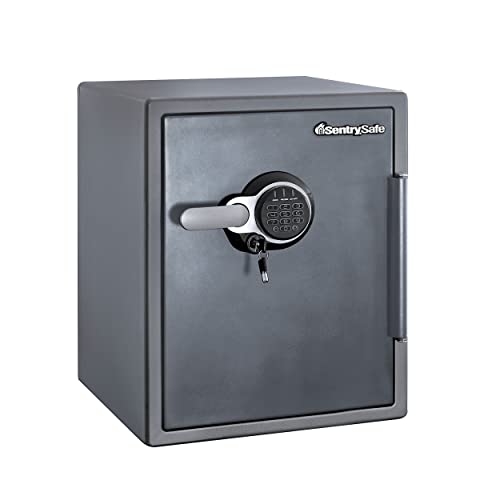
Environmental protection is a separate buying decision from digital access. SentrySafe is the clearest choice when documented fire and water protection are priorities: the listing states UL Classified performance for one hour at 1700°F and ETL-verified water protection for 24 hours in water up to 8 inches. Mitlvge lists 35-minute fire protection at 1700°F, but water protection is not stated.
Do not assume that a steel keypad safe is fireproof or waterproof simply because it is described as durable. Most products in this comparison do not provide those claims in the supplied evidence. If you need environmental protection, verify the exact certification, duration, temperature, water depth, and installation requirements.
Check cabinet fit and door clearance
Exterior dimensions determine whether a safe can enter the intended space, but the door swing and mounting surface matter too. Compact options such as SereneLife and Tenamic are easier to place near a desk, cabinet, or closet. Larger products such as Tipiyajo, Mitlvge, and SentrySafe need more deliberate placement. SentrySafe’s listing specifically calls for 17.5 inches of door clearance to open fully.
Also account for the keypad location, battery access, and the direction of the door. A safe that technically fits may be inconvenient if the keypad is blocked or the door cannot open far enough to remove documents. Confirm both the outside dimensions and any stated inside measurements before ordering.
Look for practical organization features
An interior light helps when the safe is placed in a dim closet or cabinet. Mitlvge, Tipiyajo, Aprxuvot, and SentrySafe list interior lighting. Carpet or felt lining may help reduce scratches on stored items; Amazon Basics 27EI-43, Locksworth, Tipiyajo, and Aprxuvot document a lined or carpeted interior. These features do not replace structural security, but they can make daily use more convenient.
A deposit slot changes the use case entirely. VEVOR is designed for inserting cash or documents without opening the main door and includes a saw-tooth baffle intended to prevent fishing. That is useful for recurring deposits, but unnecessary for simple personal storage.
Final Recommendation
SentrySafe SFW205GQC 2.05-Cubic-Foot Safe ranks first overall in this specification-based comparison under the published weighted criteria.
SentrySafe SFW205GQC 2.05-Cubic-Foot Safe ranks first in this specification-based comparison under the published weighted criteria.
The final choice among the best digital cabinet safes depends on the documented features that match your intended use.
SentrySafe SFW205GQC is the first overall specification-based choice. Its documented fire and water protection, large organized interior, interior lighting, and six live-locking bolts give it the broadest protection profile in this comparison. It is best suited to a dedicated floor location rather than a small cabinet.
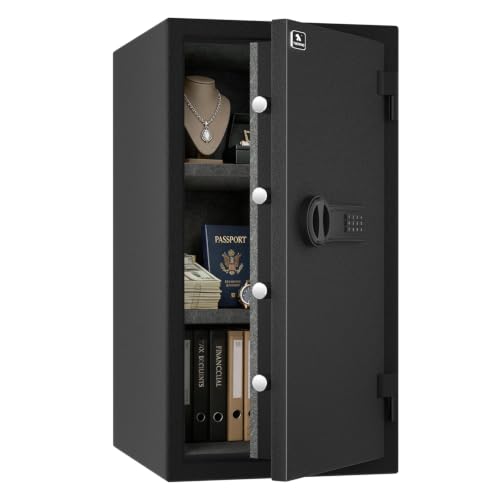
Among the top digital cabinet safes, Mitlvge is the better fit when fire protection, an external battery box, alarms, and a removable shelf are more important than water documentation. Amazon Basics 27EI-43 and 36SAM provide balanced general-purpose storage, with the latter offering especially specific steel-gauge information. Tipiyajo is the capacity pick, while VEVOR is the specialized deposit-slot choice.
For tighter spaces, Locksworth, SereneLife, and Tenamic offer more compact formats with keypad access, backup entry, and mounting options. Aprxuvot adds a useful mix of alarm, silent mode, LED lighting, and adjustable storage. Before selecting any model, verify the physical dimensions, interior layout, door clearance, anchoring surface, and whether fire or water protection is actually documented for your needs.
Frequently Asked Questions
What should I measure before buying one of the best digital cabinet safes?
Measure the available width, depth, and height, then check the safe’s exterior dimensions and door clearance. Also measure the items you intend to store, especially folders, devices, or other objects that may not fit efficiently in a compact interior. If you plan to anchor the safe, confirm that the mounting surface and supplied hardware are suitable for the installation.
Are digital cabinet safes fireproof or waterproof?
Not automatically. In this comparison, SentrySafe documents both fire and water protection, while Mitlvge documents a specific fire-protection claim. The other listed products do not provide equivalent fire or water specifications in the supplied evidence. Treat steel construction, a keypad, and an alarm as separate features unless the listing provides certification or detailed environmental-protection information.
Is a backup key important on a keypad safe?
A backup key can provide access if the code is forgotten or the batteries fail. Most selected products list override keys, and some also list an external battery box or case. Store recovery hardware somewhere accessible but separate from the safe, and follow the product instructions for battery replacement and emergency entry.
Which selected safe is best for documents?
SentrySafe is the most specification-aligned document-focused option because it lists a 2.05-cubic-foot capacity, fire and water protection, an interior light, a drawer, and a file organizer. Mitlvge and the Amazon Basics models are also suitable candidates when you need organized storage but have different space or environmental-protection requirements.
When does a deposit-slot safe make sense?
A deposit-slot design makes sense when people need to add cash or documents without opening the main compartment. VEVOR is the selected model with that design, including a slot and saw-tooth baffle. For occasional personal storage, a conventional keypad safe may be simpler because it avoids a feature you may not use.