Buying Guide
Choosing among the best digital refrigerator thermometers starts with the way you plan to monitor temperature. A single display inside a kitchen refrigerator has different needs from a garage freezer, restaurant cold-storage area, RV, or medication refrigerator. The specifications below explain which features matter and how to compare them without treating listing claims as hands-on test results.
Choose the monitoring layout first
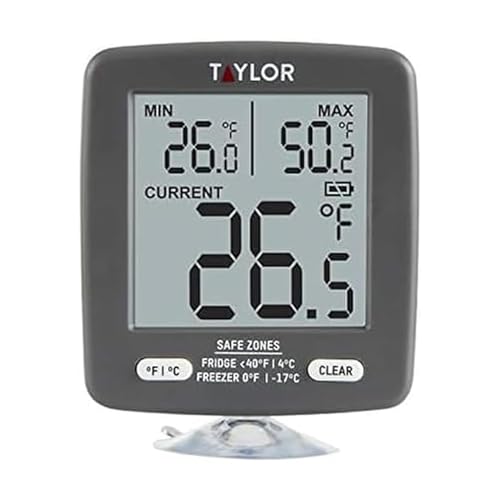
A basic single-unit thermometer is usually the simplest choice for one refrigerator or freezer compartment. Taylor 5262798 is an example of this approach: it shows current and MAX/MIN temperatures on a large LCD and uses a suction cup or clip. AMIR WA176 adds an external probe, which can be useful when the display needs to remain outside the appliance or when a sensor must reach a difficult location.
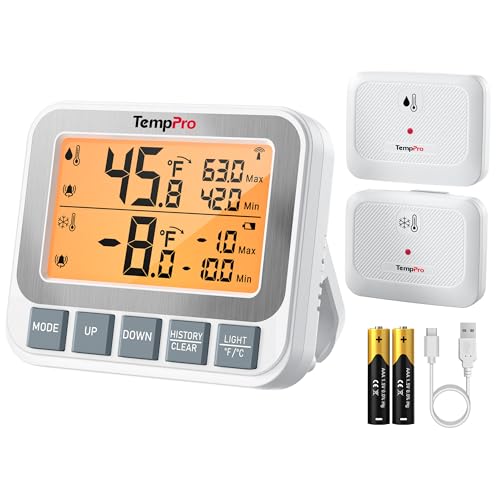
For simultaneous refrigerator and freezer monitoring, dual-sensor wireless systems offer more coverage. AMIR WA178, TempPro TempAir PLUS TP210B, U UNNI UN0583S, and AcuRite 00986M all document two-sensor designs. Check whether the listing specifies the transmission distance, update behavior, and sensor range before assuming two sensors will work equally well in every location.
A multi-pack is another way to cover separate zones. AMIR WA171 provides three independent thermometers, while Geevon 8707B and TempPro TempAir CORE TP110-2 provide two-unit sets. These designs do not require a receiver or network, but each reading must be checked at its own display unless the product specifically documents remote monitoring.
Decide whether alerts are essential
Alerts can be useful when a refrigerator door is left open, a freezer warms during an outage, or a storage area moves outside a chosen temperature range. The most specification-aligned alert options in this selection let users set high and low thresholds. GoveeLife adds app and email notifications alongside a buzzer, while several wireless models provide audio-visual alerts at the receiver.
An alarm is not the same as remote notification. A receiver alarm helps when someone is nearby; an app-connected system can send information away from the kitchen, but it requires network and app setup. If you prefer a system without WiFi, TempPro TempAir PLUS TP210B is pre-paired, and AMIR WA178 uses a direct display with no app described in the listing.
Some products document a delay before alarming. AMIR WA178 and AMIR WA176 specify a one-minute delay, which is intended to avoid an alert during a brief door opening. That feature may be useful in busy kitchens, although the supplied evidence does not establish how the delay performs in every situation.
Compare range and stated precision
Temperature range matters most when the device will be used in a deep freezer, cooler, wine cellar, or other setting outside normal refrigerator conditions. Several wireless options list broad ranges down to -40°F, including GoveeLife, TempPro TempAir PLUS TP210B, and AMIR WA176. AcuRite 00986M lists a -40°F to 100°F range for each remote sensor.
Basic digital units often cover a narrower span that still includes ordinary refrigerator and freezer use. Geevon 8707B lists -22°F to 122°F with ±2°F accuracy, while TempPro TempAir CORE TP110-2 lists -4°F to 122°F with ±1.8°F precision. The figures are product-listing specifications, not independent verification, so compare them as documented capabilities rather than test conclusions.
GoveeLife provides one of the most specific precision descriptions, listing ±0.9°F/±0.5°C, a two-second response time, and a -40°F to 158°F range. A broader range or tighter stated precision can be valuable, but only if it matches the environment you intend to monitor.
Look for a readable display
Large digits are helpful when the display is mounted on a refrigerator door or viewed through a freezer opening. AMIR WA178 has a 4.5-inch LCD, U UNNI documents a 4.5-inch display, and AMIR WA176 has a three-inch LCD. Taylor 5262798 specifies a two-inch LCD, while other compact models emphasize bold or oversized digits without supplying a display measurement.
Backlighting is especially relevant in dark freezer interiors. AMIR WA178, TempPro TempAir PLUS TP210B, U UNNI, and TempPro TempAir CORE TP110-2 document backlit displays. Consider whether the backlight remains on continuously, switches off after a period, or uses more power; AMIR WA178, for example, documents a 10-second battery backlight shutoff and continuous USB operation.
Check mounting and power details
Mounting options include magnets, stands, hooks, clips, suction cups, and wall holes. A magnet is convenient on a metal door, while a stand works on a shelf or countertop. A hook, clip, or suction cup may be more useful inside an appliance. AcuRite 00986M documents suction cups and clips on its remote sensors, and AMIR WA176 documents a removable probe suction cup.
Power choices also affect placement. Battery-only units are portable and do not need a nearby outlet. USB support can keep a receiver or backlight operating, but it introduces a cable. AMIR WA178 and U UNNI document USB options, while TempPro TempAir PLUS TP210B uses a rechargeable transmitter and battery-powered receiver. Always check whether batteries are included; the supplied listings differ on that point.
Consider records and extra indicators
MAX/MIN memory helps reveal temperature changes that may not be visible during a quick check. AMIR WA178, U UNNI, AMIR WA176, Geevon 8707B, Taylor 5262798, and other selected models document either 24-hour or all-time records. Look for whether the memory can be reset and whether it automatically resets, because those details affect how you interpret stored readings.
Some models add a practical indicator. AMIR WA171 displays a snowflake icon below 8°C, while Taylor 5262798 prints safe zones on the thermometer. These features can simplify a quick visual check, but they do not replace selecting temperature thresholds appropriate to the food or materials being stored.
Final Recommendation
GoveeLife WiFi Refrigerator Thermometer Sensor ranks first overall in this specification-based comparison under the published weighted criteria.
The final choice among the best digital refrigerator thermometers depends on the documented features that match your intended use.
GoveeLife WiFi Refrigerator Thermometer Sensor is the highest-scoring returned product and the first overall specification-based choice for users who want remote alerts, two sensors, detailed precision information, and expansion through one gateway. It is not the only sensible answer. AMIR WA178 is a better fit for a large, readable dual-zone display with USB power and no app described, while TempPro TempAir PLUS TP210B suits users who prefer pre-paired wireless monitoring without WiFi.
For straightforward coverage, AMIR WA171 offers three independent units, and Taylor 5262798 keeps the design simple with a large display and MAX/MIN information. Users who need a probe should consider AMIR WA176, while Geevon 8707B and TempPro TempAir CORE TP110-2 provide two-unit options with moisture-resistance claims. These are the top digital refrigerator thermometers in this comparison based on supplied specifications, not hands-on testing or customer sentiment.
Frequently Asked Questions
Among the best digital refrigerator thermometers, do digital refrigerator thermometers need WiFi?
No. AcuRite 00986M, AMIR WA178, and TempPro TempAir PLUS TP210B document wireless or dual-sensor monitoring without describing WiFi or app requirements. GoveeLife is the connected option here, with app and email alerts through its gateway. Choose WiFi when remote notifications matter; choose a direct receiver or independent display when simplicity is more important.
Is a probe better than a thermometer placed inside the refrigerator?
A probe changes the installation layout rather than automatically making the reading better. AMIR WA176 places a waterproof probe in the monitored area while the main display can remain outside or on a nearby surface. A standalone unit may be easier when there is enough shelf space. Compare probe placement, cable or sensor reach, and the display location with your appliance before choosing.
Are MAX/MIN records useful?
Yes, they can show whether the temperature moved higher or lower since the record was reset. They are especially useful when a brief inspection would miss a fluctuation. Check the recording period: some selected models document 24-hour memory, while AMIR WA178 and AMIR WA176 offer 24-hour or all-time modes. Records are informational and should be interpreted with the product’s stated range and accuracy.
What display features should I prioritize in a freezer?
Large digits and backlighting can make readings easier to see in a dark or crowded freezer. AMIR WA178, U UNNI, and TempPro TempAir CORE TP110-2 document backlit displays, while Taylor 5262798 specifies a two-inch LCD. Also consider whether the display is magnetic, stands on a shelf, or can be mounted outside the appliance.
How many sensors do I need?
One sensor may be enough for a single compartment. Two sensors are useful when you want refrigerator and freezer readings together, as documented for AMIR WA178, AcuRite 00986M, and TempPro TempAir PLUS TP210B. A three-pack such as AMIR WA171 can cover several independent areas, but it does not provide one combined remote display according to the supplied listing.