Buying Guide
Choosing among the best magnetic meat thermometers starts with separating useful specifications from generic marketing language. Every model in this comparison is a digital instant-read food thermometer with a documented magnet or magnetic back, but the experience can differ substantially depending on reading speed, accuracy claims, display behavior, cleanup rating, and probe design.
Start with response time and accuracy
For steaks, poultry, roasts, and fried foods, a quick reading reduces the time the probe remains exposed to heat. Several selected models state readings in 0.5 seconds, including the Typhur InstaProbe Core and ThermoMaven HT04. Other products specify one second or two to three seconds. These are listing claims rather than independent test results, so they should be treated as comparable specifications, not verified performance results.
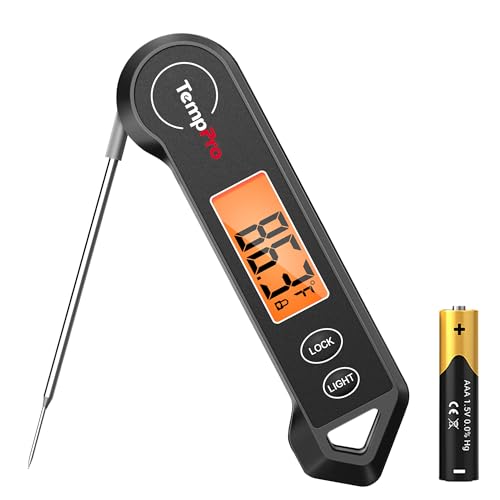
Accuracy claims also vary. Typhur and ThermoMaven HT04 document NIST-certified ±0.5°F accuracy. Lavatools describes laboratory-calibrated ±0.5°F accuracy. Several practical models state ±1°F, while TempPro TP19H states ±0.9°F. If precision is your first priority, look for a clearly stated tolerance and any documented calibration information rather than choosing solely from a speed claim.
Match the display to your cooking position
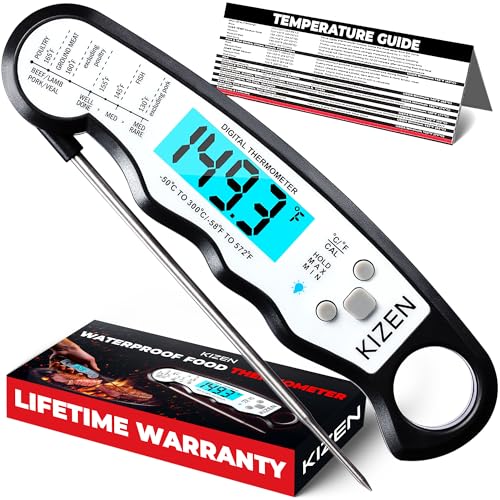
A backlit screen matters when you cook at night, near a smoker, or in a dim kitchen. TRAUSI, KIZEN, FDK, ANDAXIN, Amazon Basics, and DOQAUS all document backlit displays. A large screen can also help when the thermometer is held at an awkward angle.
Auto-rotating displays are useful for left-handed cooks or for checking food from either side of a grill. Typhur, ThermoMaven HT04, TempPro TP19H, and DOQAUS document rotating or auto-rotating screens. The TempPro TP19H lists a 2-inch display, while DOQAUS and other models describe an auto-rotating display without giving a screen size. Temperature lock is another useful control: ANDAXIN and DOQAUS document functions that let you hold or lock a reading while moving away from heat.
Check the water-resistance rating carefully
A waterproof or water-resistant rating helps with rinsing the probe and handling splashes, but the ratings are not interchangeable. IP67 appears on Typhur, ThermoMaven HT04, KIZEN, and FDK. TRAUSI lists IPX6.
The KIZEN listing specifically says the thermometer is not dishwasher safe, so an IP rating should not be interpreted as permission for every cleaning method. Follow the product’s stated cleaning directions. DOQAUS has useful cooking controls but no IP rating in the supplied evidence; that makes it harder to compare directly on cleanup protection.
Consider probe length and construction
A longer probe can help when checking thicker foods or reaching into a pan without placing your hand as close to heat. TempPro TP19H lists a 4.3-inch probe, TRAUSI lists a 4.6-inch probe, and FDK specifies food-grade 304 stainless steel. Amazon Basics, KIZEN, and DOQAUS use foldable probe designs, which can make drawer storage easier.
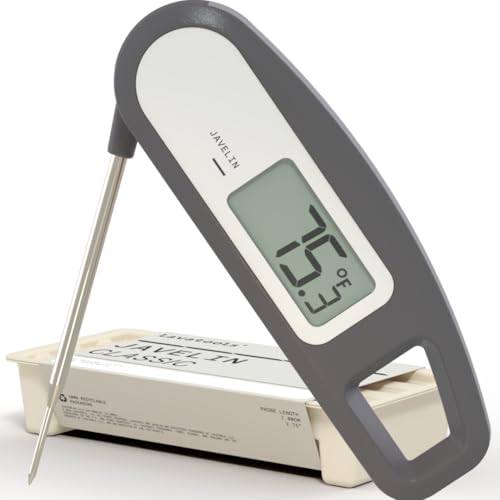
Thin probes may be preferable when minimizing the size of the puncture in meat. TRAUSI specifically describes an ultra-thin probe, while Lavatools lists a 2.75-inch probe. Neither design is automatically better: choose based on whether you more often check thick roasts, thin steaks, liquids, or baked goods.
Use the temperature range as a versatility check
A stated range of -58°F to 572°F appears on FDK, TRAUSI, ANDAXIN, Amazon Basics, and DOQAUS. That range covers ordinary meat checks as well as many baking, candy-making, frying, and hot-oil tasks. KIZEN also documents use with liquids and candy, while Typhur and ThermoMaven describe meat, soups, desserts, and general cooking without providing the same numeric range in the supplied evidence.
If you mostly grill meat, an extreme range may be less important than display readability and storage. If you make candy or deep-fry foods, a documented broad range and a probe suitable for liquids are more relevant.
Think about storage and power handling
The magnet is the defining convenience feature here. It can keep a thermometer on a refrigerator, smoker, oven, or other metal surface, but the evidence does not provide comparable holding-strength measurements. FDK describes a strong magnet; most others simply document a built-in or integrated magnet. Hanging holes offer a useful alternative when the target surface is not magnetic.
Foldable probes support compact storage and may activate the unit when opened. FDK, KIZEN, Amazon Basics, and DOQAUS document foldable designs or probe-linked operation. Motion sensing and sleep functions appear on Typhur, ThermoMaven HT04, TempPro TP19H, and other models. Lavatools states 4000-plus hours of battery life and a 60-minute auto-sleep period, while TempPro TP19H states up to 3000 hours of use. These figures come from listings and are not independent battery tests.
Final Recommendation
Typhur InstaProbe Core ranks first overall in this specification-based comparison under the published weighted criteria.
Typhur InstaProbe Core is the first overall specification-based choice among the best magnetic meat thermometers. Its documented 0.5-second response, NIST-certified ±0.5°F accuracy, IP67 protection, rotating display, motion sensing, and integrated magnet give it a broad premium feature set in this comparison.
ThermoMaven HT04 is a close alternative for buyers who also prioritize certified precision and rapid readings. Lavatools Javelin is more compelling when compact storage and stated long battery life matter. For a balanced everyday tool, KIZEN combines broad cooking coverage, a backlit display, magnetic storage, and IP67 protection. TempPro TP19H is particularly practical for left-handed users, while ANDAXIN and DOQAUS stand out for lock, calibration, or tracking controls.
These top magnetic meat thermometers should not be treated as interchangeable. Compare the specifications that match your routine: certified accuracy for precision work, a rotating backlit screen for visibility, a longer or thinner probe for the foods you prepare, and an IP rating that fits your cleaning habits.
Frequently Asked Questions
What makes the best magnetic meat thermometers different from ordinary instant-read models?
The key distinction is integrated magnetic storage. Selected models can attach to a refrigerator, grill, oven, or other metal surface, keeping the thermometer accessible between checks. Other differences involve speed, stated accuracy, screen design, water resistance, calibration, and probe construction.
Is IP67 better than IP65 for a kitchen thermometer?
The supplied ratings indicate different levels of protection, with IP67 documented on Typhur, ThermoMaven HT04, KIZEN, and FDK, and IP65 documented on Lavatools, ANDAXIN, and TempPro TP19H. However, an IP rating does not make every cleaning method acceptable. KIZEN’s listing, for example, says it is not dishwasher safe. Use the manufacturer’s cleaning instructions.
Do I need a 0.5-second thermometer for grilling?
Not necessarily. A 0.5-second claim can be attractive for quick checks, but one- to three-second models may still provide useful documented accuracy and features. Display readability, probe length, calibration, temperature lock, and storage may matter more for your routine than the smallest response-time number.
Why is a rotating display useful?
A rotating display keeps the temperature upright when the thermometer is held from different sides. This can help left-handed users, cooks checking a grill from an angle, and anyone working in low light. Typhur, ThermoMaven HT04, TempPro TP19H, and DOQAUS document rotating or auto-rotating displays.
Should I choose a foldable probe or a longer fixed-style probe?
A foldable probe is convenient for drawer storage and may activate the thermometer when opened. A longer probe can provide more reach into thicker foods or pans. The right choice depends on your cooking tasks: compact models suit everyday checks, while a documented 4.3- or 4.6-inch probe may be more comfortable around larger foods or hot surfaces.