Buying Guide
The best dining room window valances should finish the upper portion of a window without making the room feel closed in. Compare the listed width and drop first, then consider how much daylight and privacy the fabric is described as providing. This selection is based on public listing specifications and feature descriptions, not hands-on testing, so the practical differences below reflect documented construction rather than observed performance.
Measure the window and rod
Start with the window width and the rod’s diameter. A valance that is narrower than the opening may leave uncovered edges, while a wider panel can create fuller folds depending on the installation. Many selected products are single panels between 50 and 54 inches wide, including RoomTalks, Ebesto, DOTOOMA, and Oindec. ACHIM is wider at 58 inches, while AiFMQQ is narrower at 39 inches and may suit a compact opening.
Length also changes the visual effect. ACHIM and Oindec are 14 and 15 inches long, respectively, for shorter toppers. Most of the linen, floral, and lace choices measure 18 inches, while AiFMQQ extends to 20 inches. A longer drop can cover more of the upper window, but it may also be more noticeable from inside the dining room.
Rod-pocket sizing matters because a pocket must accommodate the installed rod. Kotile has dual pockets measuring 1.2 and 2.8 inches, and Ebesto also documents a dual-pocket design. RoomTalks lists compatibility with rods up to 3.5 inches, while the jinchan farmhouse option uses a 3-inch pocket and recommends a narrower rod for a neat setup. Check the actual rod diameter and pocket information before ordering.
Match light filtering to the dining room
Light-filtering descriptions vary in useful detail. The jinchan taupe valance is described as double layer and intended to diffuse excessive light while offering sufficient privacy. The striped jinchan design similarly uses double-layer fabric for light diffusion and privacy. These may be appropriate when afternoon glare or direct exposure is a concern, although the listing evidence does not establish a measured blackout level.
Sheer and lace options create a lighter appearance. Those designs can work where maintaining an airy atmosphere is more important than blocking views. The Oindec valance is described as semi-sheer and light filtering, offering a middle ground between a very open sheer and a heavier layered style.
The best dining room window valances for privacy are not necessarily the darkest-looking options. Fabric density, layering, window direction, and the view outside all affect the result, and the supplied listings do not provide standardized light-transmission measurements. Treat terms such as “light filtering” and “semi-sheer” as directional guidance rather than a guarantee of a particular level of coverage.
Choose a design that supports the room
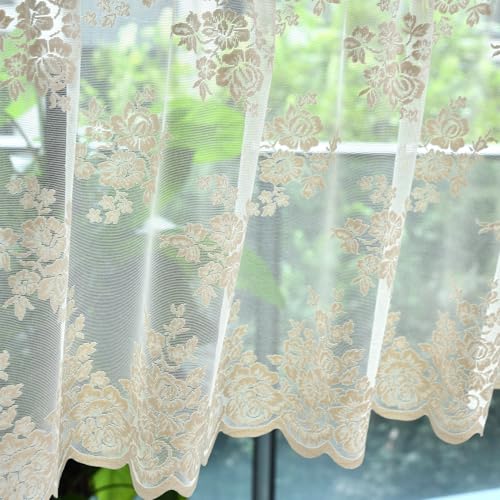
Pattern is one of the clearest differences in this group. RoomTalks and Ebesto use floral styling, with RoomTalks adding tassel trim and Ebesto adding both a scalloped edge and tassels. DOTOOMA takes a botanical approach with blue-and-white watercolor leaves and flowers. These designs can introduce visual interest above a dining banquette, sideboard, or breakfast-area window.
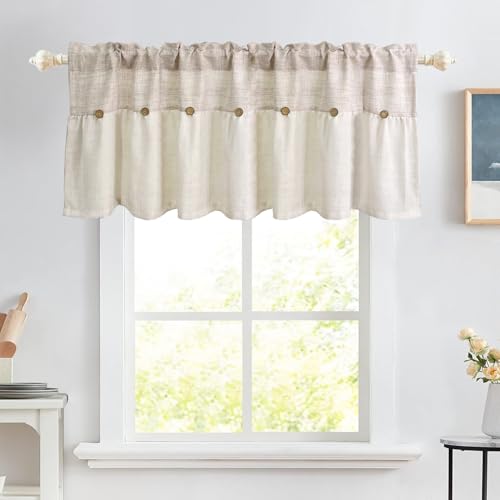
For a more structured farmhouse or country look, ACHIM’s buffalo-check pattern and macramé border are easy to identify. The two jinchan linen options provide quieter alternatives: the taupe model uses a botanic pattern, while the Liora uses geometric stripes, diamonds, chains, and crosses. AiFMQQ adds button detailing to a rustic linen-look panel.
Lace creates a more traditional or romantic effect. That silhouette is more elaborate than a standard short topper and may be better for a formal dining room or a feature window.
Consider fabric and maintenance
The listings describe a mix of polyester, linen, linen blends, faux linen, cotton-polyester blend, and sheer polyester. Natural-looking linen and faux linen provide texture, while polyester-based fabrics may be selected for their stated durability or simpler care. ACHIM specifically lists a 60% polyester and 40% cotton composition. AiFMQQ specifies soft polyester fabric with a linen appearance.
Care instructions should influence placement and expectations. Many selected valances are machine washable on a cold or gentle cycle and can be tumble dried low, including Ebesto, Kotile, Oindec, DOTOOMA, and the jinchan options. Always follow the individual care directions, especially for trims, lace, and decorative beads.
Decide between one panel and multiple panels
A single panel is simple for a small or standard opening, but the package format can matter when covering a broad window. Oindec includes two panels, each 54 inches wide, allowing the pieces to be spaced or used across separate openings.
A single wide panel can be easier to install, but it may create a centered treatment rather than a symmetrical pair. RoomTalks, Ebesto, DOTOOMA, and ACHIM each provide one panel with substantial listed width. Measure the opening and decide whether you want a continuous top treatment, two separated sections, or a layered arrangement with blinds or curtains.
Final Recommendation
Ebesto Scalloped Floral Valance in Dusty Blue ranks first overall in this specification-based comparison under the published weighted criteria.
Ebesto Scalloped Floral Valance in Dusty Blue is the highest-scoring returned product and the first overall specification-based choice.
Among the best dining room window valances, Ebesto offers a strong combination of scalloped floral styling, tassel trim, dual rod pockets, light-filtering fabric, and machine-washable care. The jinchan Linen Valance Kitchen Curtain in Farmhouse Taupe is a close alternative for shoppers who prioritize double-layer construction, botanical linen texture, and stated light diffusion with privacy support.
RoomTalks is a strong alternative when floral detail and a wider 52-inch panel are priorities. ACHIM makes sense for a shorter, wider buffalo-check treatment, while Oindec is useful when two panels are more practical than one.
The top dining room window valances are not interchangeable in coverage or maintenance. Verify rod clearance, panel count, and the desired drop before choosing. For airy rooms, consider lace or sheer fabrics; for more visual weight and privacy support, compare the double-layer linen options. The best dining room window valances are ultimately the ones whose documented size, light-filtering description, style, and care instructions fit the specific window.
Frequently Asked Questions
Among the best dining room window valances, how wide should a dining room valance be?
Use the window and rod measurements as the starting point. Selected examples range from 39 inches wide for AiFMQQ to 58 inches for ACHIM, with many options at 50 to 54 inches. A 50-inch panel may be suitable for a smaller opening, while a wider treatment or two-panel set can make more sense across a broad window. The product’s listed width does not by itself determine how full the finished folds will look.
Are these valances suitable for privacy?
Several listings describe light filtering and privacy support, including the jinchan taupe, jinchan striped, RoomTalks, Oindec, and DOTOOMA designs. Double-layer fabrics may offer a more substantial visual barrier than sheer lace, but the supplied evidence does not include standardized privacy or opacity measurements. Window direction, interior lighting, and the outside view can change the result.
What rod features should I check before buying?
Check both the rod diameter and the pocket dimensions. RoomTalks lists compatibility with rods up to 3.5 inches, while some jinchan models recommend rods around 1.2 inches or less for a neat fit. Dual pockets, such as those on Kotile and Ebesto, provide alternative hanging positions.
Which selected valance is easiest to care for?
Many selected products document cold machine washing and low tumble drying, including ACHIM, Ebesto, Kotile, Oindec, DOTOOMA, and the jinchan options. Decorative trims can need different treatment from the main fabric, so follow the care instructions for the specific valance.
Should I choose a lace, linen, or faux linen valance?
Choose lace or sheer polyester when you want a lighter, more decorative window treatment that softens daylight. Linen and linen-blend options add texture and are commonly paired with farmhouse, vintage, or modern-boho styles. Faux linen, such as Oindec’s fabric, offers a linen-like appearance with a documented light-filtering function. The right choice depends on the desired visual weight, privacy level, and maintenance routine rather than the material name alone.