Buying Guide
Choosing among the best living room window valances starts with deciding whether the treatment is mainly decorative or must also manage daylight and privacy. The selected products range from blackout panels to open-weave and sheer designs, so the right choice depends on the window’s exposure, the room’s furnishings, and how much glass you want to leave visible.
Match the light-control level to the room
Blackout and room-darkening constructions are the most functional choices for a living room that receives strong afternoon sun, has a television nearby, or needs more privacy after dark. The NICETOWN valance uses blackout fabric and comes as two panels, while the DriftAway Tree Branch option uses a double-layer linen blend described as thermal insulated and room darkening. The Threadmade Antonia listing also identifies room-darkening benefits, though its waterfall form is more decorative.
Light-filtering products create a different effect. The Vangao, Ebesto, Chyhomenyc, Oindec, jinchan, and MIULEE options are described as letting daylight through while softening glare or providing some privacy. That can work well in a bright living room where a fully covered appearance would feel too heavy. Sheer fabric generally favors illumination over privacy, so the MIULEE panel is better considered for an airy accent than for substantial screening.
Measure the window and account for the drop
Most selected panels are between 50 and 54 inches wide and 14 to 18 inches long. That makes them suitable for many standard short-window applications, but a single panel may not provide full visual width on a broad opening. The Oindec set supplies two 54-inch panels, and the NICETOWN set supplies two 52-inch panels, making both especially convenient when a matched pair is preferred.
Length changes the visual effect. Fourteen-inch Chyhomenyc panels leave more glass exposed, while 15- to 18-inch options create a fuller topper. The NAPEARL waterfall valance extends to 49 inches and the Threadmade Antonia reaches 36 inches, so these are not interchangeable with compact café-style toppers. They create more vertical layering and should be chosen only when that deeper decorative profile suits the window.
Check the rod pocket before ordering
Rod-pocket installation is common across this group and generally involves sliding the fabric directly onto a rod. However, the opening and stated rod limit vary. Several options use a 3-inch pocket, including DriftAway Tree Branch, Ebesto, Vangao, Oindec, and Threadmade Antonia. NICETOWN lists a 2-inch pocket, while jinchan Double-Layer lists a 2-inch pocket for rods up to 1 inch in diameter. Chyhomenyc specifies a 3-inch pocket for rods up to 1.5 inches, and MIULEE uses a 1.8-inch opening.
Hardware compatibility matters more with tension rods and decorative rods than with a basic standard rod. The jinchan design specifically mentions tension-rod compatibility, while the Vangao listing recommends a rod under about 1.8 inches in diameter. Measure the rod diameter and compare it with the product specification instead of assuming that every rod pocket has the same clearance.
Choose fabric and design by decorating direction
For traditional rooms, jacquard and damask details provide the most formal appearance. NAPEARL uses jacquard with beading and layered swags, while Threadmade Antonia uses a damask print with tassel trim. The NICETOWN scalloped edge offers a more tailored decorative shape while remaining functional. These styles can become focal points, so coordinate their colors with upholstery, rugs, or existing curtain panels.
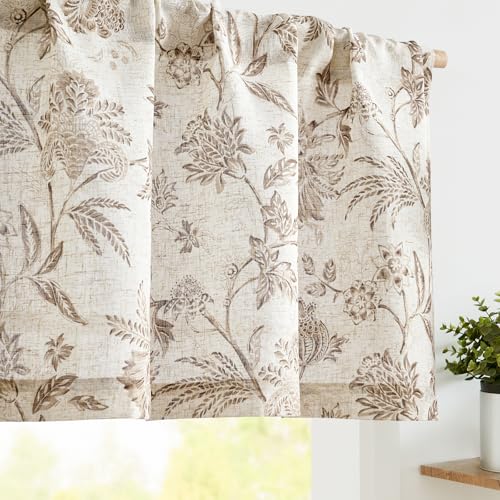
Farmhouse and cottage rooms have several documented choices. Vangao uses a peony motif on linen blend, Ebesto combines floral printing with a scalloped edge and tassels, and Oindec uses neutral faux linen. The Chyhomenyc wave-line pattern is a cleaner geometric direction, while jinchan Double-Layer adds texture through its sheer front and linen-blend back. MIULEE is the simplest option for a light, modern accent.
Consider care requirements
Care instructions differ enough to affect suitability. Threadmade Antonia also specifies machine washing and tumble drying. By contrast, the NAPEARL listing emphasizes steaming shipping wrinkles rather than giving a full washing method, and its beaded decorative details call for more attention during handling.
Use the stated instructions as the baseline. Cold or gentle washing, low drying, cool ironing, and avoiding bleach appear frequently, but they are not universal. Beaded or layered designs may also need more care when arranging the trim. A valance that looks ideal but conflicts with your normal laundry routine may be less practical than a simpler machine-washable panel.
Decide whether you need one panel or a set
Package count is an important specification, not just a shopping detail. NICETOWN and Oindec provide two-panel sets, while the other selected products are listed as single panels. A two-panel package may simplify symmetry and provide more usable width, but a single wide panel can be enough for a small opening or a centered treatment. For larger windows, calculate the desired fullness and compare it with the listed panel width before selecting a product.
Final Recommendation
NICETOWN Scalloped Blackout Valances ranks first overall in this specification-based comparison under the published weighted criteria.
NICETOWN Scalloped Blackout Valances is the highest-scoring returned product and the first overall specification-based choice among the best living room window valances. Its two-panel package, 52-by-18-inch dimensions, blackout fabric, scalloped profile, and easy-sliding pocket give it the most balanced functional specification set in this comparison.
For a patterned lined alternative, choose DriftAway Tree Branch. NAPEARL and Threadmade Antonia are better suited to formal waterfall decoration, while Ebesto, Vangao, Oindec, Chyhomenyc, jinchan, and MIULEE cover lighter farmhouse, geometric, layered, and sheer use cases. Together, these top living room window valances show why dimensions, construction, hardware fit, and care instructions should guide the final decision.
Frequently Asked Questions
Among the best living room window valances, are blackout valances suitable for a living room?
They can be useful when the room needs stronger light reduction, glare control, or added privacy. NICETOWN and DriftAway Tree Branch document blackout or room-darkening construction. A blackout valance covers only the upper portion of the window, so it should not be treated as a full-window blackout solution without compatible curtain panels or another lower treatment.
What size valance should I choose for a living room window?
Start by measuring the window and the rod, then compare the measurement with the listed width. Many selected panels are about 50 to 54 inches wide and 14 to 18 inches long. Wider openings may need two panels or a set such as NICETOWN or Oindec. Also consider the drop: a 14-inch panel exposes more glass, while a longer waterfall style creates a deeper decorative frame.
Do window valances provide privacy?
Privacy depends on the fabric and the lighting conditions. Linen-textured, faux-linen, layered, and light-filtering products may soften visibility during the day, while sheer designs generally provide less screening. Vangao specifically describes daytime privacy alongside daylight, and MIULEE describes some privacy. For stronger coverage, consider a blackout or room-darkening option.
Are rod-pocket valances easy to install?
Rod-pocket designs are generally installed by sliding the rod through the sewn pocket, without specialized hardware. Check the listed pocket size and maximum rod diameter first. The products in this comparison use openings from about 1.8 to 3 inches, and some specify narrower rod limits. Remove or adjust the rod before hanging if the pocket does not slide freely.
Which valance style works for a farmhouse living room?
Documented farmhouse-oriented choices include the floral Vangao, scalloped Ebesto, neutral Oindec, layered jinchan, and geometric Chyhomenyc designs. Choose based on the room’s existing texture and light needs: linen or faux linen adds a relaxed surface, floral patterns create a cottage direction, and a layered panel adds dimension without the full depth of a waterfall treatment.