Buying Guide
The best powersports drive chains for dirt bikes are chosen by matching the chain’s physical standard to the motorcycle, not by appearance alone. Chain number, pitch, roller dimensions, inner width, link count, sealing style, and the manufacturer’s strength requirement all matter. A chain that looks similar can still be incompatible with the front and rear sprockets.
Start with the chain number
The first check is the number specified by the motorcycle manufacturer or printed on the old chain. This comparison covers 420, 428, 428H, and 520 formats. These numbers describe chain dimensions and are not interchangeable simply because two chains have similar link counts. The NICHE 520 and D.I.D 520VX3 are intended for 520 systems, while the NICHE 428 and GOLKNHA 428H address different smaller-chain applications.
The 420 products provide useful dimensional checks. Belleone lists a 1/2-inch pitch, 1/4-inch roller width, and 5/16-inch roller diameter. MRELC also lists 420 pitch, roller width, roller diameter, and sprocket thickness. Compare these details with the old chain and sprockets, but defer to the motorcycle maker’s specification when sources differ.
Choose the correct length
Link count is a starting length, not a universal fitment guarantee. The correct number depends on sprocket sizes, wheelbase, axle position, and the adjustment range available on the bike. The 110-link NICHE 520 and D.I.D 520VX3 suit applications that call for that length, while the 120-link D.I.D 520DZ2 and JFG RACING 520 provide more chain to size down if required.
For smaller setups, MRELC supplies 132 links, Belleone supplies 110 links for its 420 chain, and Belleone’s 428H option supplies 114 links. A longer chain can be useful when the final size is uncertain, but it must be shortened correctly and joined with the proper master link.
Compare sealed and non-sealed designs
A sealed chain uses rings between components to help retain lubricant and limit contamination. The NICHE 520 and NICHE 428 list NBR O-rings, while the D.I.D 520VX3 and JFG RACING 520 are identified as X-ring chains. These are the relevant choices in this group for buyers who want documented sealing for varied riding environments.
The D.I.D 520DZ2 is explicitly a non-O-ring racing chain. That design can be appropriate when the application calls for it, but it is a different maintenance and contamination-control choice from an O-ring or X-ring chain. Sealing style should be compared with the motorcycle’s original specification and intended riding conditions.
Compare strength evidence carefully
A stated tensile-strength figure is useful, but it is only one part of chain selection. The D.I.D 520VX3 lists an average tensile strength of the current price, and the D.I.D 520DZ2 lists the current price along with a recommendation for motorcycles and ATVs up to 450cc. These are the clearest numerical strength references in the selected group.
Other products describe alloy steel, hardened steel components, solid rollers, bushings, or seamless small tubes without giving a comparable tensile figure. Those construction details support a specification comparison, but they do not establish an unstated capacity. Confirm the required strength, chain series, and engine application before installation.
Check installation contents
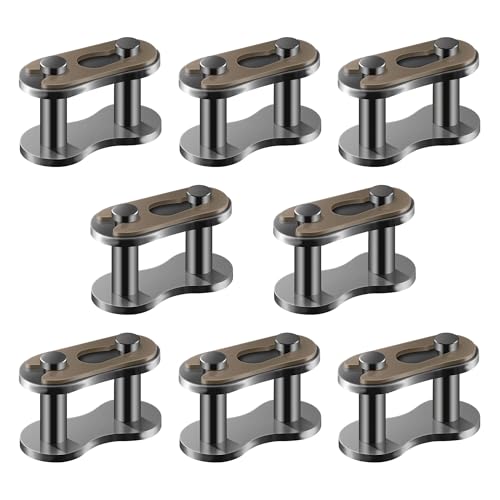
A chain breaker and extra master links can make sizing more adaptable, but they must be used correctly. HILAKE includes a breaker and connecting master link with its 114-link 520 chain. Belleone’s 420 chain includes a breaker and five connector links, MRELC includes a breaker and 10 connector links, and Belleone’s 428H includes a breaker and five master links.
The D.I.D 520DZ2, NICHE chains, and JFG RACING chain list connecting-link details but do not provide the same tool package. A clip-style master link is documented for the D.I.D 520DZ2 and both NICHE options. Use the joining method specified for the chain and inspect alignment, slack, and master-link security after fitting.
Check the complete drive system
Replacing a chain without checking the sprockets can create a poor match. Inspect tooth shape, wear, and damage, and confirm the chain’s fit on both sprockets. Verify the chain number, link count, width, and required tensile strength. Model references are useful screening evidence, but broad compatibility claims should still be checked against the exact year and model.
Color is not a performance specification. Gold, blue, gray, and other finishes may distinguish products, but they should not outweigh chain dimensions, sealing, strength evidence, or correct fit.
Final recommendation
NICHE 520 O-Ring Drive Chain, 110 Links ranks first overall in this specification-based comparison under the published weighted criteria.
NICHE 520 O-Ring Drive Chain, 110 Links is the first overall specification-based choice in this comparison.
The final choice among the best powersports drive chains for dirt bikes depends on the documented features that match your intended use. NICHE’s 520 chain combines clearly stated 520 fitment, NBR O-rings, hardened steel components, quad-riveted pins, and a clip-style connecting link. D.I.D 520VX3 is the more clearly quantified choice when tensile strength and X-ring construction are priorities. HILAKE is useful when a 520 chain breaker is important, while D.I.D 520DZ2 provides a documented non-sealed racing alternative.
For smaller chains, NICHE 428 offers clear sealed 428 evidence; GOLKNHA and Belleone provide dimension- or adjustment-focused 428H choices. The selected group includes several of the top powersports drive chains for dirt bikes, but the correct pick remains the one that matches the bike’s required chain number, length, and strength.
Before ordering, read the old chain marking or service documentation, compare the sprockets, and verify whether the motorcycle requires a sealed or non-sealed chain. Confirm the final length and master-link style after accounting for axle adjustment.
Frequently Asked Questions
How do I know which chain size my dirt bike needs?
Use the motorcycle manufacturer’s specification or identify the number stamped on the existing chain. The selected products include 420, 428, 428H, and 520 formats, and those standards should not be treated as interchangeable. Check pitch, width, roller dimensions where available, sprocket compatibility, and required link count before purchase.
Are O-ring and X-ring chains interchangeable with roller chains?
They may share a chain number, but sealing style is a separate specification and should match the intended application. NICHE documents NBR O-rings on its 520 and 428 chains, while D.I.D 520VX3 and JFG RACING identify X-ring designs. D.I.D 520DZ2 is explicitly non-O-ring. Confirm the manufacturer’s required chain type rather than substituting based only on size.
Is a longer chain better for a dirt bike?
Not automatically. A longer chain can provide material to remove when the final length is uncertain, but the finished chain still has to match the sprocket combination and axle-adjustment range. MRELC’s 132-link 420 chain and D.I.D 520DZ2’s 120-link format are examples of longer starting lengths. Use the correct breaker and master link, and follow the bike’s adjustment procedure.
HILAKE includes a chain breaker with its 114-link 520 chain, while Belleone’s 420 and 428H products and MRELC’s 420 product also list breakers and extra connecting links. Tool inclusion does not confirm vehicle fitment, so verify the chain number and final length first.
Should I replace the sprockets with the chain?
Inspect both sprockets whenever the chain is replaced. The supplied listings do not provide a universal replacement interval, and a worn or damaged sprocket can affect the fit of a new chain. Compare tooth condition and chain engagement, then follow the motorcycle manufacturer’s maintenance guidance.