Buying Guide
The best dirt bike side mirrors are not selected by appearance alone. A useful comparison starts with the handlebar and mirror-thread arrangement, then considers how much rearward visibility the design provides and how easily the mirror can be repositioned when the trail narrows. The products above include compact trail equipment, conventional clamp-mounted pairs, and folding adventure-style designs. Because this is a specification-based comparison, the practical guidance below stays within the supplied listing evidence rather than claiming hands-on performance.
Start with the handlebar and thread fit
Fitment is the first screening step. Several selected products document a 7/8-inch handlebar clamp, including the Doubletake Trail Mirror, OFIG Adventure Motorcycle Mirrors, CICMOD Motorcycle Mirrors, and XMTIKO Hawk-Eye Motorcycle Mirrors. Other listings also mention M8 and M10 screws or adapters. That does not mean every combination is interchangeable. BUMBEE specifically excludes M10 x 1.5, HD M8, and BMW bolts, while MZS Adventure Motorcycle Mirrors also warn against M10 x 1.5 and HD M8 configurations.
Before installation, identify whether the bike uses a direct threaded mirror mount, a bare 7/8-inch handlebar, or a bar-end opening. The KEMIMOTO Universal Motorcycle Mirror is a bar-end design for 7/8-inch handlebars or specified inner diameters from 13mm to 21mm, so it represents a different mounting approach from the clamp-and-bolt products selected here. It is a genuine motorcycle mirror, but its stated compatibility exclusions make careful measurement especially important.
Choose compact or full-size coverage
Lens dimensions reveal the clearest design trade-off. Doubletake’s Trail Mirror uses a compact 2-inch convex lens and a housing intended to stay behind the controls. That layout is relevant when brush, terrain, or narrow sections are a concern. It is also a single mirror, so riders should not assume it provides the same coverage as a two-mirror set.
At the other end, KEMIMOTO Adventure Motorcycle Mirrors list 5.24-by-3.74-inch HD glass lenses, while OFIG specifies 13-by-9-centimeter convex mirrors. These larger formats offer more documented surface area for riders who prioritize a broad view. The trade-off is physical space: a larger pair may be less discreet around crowded controls. The listing data supports comparing lens size, but it does not establish a measured field of view for any product.
Look for useful adjustment mechanisms
A 360-degree ball joint appears across many of the selected products. It is documented on the KEMIMOTO Adventure, BUMBEE, OFIG, MZS ATV Hawk-Eye, CICMOD, and XMTIKO designs. This feature allows the mirror angle to be set for the rider and handlebar position, but the listings do not provide a standardized adjustment test. Treat the rotation claim as a design specification rather than proof of a particular riding result.
Folding adds another kind of flexibility. The KEMIMOTO ATV Motorcycle Mirrors list a 180-degree foldable design, and MZS Adventure Motorcycle Mirrors document a foldable bracket. MZS Motorcycle Mirrors with the Street Bike Mirrors model also list a bracket that folds left and right. These designs may be useful where the mirror needs to move inward, but folding hardware can add another joint to inspect and tighten during setup. The Doubletake Trail Mirror takes the opposite approach with a compact stationary form intended to stay tucked away.
Compare construction details
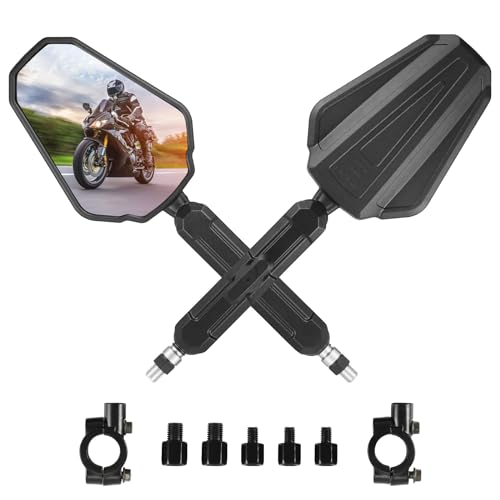
The supplied listings commonly specify ABS housing paired with glass lenses. KEMIMOTO Adventure Motorcycle Mirrors add aluminum rods and an aluminum mount; BUMBEE lists an aluminum stem; and OFIG identifies an adjustable aluminum stem. MZS ATV Hawk-Eye Mirrors and MAMIKO Eagle Eye Mirrors specify steel stems, with MAMIKO listing an 11.5mm stem and a metal mirror mount. CICMOD lists a stainless-steel stem.
These details help distinguish the products without overstating them. A metal stem is a documented material choice, not a guarantee that a mirror will remain adjusted in every situation. Likewise, references to shock resistance, corrosion resistance, or vibration control should be read as listing claims. Installation tension, thread compatibility, and the condition of the mounting surface still matter.
Consider trail clearance and installation
Trail practicality depends on how much equipment sits outside the controls. Doubletake explicitly emphasizes a compact housing designed to avoid snagging on brush or terrain. Folding products such as the KEMIMOTO ATV and MZS Adventure options offer a different way to manage clearance. Full-size options from KEMIMOTO and OFIG may suit riders who want more documented lens area, but their larger dimensions deserve a handlebar-space check.
Installation details also vary. Doubletake uses a heavy-duty UV-resistant tie and sleeve and describes the process as tool-free. OFIG, CICMOD, XMTIKO, and BUMBEE list clamps and multiple bolt sizes. MAMIKO lists clockwise and counterclockwise screws in both 8mm and 10mm formats. These package details can simplify planning, but they do not replace checking the motorcycle’s thread direction and mounting geometry.
Use the ranking for a starting point
The ranking gives the most weight to mounting fit because an otherwise capable mirror is not useful if its hardware does not match. Adjustment, visibility, construction, and off-road practicality then separate compact trail designs from larger adjustable pairs. The scores reflect only supplied features and specifications. They do not represent road approval, a field test, or a universal fitment guarantee.
Final Recommendation
KEMIMOTO ATV Motorcycle Mirrors ranks first overall in this specification-based comparison under the published weighted criteria.
The final choice among the best dirt bike side mirrors depends on the documented features that match your intended use.
Doubletake Trail Mirror is the highest-scoring returned product and the first overall specification-based choice for riders focused on compact trail use. Its 2-inch convex lens, tucked-away housing, impact-oriented construction, and 7/8-inch or 1-1/8-inch zip-tie mounting make its intended use unusually clear. Choose it when a single low-profile mirror fits the riding plan and the non-SAE specification is acceptable.
For a pair with broader documented coverage, KEMIMOTO ATV Motorcycle Mirrors are the most specification-aligned alternative in this comparison because they combine wide-view glass, 360-degree rotation, 180-degree folding, and anti-vibration screws. KEMIMOTO Adventure Motorcycle Mirrors and OFIG Adventure Motorcycle Mirrors are also compelling when lens dimensions and a conventional clamp-mounted setup matter. Among the top dirt bike side mirrors, the right choice ultimately depends on whether the priority is compact trail clearance, foldability, or a larger documented viewing surface.
Frequently Asked Questions
What should I check before buying the best dirt bike side mirrors?
Check the handlebar diameter, mirror-thread size, thread direction, and whether the bike needs a clamp, direct bolt, or bar-end mounting system. A listing may mention M8 or M10 hardware without supporting every variation. BUMBEE and MZS, for example, identify exclusions for certain bolt configurations. Confirming those details is more reliable than relying on a general universal-fit statement.
Are folding mirrors useful on a dirt bike?
Folding mirrors may help when the bike passes through narrow spaces or when the rider wants the mirror to move inward. The KEMIMOTO ATV Motorcycle Mirrors document a 180-degree foldable design, while MZS Adventure Motorcycle Mirrors list a foldable bracket. Folding is a design feature, not evidence of a particular impact outcome, so the hinge and fasteners should still be set up according to the product instructions.
Is a larger mirror always better for trail riding?
Not necessarily. KEMIMOTO Adventure Motorcycle Mirrors and OFIG Adventure Motorcycle Mirrors document larger lens dimensions, which may appeal to riders seeking more mirror surface. Doubletake’s Trail Mirror instead uses a compact 2-inch lens and a low-profile housing intended to reduce snagging. The best balance depends on available handlebar space and whether compactness or documented lens size is more important.
Can a 7/8-inch clamp fit every dirt bike?
No. A 7/8-inch clamp describes the handlebar mounting interface, but the surrounding controls, bar shape, available space, and included threaded adapters still matter. OFIG, CICMOD, and XMTIKO list 7/8-inch clamps, while some products also supply M8 and M10 hardware. Measure the bar and inspect the mounting area before choosing a kit.
What is the difference between a single mirror and a two-mirror set?
A single mirror, such as the Doubletake Trail Mirror, may offer a compact installation with less equipment around the controls. A two-mirror set, such as the KEMIMOTO, OFIG, CICMOD, or MAMIKO products, provides left and right units in the listed package. The choice depends on the intended setup; the supplied evidence does not establish that one arrangement is universally preferable.