Buying Guide
The best dishwasher-safe masticating juicers are defined by more than a dishwasher icon. A useful comparison should check which parts are dishwasher safe, how much preparation the feed system requires, whether the controls suit different produce, and how much counter space the machine occupies. The products above are ranked from supplied listing data rather than hands-on testing, so performance claims such as yield, quietness, or nutrient retention should be treated as manufacturer-stated specifications.
Check what is actually dishwasher safe
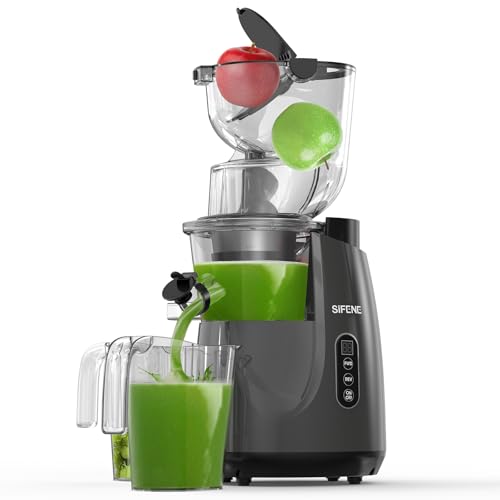
Look for wording that identifies removable or food-contact components, not just a general “easy clean” claim. The Hurom H80 identifies the chamber, hopper, strainers, juice container, and pulp container as top-rack dishwasher safe. The SIFENE vertical model similarly says all BPA-free parts are dishwasher safe except the motor base. Other listings describe detachable parts or food-contact components as dishwasher safe. The motor base should not be placed in a dishwasher, and the supplied instructions should take priority over a listing summary.
A cleaning brush can still matter even when parts are dishwasher safe. Filters and augers may retain fibrous pulp, especially after celery, kale, ginger, or wheatgrass. Models with tool-free or snap-apart construction, such as the ACOQOOS, Artemo, and Jocuu, may reduce the time needed before loading parts into the dishwasher. Dishwasher-safe does not necessarily mean every part can be left un-rinsed; check the care instructions for your chosen model.
Match the chute to your preparation habits
Feed-chute size is one of the clearest differences among the top dishwasher-safe masticating juicers. The Artemo lists a 7.1-inch chute, the ACOQOOS lists 6.5 inches, and the XTKKGFBIR model lists 6 inches. These openings are intended to accept larger pieces or whole produce, although hard pits and some tough produce may still need preparation. The SIFENE vertical model uses an 83mm chute, while the SIFENE 70mm version provides a smaller 2.75-inch opening.
A large chute can reduce chopping, but it does not remove every preparation step. Produce may need washing, pitting, peeling, or trimming. That illustrates why chute size should be considered alongside the actual produce guidance.
Consider batch size and kitchen layout
Capacity affects how often you pause to empty containers. The Hurom H80 uses a 2.2-liter self-feeding hopper, the ACOQOOS lists a 100-ounce hopper, and the XTKKGFBIR model lists an 80-ounce hopper. These are better suited to larger preparation sessions than the ZABINS model’s 34-ounce capacity or the SIFENE model’s 27-ounce jug. A larger hopper can also increase the appliance’s physical presence.
Measure both the operating footprint and storage height. Havato lists a compact footprint of about 7 by 7 inches, and the vertical SIFENE model lists a width of 5.52 inches. By contrast, the Hurom H80 lists an 18-inch width and weighs the current price. Compact models are easier to store, but they may provide less hopper capacity or a smaller feed opening. Leave room to remove the hopper, strainer, and containers without hitting an upper cabinet.
Choose useful controls for your produce
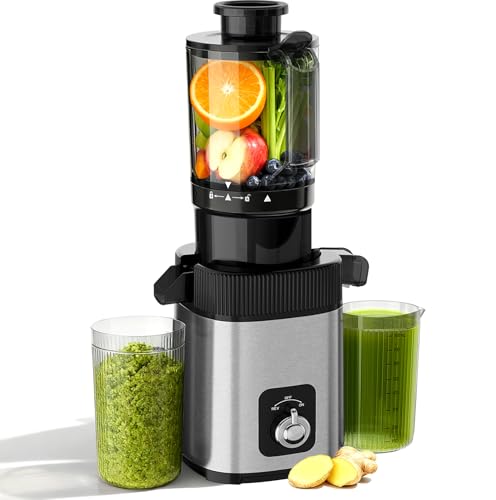
Slow masticating machines often include reverse to help release stuck ingredients. Several selected products also document separate soft and hard modes. Jocuu and the SIFENE 70mm model are clear examples: their controls are intended to distinguish softer fruit from harder or more fibrous produce. The ZABINS model documents reverse and two pulp functions, while the Ninja JC150 focuses on two pulp-texture settings and NeverClog technology.
Speed numbers are specifications, not guarantees of a particular flavor or yield. The selected products list speeds from 45 RPM on Artemo to 60 RPM on several models, while the Hurom H80 lists 50 RPM. The XTKKGFBIR model lists 55 RPM. A lower number alone should not decide the purchase; controls, feed design, strainers, and cleanup may have greater practical importance for your routine.
Some machines do more than make fruit and vegetable juice. Hurom H80, ACOQOOS, Artemo, and XTKKGFBIR document nut-milk and frozen-fruit or sorbet functions. The Hurom H80 includes fine, coarse, and ice-cream strainers, while the other multifunction models describe dedicated recipe capabilities. These features can make one appliance more useful, but they also mean more parts to store and clean.
If your goal is mainly celery, carrots, apples, or leafy greens, a simpler model may be easier to understand and store. If you want sorbet or nut milk, verify that the relevant strainer or function is included rather than assuming every cold-press juicer supports it.
Review safety and maintenance details
Useful safety documentation includes a lid or cover interlock, automatic stop when opened, overheat protection, or a correctly assembled lock. Havato lists three protection systems, SIFENE lists a double safety lock, and XTKKGFBIR lists a safety lock that prevents operation until assembly is correct. These features are safeguards, not substitutes for supervision.
Also note operating-cycle guidance. That candidate was not selected because another listing shared its model and parent grouping, but the point remains useful: read the operating instructions for pauses, produce preparation, and dishwasher care before regular use.
Final recommendation
Hurom H80 Cold Press Juicer ranks first overall in this specification-based comparison under the published weighted criteria.
Hurom H80 Cold Press Juicer is the highest-scoring returned product and the first overall specification-based choice among the best dishwasher-safe masticating juicers. Its combination of a 2.2-liter self-feeding hopper, documented top-rack dishwasher-safe components, three strainers, and 50 RPM operation makes it the most complete option for frequent, varied use.
The top dishwasher-safe masticating juicers do not all target the same kitchen. Choose the SIFENE Vertical model for a narrow upright layout, Havato for a compact footprint, Ninja for adjustable pulp texture, or Jocuu and the SIFENE 70mm model for soft-and-hard produce modes. Artemo, ACOQOOS, and XTKKGFBIR are better aligned with wide-chute, larger-batch, or multifunction preparation. ZABINS sits between personal and family use with a 34-ounce capacity.
Frequently Asked Questions
What makes a masticating juicer dishwasher safe?
The removable food-contact parts must be identified as dishwasher safe; the motor base and power cord should stay out of the dishwasher. Some listings specify top-rack placement, while others use broader wording for detachable components. Always confirm the care instructions for the exact model.
Are the best dishwasher-safe masticating juicers suitable for leafy greens?
Several selected models explicitly mention leafy greens, celery, kale, or wheatgrass. Slow extraction, a reverse function, and a suitable strainer can help with fibrous produce, but the supplied listings do not establish a universal result. Follow each product’s preparation guidance and avoid forcing ingredients.
Do wide feed chutes eliminate chopping?
Not completely. Wide chutes can accept larger pieces and some models describe whole apples, carrots, or other produce, but users may still need to remove pits, trim long pieces, or prepare especially hard ingredients. The SIFENE vertical listing specifically notes that some fruits may require pitting or cutting.
Which selected juicer has the most recipe flexibility?
The Hurom H80, ACOQOOS, Artemo, and XTKKGFBIR models document juice plus nut-milk and sorbet or frozen-fruit functions. The Hurom H80 also includes fine, coarse, and ice-cream strainers. Buyers who only want juice may prefer a simpler machine with fewer accessories.
Is a larger hopper always better?
A larger hopper can reduce refilling during batch preparation, but it may increase the machine’s footprint, weight, and storage demands. Compare the Hurom H80, ACOQOOS, and XTKKGFBIR capacities with the more compact ZABINS and SIFENE formats, then measure your counter and cabinet clearance before buying.