Buying Guide
The best bento boxes with dressing containers are not all designed for the same meal. Some are large salad bowls with removable topping trays, while others are portioned lunch boxes intended for sandwiches, snacks, or meal prep. Start by deciding whether you need one substantial meal, several smaller portions, or a set for repeated packing.
Match capacity to the meal
Large salad-oriented models such as the Jelife, Caperci, Youeon, ENCYS, and Hello Kitty options list capacities from 60 to 72 ounces. These formats leave room for greens, fruit, vegetables, toppings, or a main dish. Their larger footprints can be useful for filling lunches but may occupy more space in a backpack or lunch bag.
The Tinaforld, Shell and Turtle, and TOUWMX designs sit closer to a conventional lunch-box format. Their listed capacities range from about 40 to 44.5 ounces, which may be easier to portion for work or school meals. QQKO is smaller at 25 ounces, while Canfanni lists 37 ounces. Those compact choices are better suited to snacks, modest lunches, or children’s portions than to very large salads.
Check how the dressing is stored
A dressing container can be a small jar, cup, pot, or removable sauce container. The distinction matters. Caperci lists two 3-ounce sauce containers, while Jelife lists two sauce containers without specifying their individual capacity. Caperci, Youeon, and ENCYS place the dressing container within a topping-tray system, keeping wet ingredients apart from greens and dry foods.
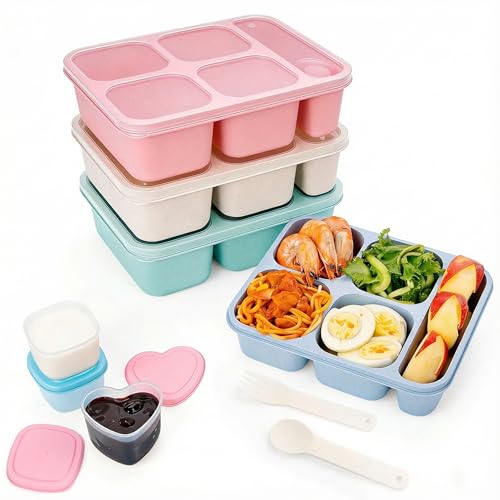
Several multi-packs provide one sauce container for each box. TOUWMX lists four dressing containers for four boxes, Canfanni lists four removable sauce containers, and QQKO lists four bonus sauce containers. This arrangement is convenient when preparing multiple lunches, but confirm the individual cup size if you routinely carry generous amounts of dressing.
Consider compartment layout
More compartments are not automatically better. A five-compartment tray, as listed for Caperci, can separate toppings into several small portions. Tinaforld lists six compartments across a two-layer design. These layouts are useful when you want ingredients to remain distinct until mealtime.
A four-compartment box such as Shell and Turtle or TOUWMX may be simpler for a main dish, side, fruit, and snack. The three-plus-one layouts on Canfanni and QQKO provide a larger area alongside smaller sections, which can work well for snacks and dips. Removable inserts, such as the one documented for Hello Kitty, provide another approach by allowing more flexible organization.
Review sealing details carefully
Listing evidence for leak control varies. Look for specific hardware rather than relying only on a general leak-proof phrase. Jelife describes a double-layer fully sealed design. Caperci and Tinaforld list silicone sealing elements and locking features. ENCYS specifies a silicone sealing ring and four buckles, while Youeon describes a silicone seal and four-sided latch. Shell and Turtle lists an embedded gasket, four locking buckles, and compartment gaskets.
These features are relevant when dressings or sauces travel in the same bag as clothing, electronics, or paperwork. They are still design specifications, not a guarantee of performance in every position or situation. Follow the product’s closure instructions and keep the dressing cup properly sealed.
Understand microwave and dishwasher instructions
Care claims differ by product and often apply differently to the lid and container. Jelife lists microwave, dishwasher, and freezer use. Youeon states that the container is microwave, dishwasher, and refrigerator safe but excludes the lid from microwave and dishwasher use. Canfanni similarly says to remove the lid before microwaving. QQKO also specifies lid removal for heating.
TOUWMX describes the food container as microwave safe and the boxes as top-rack dishwasher safe. Hello Kitty provides a more specific limit: microwave reheating up to 600W for two minutes with the lid removed. ENCYS lists refrigerator, microwave, and dishwasher use, but its stainless steel construction makes it especially important to follow the manufacturer’s instructions for the exact component being heated.
Choose materials for your routine
Most selections use food-grade PP plastic, sometimes combined with silicone. Jelife, Youeon, Shell and Turtle, TOUWMX, Canfanni, and QQKO specifically describe BPA-free materials. ENCYS uses 18/8 stainless steel, while the Hello Kitty listing describes BPA-free construction without identifying the main body material in the supplied specifications. Stainless steel may appeal to shoppers seeking an alternative to an all-plastic body, while PP generally supports lighter lunch-box formats.
Decide between a single box and a multipack
Single-box formats may be preferable when you want one large container or a particular salad layout. Multi-packs make more sense for families, repeated meal preparation, or keeping several lunches ready. Youeon supplies three salad containers, while TOUWMX, Canfanni, and QQKO supply four boxes. Multipacks require more cupboard space, even when the boxes are described as stackable.
Final Recommendation
Caperci 68oz Salad Lunch Container ranks first overall in this specification-based comparison under the published weighted criteria.
Jelife is the first overall specification-based choice among the best bento boxes with dressing containers because it combines 72 ounces, three stackable layers, five compartments, two sauce containers, utensils, and documented sealing and care features. Caperci is the stronger salad-specialist alternative, particularly for shoppers who want five topping sections and two 3-ounce cups. Youeon is appealing for batch salad preparation, while ENCYS is the main stainless steel option.
For more conventional lunches, Tinaforld and Shell and Turtle offer moderate capacities with dedicated sauce storage and utensils. TOUWMX, Canfanni, and QQKO are practical multipacks, with the latter two better suited to snacks or smaller portions. Hello Kitty adds a character-led design and a large listed capacity. Among the top bento boxes with dressing containers, the best fit depends on whether your priority is salad volume, compact portioning, several boxes, or material preference.
Frequently Asked Questions
What should I look for in the best bento boxes with dressing containers?
Prioritize a dressing cup with a stated capacity, a compartment layout that matches your meal, and specific sealing details such as silicone gaskets, locking buckles, or latching lids. Also check whether microwave and dishwasher claims apply to the lid, the container, or both.
Are large salad containers better than standard bento boxes?
Neither format is universally better. Large salad containers such as Caperci, Youeon, and ENCYS provide room for greens and multiple toppings, while moderate-size boxes such as Tinaforld and Shell and Turtle may be easier to carry for ordinary lunches. Choose based on portion size and available bag space.
Can dressing stay inside the main compartment?
The selected products document separate cups, jars, pots, or sauce containers intended to keep dressing apart from other food. Keeping dressing separate may help preserve the intended separation of wet and dry ingredients, but the container and lid should be closed according to the listing’s instructions.
Are bento box lids usually microwave safe?
Not necessarily. Several listings specifically instruct users to remove the lid before microwaving. Hello Kitty gives a 600W, two-minute, lid-off instruction, while Youeon, Canfanni, and QQKO also distinguish the lid from the food container. Always follow the individual product directions.
A multipack can be useful for recurring meal prep or several people. Youeon lists three salad containers, while TOUWMX, Canfanni, and QQKO list four boxes. Compare the capacity and dressing-cup arrangement before choosing, since smaller multipacks may be better for snacks than full-size meals.