Buying Guide
The best battery generators are portable power stations built around a rechargeable battery, inverter, and group of outputs. They store electricity from a wall outlet, solar panel, vehicle, or another supported source instead of producing power from fuel. That makes them useful for quiet backup power, off-grid charging, travel, and temporary support for selected appliances.
The right model depends on how capacity, output, charging, and portability fit your intended use. A compact station can suit phones and laptops, while a larger unit is more appropriate for refrigerator backup or repeated high-demand use.
Match capacity to runtime
Capacity is listed in watt-hours, or Wh. A higher number generally means more stored energy, but actual runtime varies with the device, inverter losses, temperature, and operating pattern. The 288Wh BLUETTI Elite 30 V2 and Anker SOLIX C300 are compact choices for short sessions with electronics, lights, routers, or similar loads. They are not designed to provide the same duration as a 1,000Wh or 2,000Wh station.
Around 1,000Wh, the BLUETTI Elite 100 V2, Jackery Explorer 1000 v2, Anker SOLIX C1000, and EBL EB1000 offer a practical middle range. These models can support more devices and longer sessions, but users should compare the appliance’s running wattage with the station’s continuous output.
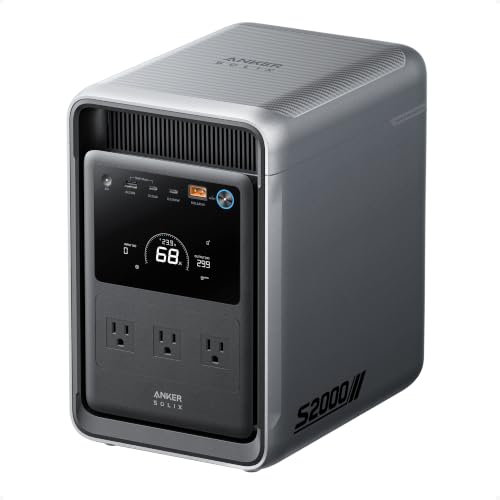
For longer backup, the Anker SOLIX S2000, Segway Cube 2000, BLUETTI Elite 200 V2, and EF ECOFLOW DELTA Pro provide substantially more storage. The DELTA Pro goes further with a documented 3,600Wh battery and optional expansion. Expansion can help when a fixed-size station would require frequent recharging, but it also adds equipment.
Check continuous and surge output
Continuous AC output is the key figure for devices that run for more than a brief startup period. Surge or peak output helps some motor-driven appliances start, but it should not be treated as the station’s sustained wattage. The Jackery Explorer 1000 v2 lists 1,500W continuous and 3,000W surge, while the Anker SOLIX C1000 lists 1,800W output and 2,400W SurgePad capability.
Large appliances may need more than a compact station can provide. The DELTA Pro’s 3,600W AC output is the clearest fit here, while the Elite 200 V2 lists 2,600W continuous output. Check the appliance label and station manual before connecting heating elements, pumps, compressors, or other demanding equipment.
Power lifting modes can support certain compatible loads with a different operating approach. They do not increase battery capacity and should not be confused with a higher continuous rating.
Compare recharge methods
Wall charging is usually the simplest option for preparation and post-outage recovery. Fast-charging specifications vary: the BLUETTI Elite 100 V2 lists about 70 minutes for a full charge, the Anker SOLIX C1000 lists a full charge in under an hour, and the DELTA Pro lists several charging paths with different times.
Solar input matters for off-grid use, but the station must support a compatible voltage and wattage range. The Segway Cube 2000 documents MPPT solar charging, the Anker SOLIX C1000 supports up to 600W solar input, and the BLUETTI Elite 100 V2 lists up to 1,000W solar input. Panels may be optional, so confirm what is included before planning a solar setup.
Car charging is useful for road trips and recovery away from an outlet. The DELTA Pro also documents EV station charging and Smart Generator support, giving it more recharge flexibility than compact stations. Some products support pass-through charging, allowing the station to charge while powering connected devices, but use this feature according to the manufacturer’s guidance.
Consider battery chemistry and service life
Every selected product uses lithium-based storage, and most specify LiFePO4 chemistry. LiFePO4 batteries are commonly chosen for cycle life, but the supplied cycle figures are manufacturer claims rather than independent test results. The BLUETTI Elite 200 V2 lists more than 6,000 cycles, the Anker SOLIX S2000 lists 10,000 cycles, and several compact products list 3,000 to 4,000-plus cycles.
Cycle claims do not predict exact household service life. Storage conditions, depth of discharge, heat, and maintenance all matter. A station with more capacity may also need fewer deep discharge cycles for a given task. Follow the included manual for charging, storage, and temperature limits.
Weigh portability against capability
Weight matters when a station moves between a home, vehicle, campsite, or work area. The Anker SOLIX C300 weighs the current price, the BLUETTI Elite 30 V2 weighs the current price, and the Jackery Explorer 1000 v2 weighs the current price. These are easier to reposition than the 99-pound DELTA Pro.
Port layout is equally practical. USB-C power delivery can charge newer laptops and devices directly, while AC outlets support traditional chargers and appliances. DC or car outputs can be useful in vehicles. The Anker SOLIX S2000 has front and rear AC outlets but no 12V DC port, so it is better suited to an indoor or organized backup setup than every vehicle scenario.
Look for backup features and controls
A clear display helps monitor remaining capacity and input or output activity. App controls can add remote monitoring and charging-mode selection. The EF ECOFLOW DELTA Pro, BLUETTI Elite 200 V2, BLUETTI Elite 100 V2, Jackery Explorer 1000 v2, and Anker SOLIX C1000 document app functionality.
UPS switching is important for devices that should remain powered during an outage. Use UPS features for compatible equipment and verify the stated transfer behavior for your setup.
Final recommendation
EF ECOFLOW DELTA Pro 3600Wh ranks first overall in this specification-based comparison under the published weighted criteria.
EF ECOFLOW DELTA Pro 3600Wh is the first overall specification-based choice among the best battery generators. Its 3,600Wh capacity, 3,600W AC output, expansion support, and broad charging options cover the widest documented combination of backup capabilities in this comparison. It is the most suitable selection here for planned home backup, though its 99-pound weight is a serious portability trade-off.
For a lighter high-capacity alternative, the BLUETTI Elite 200 V2 offers 2,073.6Wh and 2,600W continuous output. The Anker SOLIX S2000 is useful when 2kWh storage and a comparatively light body matter. For everyday portable use, the BLUETTI Elite 100 V2 and Jackery Explorer 1000 v2 provide strong 1kWh-class specifications without the bulk of larger stations.
The top battery generators are not interchangeable. Compact buyers should consider the BLUETTI Elite 30 V2 or Anker SOLIX C300 for electronics and short sessions. Buyers planning to run larger appliances should focus on continuous output first, then confirm capacity, recharge time, outlet type, and operating limits.
Frequently Asked Questions
What are the best battery generators for home backup?
For the highest documented capacity, the EF ECOFLOW DELTA Pro is the most specification-aligned fit in this selection. The BLUETTI Elite 200 V2 and Anker SOLIX S2000 offer substantial capacity in smaller formats. Choose according to the appliances you need to support, their continuous wattage, and how long you need power before recharging.
Can a battery generator run a refrigerator?
Some selected models document support for refrigerators or home essentials, including the EF ECOFLOW DELTA Pro, BLUETTI Elite 200 V2, Anker SOLIX S2000, Jackery Explorer 1000 v2, and Anker SOLIX C1000. Refrigerator startup demand varies, so compare both the appliance’s running and startup requirements with the station’s continuous and surge specifications.
Are solar panels included with these battery generators?
Not generally. The supplied listings describe solar compatibility or solar input for many models, but panels are often optional. Confirm the package contents, connector type, voltage range, and maximum solar input before buying panels.
How large a battery generator do I need for camping?
A 288Wh unit such as the BLUETTI Elite 30 V2 or Anker SOLIX C300 can suit phones, lights, cameras, and laptops when sessions are relatively short. A 1,000Wh-class model is more appropriate for longer trips or several devices. Add capacity when you need extended runtime, but remember that larger batteries are heavier.
Do battery generators work during a power outage?
Yes, a charged power station can supply supported devices during an outage. Models with documented UPS functions, including the BLUETTI Elite 100 V2, BLUETTI Elite 30 V2, and Anker SOLIX S2000, may be useful for routers, computers, and other compatible equipment. They are not a replacement for a permanently installed home electrical system, and loads must remain within the unit’s limits.