Buying Guide
Choosing among the best eco-friendly rug pads starts with the rug, the floor, and the type of movement you need to control. A pad that is excellent under a heavy living-room rug may be unsuitable under a lightweight runner or on a carpeted floor. The listings in this comparison include felt-only, felt-and-rubber, felt-and-latex, jute-and-rubber, silicone-backed, and TPR-backed designs, so construction matters more than the word “eco-friendly” alone.
Match the pad to rug movement
If the rug already stays in place under furniture, a felt-only pad can be a sensible choice. RUGPADUSA Eco-Plush and RUGPADUSA Basics both explicitly say they are not non-slip products and are intended for rugs anchored by furniture or rugs that stay put on their own. Their felt layers focus on cushioning, floor protection, sound reduction, and insulation.
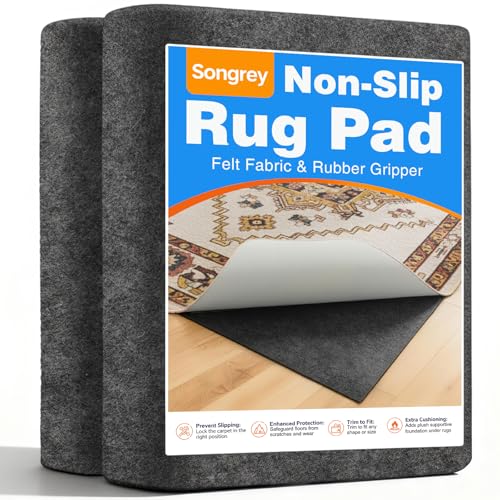
For a loose rug in a traffic lane, select a backing designed to grip. RUGPADUSA Dual Surface uses reinforced rubber, Mohawk Home Non Slip uses latex rubber, Nature’s Grip uses a natural rubber coating, and the BAGAIL, Acapet, Songrey, and Deep Dream products also document rubber, silicone, or TPR backing. These constructions are intended to reduce sliding, bunching, or wrinkling, but the floor manufacturer’s care instructions should still take priority.
Decide how much thickness you need
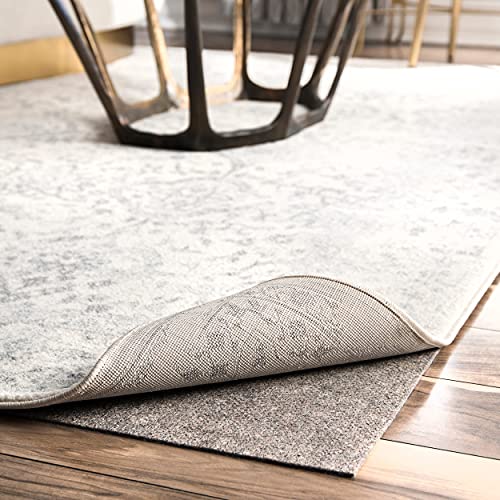
Profile affects comfort, door clearance, furniture placement, and the visual edge of the rug. The RUGPADUSA Dual Surface and nuLOOM options are approximately 1/8 inch thick, making them reasonable starting points when you want cushioning without much added height. Nature’s Grip is described as ultra-low-profile and may suit entryways or other tight spaces.
A 1/4-inch pad gives a more noticeable cushion. RUGPADUSA Eco-Plush, RUGPADUSA Basics, Mohawk Home Non Slip, and Acapet all use approximately 1/4-inch constructions. That added material may help with underfoot softness, sound absorption, or insulation, but measure the gap beneath doors and furniture before ordering. Songrey’s listed 3mm felt layer sits between the very slim and quarter-inch choices.
Examine the material evidence
Material transparency is useful when comparing eco-conscious products. The most specification-aligned disclosures in this selection include RUGPADUSA Eco-Plush and Basics, which identify 100% felt and state that the pads contain no glues, PVC, or latex. RUGPADUSA Dual Surface identifies 100% recycled, low-VOC felt and low-VOC reinforced rubber. nuLOOM states that its pad uses 100% recycled materials, while Mohawk Home identifies recycled felt.
Other listings use terms such as natural rubber, natural latex, odorless, low-VOC, non-toxic, or eco-friendly materials. Those descriptions can still be relevant, but they do not all provide a recycled-content percentage or a complete material breakdown. Compare the specific claim with your priority instead of assuming that every natural or odor-free description means the same thing.
Check floor compatibility carefully
Several selected pads list broad compatibility across hardwood, tile, laminate, vinyl, carpet, stone, or linoleum. The nuLOOM pad names hardwood, carpet, tile, vinyl, and linoleum; Mohawk Home describes hardwood, carpet, and tile; and BAGAIL lists hardwood, stone, vinyl, laminate, tile, and carpet. RUGPADUSA Dual Surface specifically mentions hardwood and vinyl plank when the flooring manufacturer’s instructions are followed.
Broad compatibility is not a substitute for checking your floor finish. Among the selected products, BAGAIL cautions against high-temperature, humid, or wet areas, and Deep Dream’s waterproof backing should not be treated as permission to install a pad anywhere moisture is expected. Keep the floor clean and dry before installation unless the product instructions say otherwise.
Plan the fit and trim allowance
Most of these products can be cut with household scissors. The usual listing guidance is to make the pad smaller than the rug so its edge remains hidden. nuLOOM recommends trimming each side two inches short of the rug perimeter, while Acapet and Mohawk Home describe a one- to two-inch margin. Measure the rug rather than relying only on the nominal size, especially when working with an unusual shape.
Round and irregular rugs need a little more planning. Deep Dream’s 7-foot round format is the most direct selected match for a circular rug, and its listing also describes trimming for irregular shapes. A rectangular pad can still be cut for a custom outline, but mark the rug perimeter first and keep the pad fully inside the edge.
Prioritize the room’s main problem
For a large rug that slides, RUGPADUSA Dual Surface is the most specification-aligned specification-based starting point because it combines low-VOC recycled materials, grip, protection, and a restrained profile. For a thick comfort layer under furniture, RUGPADUSA Eco-Plush or RUGPADUSA Basics is more appropriate because both are felt-only and explicitly not non-slip. For an entryway, Nature’s Grip emphasizes low profile and grip. For a round rug, Deep Dream removes much of the shape-matching work.
These distinctions are more useful than treating all of the top eco-friendly rug pads as interchangeable. A pad’s documented construction should match the installation rather than simply the room label.
Final Recommendation
RUGPADUSA Dual Surface 9’ x 12’ ranks first overall in this specification-based comparison under the published weighted criteria.
RUGPADUSA Dual Surface is the first overall specification-based choice among the best eco-friendly rug pads. Its 100% recycled, low-VOC felt and low-VOC reinforced rubber provide the most balanced evidence for material transparency, grip, floor protection, and low-profile cushioning. It is especially compelling for a large rug that needs stability without the bulk of a thicker felt pad.
For a different priority, choose RUGPADUSA Eco-Plush when cushion and glue-free, PVC-free, latex-free felt matter more than non-slip performance. Choose RUGPADUSA Nature’s Grip for a slim jute-and-natural-rubber design, or Deep Dream Dual Surface when a round format and waterproof TPR backing are useful. These are among the top eco-friendly rug pads here, but each is best suited to a different installation.
Frequently Asked Questions
What makes the best eco-friendly rug pads different from ordinary rug pads?
The evidence varies by product. Some selected pads document recycled felt, 100% felt, natural rubber, low-VOC materials, or the absence of glues, PVC, and latex. Look for a specific construction or material statement rather than relying only on a broad eco-friendly label.
Should I choose felt-only or felt with rubber backing?
Choose felt-only when the rug is already anchored by furniture or is heavy enough to remain stable. Choose felt with rubber, latex, silicone, or TPR backing when limiting sliding and bunching is a primary need. The felt-only RUGPADUSA models explicitly state that they are not non-slip.
How much smaller should a rug pad be than the rug?
The listings generally recommend trimming the pad so it remains hidden beneath the rug. Guidance ranges from one to two inches inside the rug perimeter, and nuLOOM specifically recommends two inches on each side. Measure and mark before cutting.
Can these pads be used on every floor?
No. Several listings describe broad floor compatibility, but restrictions still apply. Follow the flooring manufacturer’s instructions, and review cautions about moisture, heat, finishes, or specific surfaces before installation. A broad compatibility claim should not override those instructions.
Which selected pad is best for a round rug?
Deep Dream Dual Surface is the clearest match because the selected listing is a 7-foot round pad. It combines 1/8-inch felt with waterproof TPR backing and can be trimmed, although the floor and room conditions should still suit the product guidance.