Buying Guide
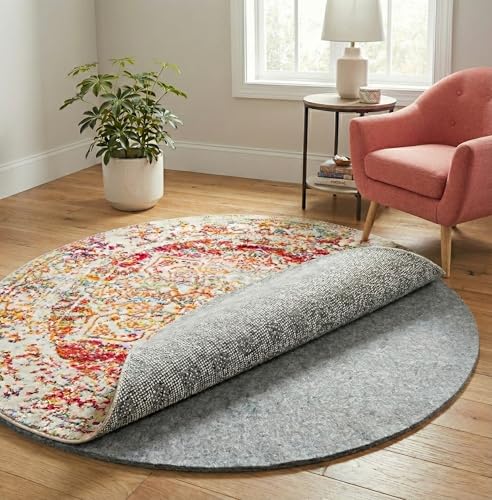
The best round rug pads are not interchangeable: a thick felt cushion solves a different problem from a thin open-grid gripper. Start with the rug’s actual diameter, then compare the backing, thickness, floor compatibility, and whether the pad is meant to stop movement or simply protect the floor.
Choose the backing by room conditions
Rubber, latex, silicone, and TPR backings are the main grip-oriented designs documented in this comparison. Mohawk Home uses latex rubber, while the BAGAIL 6-foot pad uses natural rubber. Veken combines felt with silicone, and pdpdoc and Warmstar document waterproof TPR. These constructions are the more relevant starting points when a round rug slides, bunches, or wrinkles on a hard floor.
A felt-only pad is different. RUGPADUSA Eco-Plush and RUGPADUSA Basics explicitly state that they are not non-slip products. They are intended for rugs held down by furniture or for heavier rugs that already stay put. Felt can provide a soft protective layer without adding a rubberized backing, but it should not be selected as the primary solution for an unsecured rug in a busy walkway.
Match thickness to clearance and comfort
Thickness affects both feel and fit. RUGPADUSA Eco-Plush is listed at 1/2 inch, making it the cushioning-focused choice in this group. Mohawk Home, the BAGAIL 6-foot pad, Veken’s 6-foot pad, and Rugs.com use approximately 1/4-inch constructions. The BAGAIL 8-foot open-grid pad is listed at 0.1 inch, while Warmstar documents a 1/8-inch option.
Thicker pads may add more underfoot softness, sound absorption, insulation, and protection, but they can also create clearance issues at doors or furniture edges. A low-profile gripper may fit better beneath a rug near a door swing. Measure available clearance and check whether the listing’s thickness applies to the exact variant you plan to buy.
Check the floor compatibility
Floor compatibility varies among these products. Mohawk Home documents use on hardwood, tile, carpet, and other floors. BAGAIL’s felt-and-rubber model lists hardwood, stone, vinyl, laminate, tile, and carpet, but warns against wet, humid, and high-temperature areas. The pdpdoc listing identifies hardwood, tile, and carpet use, and Warmstar describes hardwood, tile, and laminate.
The 4-foot Veken pad has more specific restrictions: it should not be used on vinyl, lacquered, acrylic, natural stone, porous, refinished, concrete, or heated floors. RUGPADUSA’s felt products are documented as safe for all flooring surfaces and finishes, although the non-slip limitation still applies. Prioritize the floor exclusions in the product listing rather than assuming every pad works everywhere.
Measure for coverage and trimming
Round sizes in this list range from 3 feet to 10 feet. Measure the rug’s diameter rather than relying on a nominal room size. A pad that is slightly smaller than the rug is easier to hide, while an oversized pad may require trimming. Several selected products document trim-to-fit use with household scissors, including Mohawk Home, Veken, BAGAIL, pdpdoc, and Warmstar.
For a clean result, place the rug over the pad, mark the excess, and trim gradually. Warmstar recommends cutting about 2 inches smaller than the floor covering, while other listings simply describe trimming to fit. Follow the specific instructions for the product you choose rather than assuming every material cuts identically.
Decide whether waterproofing matters
Waterproof construction is useful when a rug is placed where spills or moisture are a concern, but it does not eliminate the need to follow floor-care instructions. The pdpdoc pad uses felt with waterproof TPR backing, and Warmstar documents waterproof protection with TPR. Those designs stand apart from ordinary felt pads and may be relevant beneath entry-area or dining-area rugs when the floor is approved by the listing.
Waterproofing should not be confused with suitability for bathrooms or kitchens in every case. BAGAIL’s thicker felt-and-rubber model specifically excludes high-temperature, humid, and wet areas. Product-specific restrictions are therefore more important than a general waterproof label.
Consider care and installation
Open-grid designs such as the BAGAIL 8-foot pad and Veken 4-foot pad are described as allowing airflow and helping with vacuuming. Felt pads may be vacuumed, shaken, or trimmed depending on the model. Warmstar documents wipe-or-vacuum care, and Veken’s 6-foot pad is described as odorless and glue-free.
Lay the pad flat, smooth wrinkles, and confirm that the rug itself lies flat before regular use. Follow the care and installation information supplied with the specific listing, particularly when the floor has a finish or material named in the product warnings.
Final recommendation
BAGAIL Felt and Natural Rubber 6’ Round Pad ranks first overall in this specification-based comparison under the published weighted criteria.
Mohawk Home 6’ Round Rug Pad is the first overall specification-based choice among the best round rug pads in this comparison.
It combines a 1/4-inch recycled felt layer, latex grip, dual-surface use, documented floor compatibility, and trim-to-fit flexibility without the explicit non-slip limitation attached to the felt-only options. BAGAIL Felt and Natural Rubber 6’ Round Pad is a close alternative when natural rubber backing and a dense cushioned surface are more important.
For a thick cushion, RUGPADUSA Eco-Plush is the focused choice, provided furniture keeps the rug anchored. For a large round rug, Rugs.com Everyday Performance offers a documented 10-foot format, while pdpdoc adds waterproof TPR construction at 8 feet. Shoppers prioritizing a thin profile can consider BAGAIL’s 8-foot open-grid design, and Warmstar suits shoppers who need a compact waterproof pad.
The top round rug pads in this comparison differ mainly in backing and intended use, not just diameter. Select a rubber, latex, silicone, or TPR-backed model when movement is the main concern; select felt-only when the rug is already anchored and cushioning or floor protection is more important. These are specification-based recommendations, not hands-on test results.
Frequently Asked Questions
What should I look for in the best round rug pads?
Start with the rug diameter and floor type. Then decide whether you need non-slip grip, cushioning, waterproof backing, or a low profile. A rubber, latex, silicone, or TPR backing is the more relevant documented feature when preventing movement is the priority. A felt-only pad may be suitable when furniture already anchors the rug.
Are felt-only round rug pads non-slip?
Not necessarily. RUGPADUSA Eco-Plush and RUGPADUSA Basics explicitly state that they are not non-slip. They are intended for rugs held by furniture or rugs that stay in place through their own weight. Choose a backed gripper instead when the rug needs resistance to sliding or bunching.
How thick should a round rug pad be?
Use available clearance and desired feel as your guide. The selected products range from about 0.1 inch to 1/2 inch. A thicker pad can provide more cushioning, but a thinner design may fit better beneath doors or furniture. Confirm the exact thickness of the variant you plan to purchase.
Can round rug pads be cut to fit?
Several selected models document trimming with household scissors, including Mohawk Home, Veken, BAGAIL, pdpdoc, and Warmstar. Trim gradually and keep the pad slightly inside the rug’s edge so it remains hidden. Follow the individual listing’s instructions because materials and recommended margins vary.
Which of the best round rug pads is suitable for moisture concerns?
The pdpdoc 8-foot and Warmstar 3-foot options document waterproof TPR backing. However, waterproof construction does not override floor restrictions. Check the listing for approved surfaces and avoid assuming that a waterproof pad is appropriate for every humid or wet location.