Buying Guide
The best elastomer plate casters are selected by matching wheel material, load, mounting geometry, and movement control—not by wheel diameter alone. The products in this comparison use TPE, TPR, rubber, polyurethane, or polyurethane-rubber wording. These materials are described in the supplied listings as supporting quieter, non-marking, or floor-conscious movement, but the exact compound and behavior vary by product.
Start with the real working load
Treat an advertised capacity as a specification to verify, not as an automatic operating target. Add the weight of the furniture, cart, equipment, and contents. Then consider how the load will be distributed. A four-caster set may not carry its full advertised total if one wheel is lightly loaded, the floor is uneven, or the mounting surface flexes.
Nefish documents a 600-pound total capacity. CLOATFET and ASHGOOB state the current price per set, while WISD states the current price per set and POWERTEC states the current price per set. TABKEER lists the current price per wheel, and PUIPUM lists the current price per caster. Compare the basis of each rating before choosing, and account for the structure supporting the plate.
Match the wheel material to the floor
The best elastomer plate casters for finished floors should have a wheel description that fits the surface and project. CLOATFET and WISD describe TPR or TPE wheels as quiet, non-marking, or floor-friendly. PUIPUM, ASHGOOB, and the selected Online Best Service models emphasize non-marking or floor-protective behavior. These are useful listing-based signals, but they do not replace checking compatibility with a particular floor coating.
Soft elastomer wheels may be preferable when noise and surface marking matter. However, compounds differ, and the supplied evidence does not provide a standardized hardness scale for the selected products. If a caster will cross carpet, thresholds, or rough workshop flooring, inspect wheel diameter, tread width, and clearance together. TABKEER’s 3-inch wheels provide a larger format than the 1.5-inch ANDUTEES model.
Measure the plate before ordering
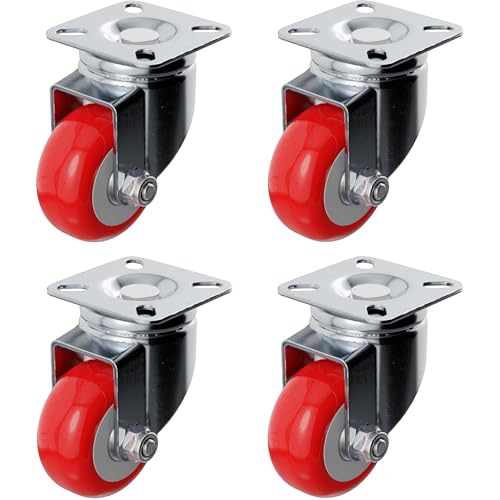
Plate casters are useful only when their hole pattern and footprint match the mounting surface. Measure the existing plate, distance between hole centers, screw diameter, and available clearance. The selected Online Best Service polyurethane model lists a 1.96-by-1.96-inch plate and 1.29-by-1.29-inch hole centers. Its rubber-base model also provides plate and hole-center measurements. POWERTEC lists a 1-7/8-by-2-5/8-inch plate, and WISD lists a 1.5-by-1.8-inch plate.
A larger plate may distribute load across more material, but it can overhang a narrow furniture leg or interfere with nearby components. A small plate may fit better but place more stress on a limited mounting area. Nefish uses an L-shaped side-mount design intended to save space; that is a different installation approach from a conventional flat top plate.
Decide how much brake control you need
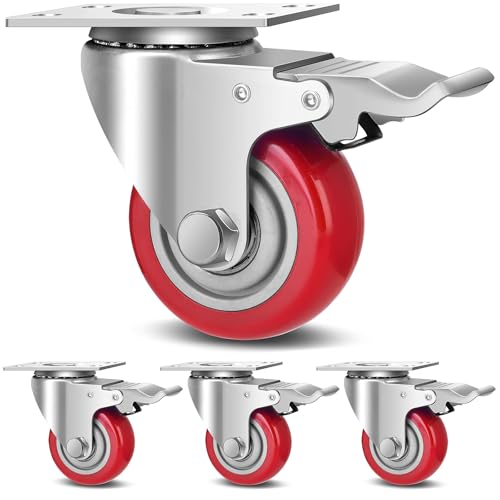
Brake configuration affects how the finished object behaves when parked. CLOATFET equips every caster with a double-locking brake that locks the wheel and swivel. PUIPUM specifies dual brakes. Nefish and WISD provide mixed sets with two braked and two unbraked casters, which can preserve directional movement while adding some parking control.
ASHGOOB, POWERTEC, and both selected Online Best Service versions are presented without brakes. That can be appropriate for equipment that must be repositioned frequently, but it provides no built-in way to secure the object. For a workbench, cart, or cabinet that must remain stationary during use, favor a documented locking design and place the braked casters where they can be reached.
A 360-degree swivel describes direction change, but bearing information helps show how the swivel assembly is documented. Nefish specifies double-ball sealed bearings, while ASHGOOB, TABKEER, and the selected Online Best Service models describe double ball bearings. ANDUTEES identifies bearing language and states 360-degree rotation.
Where a listing does not name a bearing type, avoid assuming one. WISD, CLOATFET, PUIPUM, and POWERTEC provide swivel or rotation information without detailed bearing specifications. That does not establish poor performance; it limits what can be compared from the supplied evidence.
Consider installation hardware and use case
Included hardware can simplify installation, but it does not guarantee compatibility. ANDUTEES includes stainless steel screws; WISD, CLOATFET, and Nefish also list mounting hardware. PUIPUM adds screws, rings, and a wrench. Confirm screw length, pilot-hole requirements, plate orientation, and the strength of the material receiving the fasteners.
For compact furniture, ANDUTEES and WISD document applications such as tables, desks, shelves, and cabinets. For workshop mobility, ASHGOOB, POWERTEC, CLOATFET, and PUIPUM target workbenches, carts, or storage equipment. TABKEER is aimed at trailers, saw tables, stages, and other listed heavy-use applications, while the Online Best Service polyurethane model is described for lighter commercial use.
Final recommendation
Among the top elastomer plate casters, the ranked products differ under documented elastomer wheel and floor behavior, documented load capacity, plate dimensions and mounting support, swivel and brake control, bearing and rolling design, and application and installation fit.
Nefish 2-Inch L-Shaped TPR Plate Casters ranks first overall in this specification-based comparison under the published weighted criteria.
Nefish 2-Inch L-Shaped TPR Plate Casters is the first overall specification-based choice in this comparison.
The final choice among the best elastomer plate casters depends on the documented features that match your intended use. Nefish combines the highest stated set capacity in this group with TPR wheels, sealed bearings, mixed brake control, and a space-saving plate. CLOATFET is a suitable alternative when every caster needs a double-lock brake, while PUIPUM is suited to projects where stated per-caster capacity and dual brakes matter.
Choose TABKEER when a larger 3-inch wheel, total locking brake, and stated per-wheel capacity fit the project. Choose ASHGOOB when uninterrupted, no-brake repositioning is the priority. For detailed mounting measurements, the Online Best Service polyurethane and rubber-base models provide useful dimensions. POWERTEC suits low-profile furniture and workbench projects, while WISD and ANDUTEES are compact options for lighter applications. Before installation, verify the actual load, plate pattern, floor compatibility, and clearance.
Frequently Asked Questions
What makes the best elastomer plate casters different from hard plastic casters?
The selected listings describe elastomer materials such as TPE, TPR, rubber, and polyurethane as quiet, non-marking, shock-absorbing, or floor-friendly. Hardness and compound vary, so use the stated material and floor claims as comparison points rather than assuming every elastomer wheel behaves identically.
Should all four plate casters have brakes?
Not always. CLOATFET and PUIPUM provide brake control across the set, while Nefish and WISD use mixed configurations. A full brake set is useful when the object must remain parked. Mixed or no-brake sets can be suitable when frequent repositioning is more important, provided the application does not require built-in restraint.
How do I confirm that a plate caster will fit?
Measure the existing plate length and width, hole-center spacing, screw-hole diameter, overall height, and available clearance. The Online Best Service polyurethane model, Online Best Service rubber-base model, POWERTEC, and WISD provide useful mounting measurements. Do not rely on wheel diameter alone.
Is a stated set capacity the same as a per-caster capacity?
No. A set rating describes the group, while a per-caster rating describes one wheel. WISD, POWERTEC, and Nefish state set figures, while TABKEER, PUIPUM, ANDUTEES, and the Online Best Service polyurethane model provide per-caster figures. Use the relevant limit after accounting for uneven loading, floor conditions, and mounting-surface strength.
Are side-mount casters interchangeable with flat plate casters?
No. Nefish uses an L-shaped side-mount design intended to save mounting space, whereas conventional plate casters attach through a flat top plate. Confirm the installation surface and hole orientation before selecting a replacement.