Buying Guide
Choosing the best iron plate casters starts with the connection between the caster plate and the equipment base. A wheel can have an appropriate diameter and still be a poor fit if the plate, hole spacing, or overall height does not match the project. Compare the mounting pattern first, then evaluate capacity, movement, wheel material, and braking.
Match the caster type to the movement
Rigid casters travel in one direction and are useful when an object should track predictably. The Shepherd Hardware 9182 documents this fixed design in a compact 2-inch format. Swivel casters rotate 360 degrees and are better for carts, furniture, and workbenches that must turn. Shepherd Hardware 9174, the Online Best Service models, FactorDuty, and ASHGOOB document swivel movement.
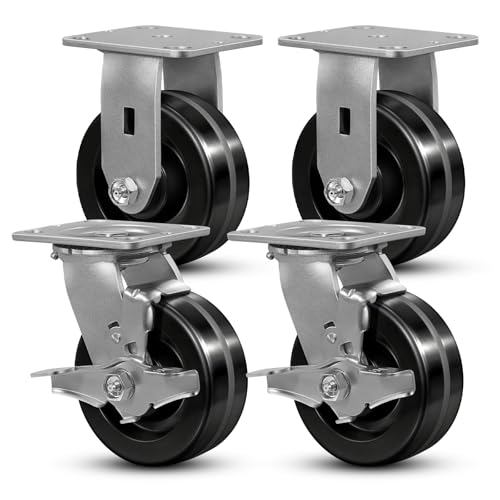
A mixed configuration can combine both behaviors. The VEVOR set includes two rigid and two swivel casters, while FactorDuty and Ulifestar pair braked and non-braked units. This arrangement can help an object roll forward while retaining some control, but installation should follow a stable layout appropriate to the equipment.
Check capacity conservatively
Capacity figures in the listings are not presented in a single format. Several products state a per-caster limit, including VEVOR, Online Best Service, FactorDuty, Shepherd, and Lygoeege. Other products state a total set capacity, such as ASHGOOB, CLOATFET, and Ulifestar. Do not treat a set rating as a per-wheel rating.
The VEVOR option documents the current price per caster. Online Best Service documents the current price for its 3-inch version and the current price for its 3.5-inch version, while FactorDuty also lists the current price per caster. These figures make them candidates for heavier equipment than the compact Shepherd models, which list the current price per caster.
The load should also be distributed across the complete installation. Equipment may shift its center of gravity during movement, and the listing data does not establish a real-world safety margin. Select a documented capacity that leaves practical allowance rather than matching the equipment weight exactly.
Measure the plate and total height
Plate-mounting fit is a key reason to compare technical specifications instead of relying only on wheel diameter. The Online Best Service products document a 2.5-by-3.5-inch plate and hole-center measurements of 1.7 by 2.8 inches. FactorDuty provides the same plate size and hole-center information. Shepherd 9174 specifies a 2-by-2.5-inch plate, while Shepherd 9182 lists a 1.5-by-2.5-inch plate.
The wheel diameter affects more than rolling clearance. It also raises the equipment, changes the overall height, and may alter the load position. FactorDuty lists a 4.5-inch overall height, Online Best Service lists 3.8 inches for the 3-inch version, and VEVOR lists an overall height of about 7.68 inches. Measure the available space and confirm that doors, shelves, ramps, and work surfaces will still clear.
Choose wheel material for the floor
Cast iron and iron wheels are oriented toward durable, industrial-style use, and the Shepherd listing specifically recommends its cast iron casters for rough wood or concrete and infrequent movement. Hard wheels can be unsuitable for delicate finished flooring because the supplied evidence does not describe them as non-marking.
Polyurethane, PU, rubber, and TPR wheels offer different priorities. VEVOR describes polyurethane wheels as non-marking, shock-absorbing, wear-resistant, and quiet. Ulifestar describes its PU wheels as non-marking and suitable for hardwood, tile, and smooth floors. ASHGOOB likewise specifies non-marking PU wheels for workshops and storage equipment.
It lists a 1.1-inch total height, rigid movement, a 26.5-pound capacity per wheel, and a 16-wheel package. It is useful when low clearance matters, but its TPR wheel means it should be evaluated as an iron-plate caster with a soft wheel, not as an exposed iron-wheel product.
Decide whether brakes are necessary
Brakes help hold mobile equipment in place, but not every project needs them. Lygoeege documents a dual-lock system that secures both wheel rotation and swivel direction. CLOATFET also documents dual-lock brakes on all four casters. FactorDuty provides two braked and two non-braked swivel casters, and Ulifestar uses the same two-and-two arrangement.
The VEVOR set places side brakes on two wheels and uses two rigid casters for directional stability. ASHGOOB deliberately omits brakes for applications requiring constant repositioning. That can be appropriate for a production cart or frequently moved workbench, but it provides less parked control. Choose the brake arrangement before installation because replacing individual caster types can change both height and movement behavior.
Review bearing and frame details
Bearing information helps distinguish otherwise similar plate casters. The VEVOR set lists double ball bearings, while Online Best Service and FactorDuty describe two ball bearings plus a roller bearing per caster. Shepherd 9174 specifies a heavy-duty ball-bearing swivel mount, and ASHGOOB lists double ball bearings for its swivel action.
Frame construction also matters. VEVOR documents a 5.5-millimeter galvanized steel plate body, FactorDuty describes a high-gauge steel frame and top plate, and Lygoeege specifies a thick steel plate bracket. These details support a more informed comparison, but they do not replace checking the mounting surface, fasteners, and actual equipment requirements.
Final Recommendation
VEVOR 6-Inch Heavy-Duty Plate Caster Set ranks first overall in this specification-based comparison under the published weighted criteria.
VEVOR 6-Inch Heavy-Duty Plate Caster Set is the first overall specification-based choice.
VEVOR 6-Inch Heavy-Duty Plate Caster Set is the highest-scoring returned product among the best iron plate casters. Its combination of 1,000-pound-per-caster capacity, mixed rigid and swivel movement, partial braking, double ball bearings, and galvanized plate body gives it a broad heavy-duty specification profile.
For a smaller iron-wheel setup, Online Best Service 3.5-Inch Braked Plate Casters and FactorDuty 3.5-Inch Swivel Plate Caster Combo are useful alternatives. Choose Lygoeege when dual-lock control matters most, Shepherd 9182 when fixed movement is preferred, and Ulifestar or ASHGOOB when non-marking polyurethane wheels are more appropriate for finished floors. Among the top iron plate casters, the correct choice depends mainly on capacity, mounting fit, wheel material, and whether the equipment must stay locked when parked.
Frequently Asked Questions
Among the best iron plate casters, are iron plate casters suitable for finished floors?
It depends on the wheel material. The Shepherd models use cast iron wheels and are recommended for rough wood or concrete, while Ulifestar, ASHGOOB, and VEVOR document non-marking polyurethane wheels. For hardwood, tile, or epoxy, a listed PU, polyurethane, rubber, or TPR wheel may be a more floor-conscious option than exposed iron.
What is the difference between a rigid and swivel plate caster?
A rigid caster travels in a fixed direction, while a swivel caster rotates to change direction. Shepherd Hardware 9182 is the selected rigid example. Shepherd Hardware 9174, Online Best Service, FactorDuty, Lygoeege, Ulifestar, and ASHGOOB document swivel designs. The VEVOR set combines both types.
Should all four casters have brakes?
Not necessarily. Two-brake and two-free arrangements, such as those documented for FactorDuty and Ulifestar, balance parking control with movement. Lygoeege and CLOATFET document dual locks, while ASHGOOB has no brakes for uninterrupted repositioning. The best configuration depends on whether the equipment is moved often or must remain stable when parked.
How should I compare caster load ratings?
First determine whether the listing states capacity per caster or for the entire set. VEVOR, FactorDuty, Online Best Service, Shepherd, and Lygoeege provide per-caster figures, while ASHGOOB, CLOATFET, and Ulifestar state set-level capacity. Use the correct basis, account for uneven load distribution, and leave practical allowance rather than matching the listed limit exactly.
Why do plate dimensions matter if the wheel diameter fits?
The plate and hole pattern determine whether the caster can attach securely to the equipment. Online Best Service and FactorDuty provide plate and hole-center measurements, while some other listings do not. Measure the existing mounting area, hole spacing, and available height before selecting from the best iron plate casters.