Buying Guide
The best exterior door hinges should be selected from the door’s measurements and use conditions, not from finish alone. Check the hinge height and width, corner shape, thickness, screw-hole layout, pin style, and the door’s approximate weight before comparing materials or pack sizes. A hinge that looks right can still require mortise changes if its corners do not match.
Start with size and corner shape
Many selected products use a 4-by-4-inch format, which is a common size for exterior and entry-door replacement work. The BENERAY, KOLET, LITLANDSTAR, Yaocom, Goldenwarm, IOQ, and TDCHINGES listings all describe 4-inch hinges, but their corners differ. IOQ’s square-corner model specifies 90-degree corners. Several other products specify a 5/8-inch radius, while Goldenwarm’s black steel model specifies a 1/4-inch radius. These profiles are not interchangeable by assumption.
Measure an existing hinge before ordering. Confirm the leaf dimensions, corner radius, thickness, screw-hole pattern, and the door thickness listed by the product. If a listing provides two corner formats, such as square and rounded options, verify which version is actually supplied. The BENERAY listing includes both square and radius-corner references, so direct confirmation is especially important.
Choose stainless steel, steel, or iron according to exposure
Stainless steel is the clearest material choice in this group when corrosion resistance is a primary concern. BENERAY identifies 304 stainless steel and specifically mentions homes near the ocean. KOLET, LITLANDSTAR, and Yaocom also describe stainless-steel construction and outdoor use. These specifications are useful for exposed locations, but they do not eliminate the need to confirm the finish and maintain the surrounding door hardware.
Steel and iron options can still fit many exterior applications when their listings document an anti-rust or rust-resistant surface. The IOQ standard and square-corner hinges use iron with rust-resistant treatments. Goldenwarm describes steel with a rust-resistant coating, while TDCHINGES specifies steel with an oil-rubbed bronze finish. Treat these statements as product specifications rather than guarantees for every climate or installation.
Decide whether ball bearings are useful
Ball-bearing hinges are documented by KOLET, LITLANDSTAR, Yaocom, Goldenwarm’s black ball-bearing set, BENERAY, and TDCHINGES. Their listings associate the bearing design with smoother or quieter movement. KOLET specifies permanently lubricated bearings, Yaocom specifies four built-in ball bearings, and TDCHINGES describes a pre-lubricated knuckle.
A ball-bearing design can be worth considering for a heavy or frequently used exterior door, but the listing evidence varies. BENERAY identifies ball bearings without providing a numeric capacity, while other products provide different types of load guidance. Compare the complete specification set instead of assuming every ball-bearing hinge has the same support level.
Match the pin to your maintenance and security needs
Removable pins make it easier to take a door off its hinges and are included on BENERAY, IOQ’s standard and square-corner models, and both Goldenwarm products. BENERAY also describes use on left- or right-hand doors and the possibility of adding a door stop. These features can be helpful during replacement or future maintenance.
Non-removable pins appear on KOLET and TDCHINGES. TDCHINGES explicitly presents its non-removable-pin design as a security feature, while KOLET notes that its pin cannot be removed because of the ball-bearing structure. Choose this style when retaining the pin is more important than quick door removal, and check the existing installation before assuming the change will be convenient.
Plan hinge count and load support carefully
Pack quantity is not the same as required hinge count. Several listings recommend at least three hinges for an exterior door. IOQ’s spring-loaded model lists up to the current price per hinge and says a pair supports up to the current price, while its standard model lists up to the current price per hinge. TDCHINGES lists up to the current price per hinge, and Goldenwarm’s 1/4-inch-radius model states that three hinges can support up to the current price.
Use the manufacturer’s stated guidance conservatively and account for the actual door, frame, screw holding, and installation. The IOQ spring-loaded hinges may require especially careful planning because their stated capacity is lower than several standard hinge options. For a replacement project, do not assume a three-pack should always be installed as a pair; follow the product’s instructions and the door’s existing layout.
Consider self-closing hardware separately
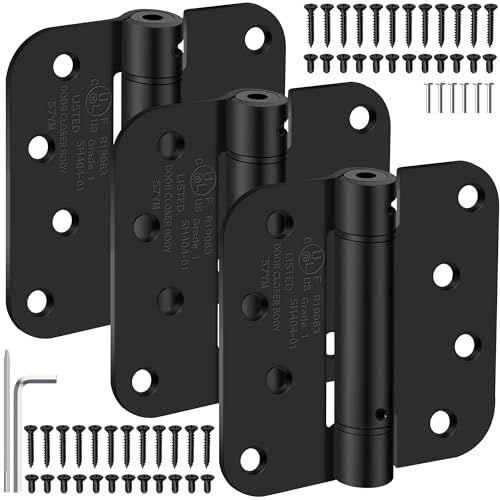
The IOQ matte black spring hinges and brushed nickel spring hinges are the selected self-closing designs. Their adjustable springs are intended to close the door slowly and gently, and both listings describe left- and right-hand compatibility. The black version is a three-pack; the brushed nickel version is a two-pack.
Self-closing hinges solve a different problem from standard butt hinges. They may be appropriate for a garage, basement entrance, or exterior door that should close automatically, but spring tension can affect how the door behaves. Confirm the door weight, the required number of hinges, and the adjustment method before replacing ordinary hinges with spring-loaded models.
Check the included screws and finish
Most selected sets include matching or compatible screws, but the quantity varies from 24 screws to larger multi-pack supplies. LITLANDSTAR and Yaocom each list 48 screws with six hinges. TDCHINGES includes 32 screws with its two-pack, and the IOQ products include installation hardware plus a longer screw for pin removal where applicable.
The visible finishes include matte black, brushed nickel, satin nickel, silver, and oil-rubbed bronze. Finish matching is a practical consideration when replacing only hinges. Compare the hinge color with the door handle, lock, threshold, and other exposed hardware rather than relying on a generic color name.
Final recommendation
BENERAY 4-Inch Stainless Steel Ball-Bearing Hinges ranks first overall in this specification-based comparison under the published weighted criteria.
BENERAY is the first overall specification-based choice among these best exterior door hinges because it combines 304 stainless steel, ball-bearing operation, a removable pin, exterior suitability, and supplied screws. For the top exterior door hinges in a coastal or highly exposed setting, its stainless-steel specification is especially relevant, while KOLET is a strong alternative for a non-removable-pin, quiet ball-bearing configuration.
Choose LITLANDSTAR or Yaocom when a six-pack is more useful than a three-pack. Select the IOQ spring-loaded model when automatic closing is the main requirement, and choose TDCHINGES when a non-removable pin, bronze finish, and stated 3.3-millimeter steel construction fit the project. Before purchase, verify the hinge dimensions, corner radius, screw pattern, door weight, and required quantity.
Frequently Asked Questions
What size should I look for in the best exterior door hinges?
Several products in this comparison use a 4-by-4-inch format, but size alone is not enough. Confirm the hinge height, width, thickness, corner radius, screw-hole pattern, and existing mortise. A 4-inch hinge with square corners may not directly replace a 4-inch hinge with a 5/8-inch or 1/4-inch radius.
Are stainless-steel hinges better for exterior doors?
Stainless steel is a strong specification to prioritize when corrosion resistance matters. BENERAY identifies 304 stainless steel, and KOLET, LITLANDSTAR, and Yaocom also list stainless-steel construction for outdoor use. The finish, installation location, and maintenance still matter, so stainless steel should be treated as one factor rather than a universal guarantee.
Are ball-bearing hinges suitable for heavy exterior doors?
Ball-bearing designs are listed for smooth, quiet operation and are included among several selected products. However, their documented load information differs. Compare the specific manufacturer guidance for the hinge, door weight, number of hinges, and screw installation rather than assuming all ball-bearing hinges support the same load.
When should I choose self-closing hinges?
Choose a spring-loaded model when the door needs automatic closing. The selected IOQ self-closing hinges describe adjustable spring tension and slow, gentle closing. Check the stated weight guidance and pack quantity first, because the spring-loaded options have different capacity and configuration details from standard hinges.
Is a removable pin necessary?
A removable pin is useful when the door may need to be removed for installation, maintenance, or adjustment. BENERAY, IOQ’s standard and square-corner models, and Goldenwarm’s selected products document removable pins. KOLET and TDCHINGES use non-removable pins, which may better suit buyers prioritizing a retained-pin security design.