Buying Guide
The best forged steak knives are easier to compare when construction, edge style, steel, handle design, and care are considered together. A forged label alone does not explain the whole product. Look for supporting details such as a full tang, bolster, rivets, named steel, hardness, or a stated sharpening angle. This guide uses only public listing specifications, so it does not claim hands-on cutting performance.
Start with forged construction
Forging refers to the manufacturing description supplied by the listing, while full tang describes how far the blade extends through the handle. These are related but different details. Cangshan, Cutluxe, Mercer Culinary, Babish, and Piklohas explicitly document both forged construction and full-tang designs. A bolster is another useful specification because it describes the transition between blade and handle and may contribute to the balance profile, but it should not be treated as proof of a particular feel in the hand.
If a listing only says “sharp” or “durable,” it provides less useful comparison evidence. The most specification-aligned technical entries here add steel type, edge angle, hardness, or heat-treatment information. Cangshan specifies X50CrMoV15 German steel, a 16-degree-per-side edge, and HRC 58 +/- 2. Babish identifies 1.4116 German steel, HRC 55 +/- 2, and a 13-degree cutting edge. Cutluxe gives a 14-16-degree-per-side range and 56+ Rockwell hardness.
Choose serrated, straight, or dual edge
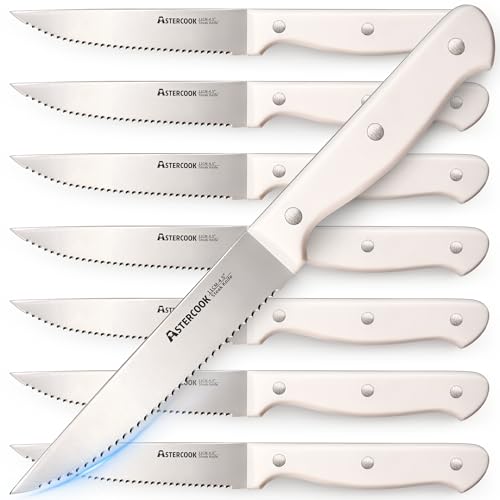
Serrated blades, such as those listed for the HENCKELS Forged Contour and KitchenAid sets, are designed with teeth along the edge. The supplied evidence describes them for cooked meats, steaks, chops, or cutlets. HENCKELS also documents smaller serrations within larger serrations on another forged model, but that model was not selected for this list because its supplied evidence does not clearly identify a forged construction claim in the product details used for selection.
Straight-edge knives are represented by Cangshan, Cutluxe, CoquusAid, and Piklohas. Their listings describe clean or precise slicing and, in some cases, specify hand sharpening or a plain edge. A straight edge may be preferable if you want a continuous blade surface and are comfortable following the maker’s care guidance. It may also require more attention to edge maintenance than a serrated design, although the supplied listings do not provide a common maintenance interval.
Freelander takes a different approach by documenting both serrated and straight sections on the same blade. That can appeal to shoppers seeking one knife style for different textures, but it is a more specialized design than choosing one consistent edge type.
Compare steel and durability details
Named steel is more informative than a generic stainless-steel description. X50CrMoV15 appears in the Cangshan, Messermeister, and Piklohas evidence, while Cutluxe identifies imported high-carbon German steel and Babish specifies 1.4116 German steel.
Hardness and heat treatment provide additional context when supplied. Cangshan lists proprietary ULTRA6 heat treatment and HRC 58 +/- 2. Babish lists HRC 55 +/- 2. These numbers are specifications, not independent verification, so they should be read as documented product information rather than a performance guarantee. Stainless or rust-resistant wording likewise does not eliminate the need to follow care directions.
Match the handle to your table and use
Handle materials and attachment details affect the design profile. Cutluxe and Messermeister use pakkawood handles with multiple rivets. HENCKELS Forged Contour, KitchenAid, and Babish list black handles with riveted or bolstered construction. Full tangs and bolsters are repeatedly documented across the selection, but the evidence cannot establish how any knife feels during actual use.
A holder, case, or roll can matter as much as the blade count. Mercer Culinary includes a six-pocket storage roll. These are different storage solutions: a roll is portable, a holder is more accessible for organized storage, and a case is oriented toward presentation.
Check set size and care instructions
Four-piece sets work for smaller households or a limited place setting. Six-piece sets offer more coverage, while eight-piece sets are more convenient for larger tables and entertaining. Count the actual knives rather than accessories: CoquusAid includes six knives plus six spoon rests, and Piklohas includes eight knives with a holder.
Care guidance varies. HENCKELS Forged Accent, not selected here, also lists dishwasher or hand washing, but every model should be judged by its own instructions. Mercer Culinary specifically recommends hand washing with mild soap followed by thorough drying. If a listing does not document care, avoid assuming dishwasher compatibility.
Consider documentation more than broad claims
This is a specification-based comparison, not a test of sharpness, comfort, longevity, or cutting results. Product descriptions sometimes use strong promotional wording, but the scoring gives more weight to concrete details that can be checked in the supplied listing: steel grade, forging, full tang, edge type, hardness, angle, handle construction, set contents, warranty, and care. That approach helps separate a technically documented option from one that simply uses impressive adjectives.
Final recommendation
Cangshan L Series 4-Piece Steak Knife Set ranks first overall in this specification-based comparison under the published weighted criteria.
The final choice among the best forged steak knives depends on the documented features that match your intended use.
Cangshan L Series 4-Piece Steak Knife Set is the highest-scoring returned product and the first overall specification-based choice. Its combination of forged full-tang construction, X50CrMoV15 steel, stated heat treatment, 16-degree-per-side sharpening, HRC 58 +/- 2 hardness, ergonomic handle, and NSF certification gives it the most specification-aligned documented profile in this comparison.
The top forged steak knives are not identical, so the right choice depends on the setting. Choose HENCKELS Forged Contour if eight serrated knives and a gift box matter most. Choose Cutluxe for a straight edge with a pakkawood handle and detailed edge geometry. KitchenAid is the practical pick for a dishwasher-compatible four-piece set, while Mercer Culinary is useful when a storage roll is part of the plan. Babish offers unusually clear edge and hardness specifications in a compact set. Piklohas is the storage-focused option, and Freelander is the specialist choice for a dual-edge design.
Frequently Asked Questions
What should I look for in the best forged steak knives?
Look for an explicit forged construction statement supported by details such as full tang, bolster, rivets, named steel, hardness, or edge angle. Also confirm the edge style and care instructions. Cangshan, Cutluxe, and Babish provide especially detailed blade specifications in the supplied listings.
Are straight-edge or serrated steak knives better?
Neither is universally better based on the supplied evidence. Serrated designs are documented for cutting cooked meats and may appeal to shoppers who prefer that edge format. Straight-edge models from Cutluxe, Cangshan, CoquusAid, and Piklohas are described for precise slicing. The choice depends on your preferred design and maintenance routine.
How many knives should a steak knife set include?
Four knives suit a smaller household or occasional use. Six knives provide broader everyday coverage, while eight knives are more convenient for larger dinners. Remember that an advertised piece count may include accessories: CoquusAid’s six-piece set includes six knives and six spoon rests, while Mercer Culinary’s configuration includes six knives and a storage roll.
Can forged steak knives go in the dishwasher?
Only use the care method documented for the specific model. When the listing does not clearly state dishwasher compatibility, hand washing is the more cautious interpretation, but the manufacturer’s instructions should control.
Full tang is a construction detail, not a guarantee of cutting performance. It indicates that the blade extends through the handle, and many selected listings pair it with rivets or bolsters. Compare it with the steel, edge design, hardness, sharpening angle, handle details, and care guidance for a fuller specification-based view.