Buying Guide
This guide compares the best glass kitchen scales using documented capacity range, measurement precision, units and tare controls, glass surface and cleanup design, and display, power, and usability.
A glass kitchen scale is most useful when its documented specifications match the way you prepare food. For everyday baking, an 11-pound model may be sufficient. For bread dough, bulk meal prep, or large containers, a 22- or 33-pound limit provides more headroom. Glass surfaces are also commonly described as smooth, stain resistant, or easy to wipe, but care instructions still differ between models.
Start with capacity
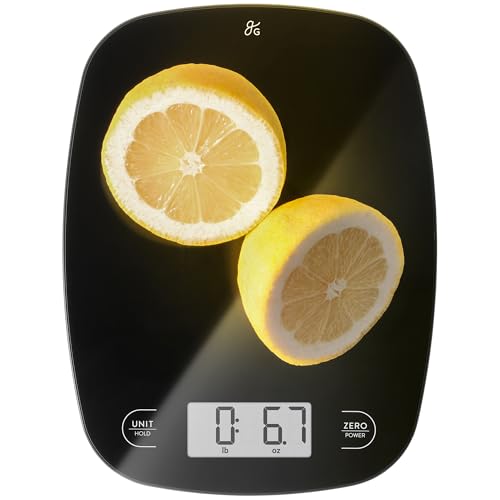
Capacity determines how much food and container weight the scale can handle together. The Taylor Glass Top Scale, OXO Good Grips Everyday Glass Food Scale, and Greater Goods Compact Black Glass Scale each list an 11-pound maximum. That is a practical range for standard mixing bowls, portions, and most home recipes.
The Escali Arti lists the current price. Nicewell reaches the current price, while the HOMEBUDS HB907, KOIOS K7H, and Brod & Taylor models list the current price. KitchenAid KQ917 lists the current price. These higher-capacity choices provide more headroom for large doughs, stockpot batches, or weighing a heavy bowl with ingredients already inside. Capacity alone does not establish superior accuracy, so compare it with the stated increment and minimum range.
Check precision and minimum weight
The clearest precision specifications in this group are 1 gram or 0.1 ounce. Brod & Taylor, KOIOS, HOMEBUDS, Taylor Glass Top, and Nicewell document that level in their listings. Greater Goods provides more detail by stating accuracy from 2 grams to the current price with 1-gram increments. That low-end information is helpful when measuring small amounts such as spices or coffee.
Some listings state capacity but omit the increment. That is the case for KitchenAid KQ917, Escali Arti, OXO, and Cuisinart in the supplied evidence. Do not assume that an unspecified increment matches another model. If your recipes depend on small, repeatable additions, favor a scale with an explicit 1-gram or 0.1-ounce specification.
Look for useful unit controls
Most of the selected scales support common kitchen formats. Grams, ounces, pounds, fluid ounces, and milliliters appear across the range, although the exact combination varies. KOIOS, Brod & Taylor, Nicewell, and OXO document broad unit conversion, while Cuisinart specifically identifies imperial and metric modes.
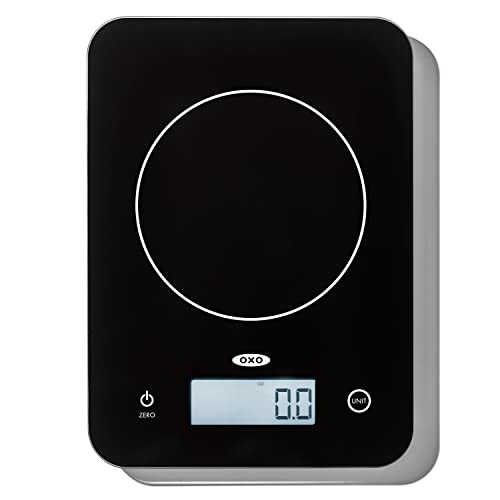
A tare or zero function is important for weighing directly into a bowl. It subtracts the container so the displayed result reflects the ingredient. Several models also describe layering ingredients in one container. OXO specifically says its zero function works without removing the bowl, while KitchenAid KQ917 and Taylor models document tare for resetting the container weight. Greater Goods, Escali, KOIOS, and Nicewell also list tare functions.
Hold is a separate convenience. Greater Goods and Escali document a hold feature or display hold, which can keep the reading visible after an item is removed. Brod & Taylor takes a different approach by documenting a five-minute display period before shutdown. These features may be useful when a bowl obscures the display or when ingredients are added gradually.
Consider glass and cleaning instructions
Taylor models describe glass platforms or tops, and The Display Guys listing calls its surface true glass. A smooth glass platform can be convenient for wiping flour, liquid ingredients, and food residue, but the product instructions still matter.
KitchenAid KQ908 is specifically listed as hand-wash only and should not be immersed or placed in a dishwasher. KOIOS describes its tempered glass as waterproof, while OXO, Taylor, and Greater Goods emphasize easy-clean or stain-resistant surfaces rather than immersion. The Cuisinart design includes a removable stainless steel bowl, giving you a separate vessel for ingredients but also adding another component to wash and store.
Compare displays and controls
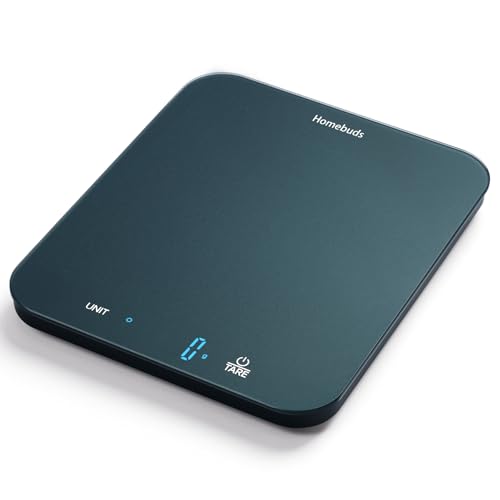
Readability depends on the display type, number size, lighting, and placement. KitchenAid KQ917 and HOMEBUDS specify bright LED displays. KOIOS identifies a large backlit LCD, and Brod & Taylor describes an extra-bright, high-contrast LCD. Taylor lists a 0.75-inch digital screen, while OXO describes large numbers.
Controls also affect cleanup. Touch-sensitive surfaces appear on KitchenAid KQ917, KitchenAid KQ908, Taylor, Greater Goods, and Brod & Taylor. The KitchenAid KQ908 uses a rotating knob for unit selection and tare or power control, a design that differs from the touch-button layouts elsewhere. A separate physical button or knob may be easier for some users to operate, while sealed touch controls can reduce gaps where crumbs collect. The supplied listings establish the control types but do not provide hands-on evidence about responsiveness.
Plan for power and storage
Many selected models include AAA batteries. Taylor, HOMEBUDS, KitchenAid KQ908, Brod & Taylor, Nicewell, and Cuisinart list included batteries or battery operation. Escali uses two CR2032 batteries. KOIOS documents both USB-C charging and two AAA batteries, giving it the most flexible power specification in this comparison.
A slim scale is easier to keep in a drawer. Greater Goods lists a 0.5-inch profile, while OXO lists a 0.75-inch height and several other models list heights around 0.8 to 0.94 inches. Nicewell adds an attached hook, and KOIOS lists a hidden hook design. Cuisinart is a more substantial bowl-based option, so it may need dedicated cabinet or counter space.
Match the design to your routine
Choose an 11-pound scale when most recipes use ordinary mixing bowls and you want a compact footprint. Move to Nicewell or Escali when you need more capacity without choosing the largest format. For large bread batches or bulk cooking, KitchenAid KQ917, Brod & Taylor, KOIOS, and HOMEBUDS provide the clearest high-capacity specifications.
For a specialized workflow, consider the documented convenience rather than an assumed performance advantage. Escali and Greater Goods offer hold functions, Cuisinart includes a dedicated bowl, KOIOS offers dual power, and Brod & Taylor provides a longer stated display timeout. These distinctions can matter more than finish color or brand familiarity when comparing the top glass kitchen scales.
Final recommendation
KOIOS K7H 33lb Glass Kitchen Scale ranks first overall in this specification-based comparison under the published weighted criteria.
KOIOS K7H 33lb Glass Kitchen Scale is the first overall specification-based choice among the returned products. It combines 33-pound capacity, documented 1-gram or 0.1-ounce precision, USB-C charging, AAA backup, five units, tare, and waterproof tempered glass.
The top glass kitchen scales differ under documented capacity range, measurement precision, units and tare controls, glass surface and cleanup design, and display, power, and usability. Brod & Taylor High Capacity Baking Scale follows closely for its 33-pound range, 1-gram precision, and five-minute display period. HOMEBUDS is another high-capacity option with a bright LED and extra-large platform.
For bread-focused kitchens, Brod & Taylor has the most directly relevant documented features. For flexible power, KOIOS is the clearest choice. At the compact end, Greater Goods and OXO emphasize low-profile designs and everyday controls, while Taylor Glass Top provides a clear precision and screen specification. Escali is the standout for display hold, Nicewell adds 22-pound capacity and a storage hook, KitchenAid KQ917 offers 30-pound capacity, and Cuisinart is the distinct bowl-based design.
The best glass kitchen scales are not identical substitutes. Review the capacity, stated increment, unit list, surface-care language, display, and power method before choosing. Because this guide uses listing evidence rather than hands-on testing, treat undocumented details as unknown instead of assuming that one model performs like another.
Frequently Asked Questions
What capacity should I choose for the best glass kitchen scales?
An 11-pound scale is generally suited to standard cooking, baking, portions, and meal prep when the container is moderate in size. Choose a 15- or 22-pound model for more room, or a 30- or 33-pound model for large doughs, bulk ingredients, and heavy containers. Remember that the container contributes to the total weight, so capacity is not the same as the amount of food you can add.
Are all glass kitchen scales waterproof?
No. The supplied listings use different care language. KOIOS describes waterproof tempered glass, while other models describe easy-clean or stain-resistant glass. KitchenAid KQ908 specifically says to hand wash, avoid immersion, and avoid the dishwasher. A glass platform may wipe clean easily without being suitable for rinsing or submersion, so follow the individual listing’s instructions.
Is 1-gram precision enough for baking?
The selected listings commonly describe 1-gram or 0.1-ounce increments, and that is a useful specification for many cooking and baking tasks. Greater Goods also states a 2-gram starting point, providing more detail about its lower range. However, the listings do not provide independent test results, so this comparison reports the stated increments without claiming measured accuracy.
What does tare do on a glass kitchen scale?
Tare, also called zero, subtracts the weight of a bowl, plate, or other container. You can then add ingredients while the display tracks the ingredient weight rather than the combined total. Several selected models also describe layering multiple ingredients in one container. Check whether the design lets you tare without moving the bowl; OXO explicitly documents that convenience.
Which selected scale is easiest to store?
Greater Goods lists a 0.5-inch profile, and OXO lists a 0.75-inch height, making both compactly documented choices. Nicewell and KOIOS add hooks for storage, while several other models list slim footprints. Cuisinart includes a bowl that can invert as a cover, but its bowl-based format may require more cabinet space than a flat platform scale.