Buying Guide
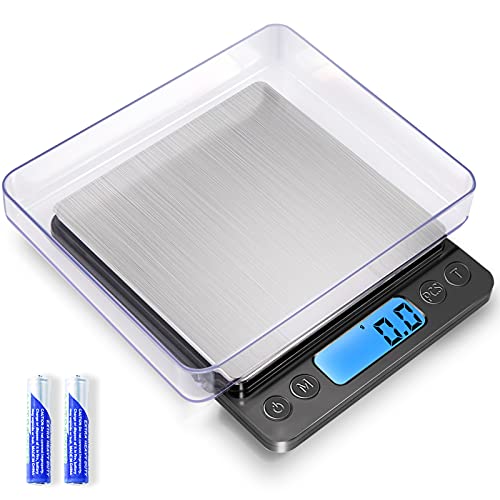
Choosing among the best kitchen scales with trays starts with the kind of weighing you actually do. A compact precision model can be excellent for coffee, spices, yeast, jewelry, or small portions, while a larger platform is more practical for bread dough, meal-prep containers, pet food, and bulk ingredients. A tray is useful because it can provide a dedicated weighing surface, protect the platform during storage, or act as a small container.
Match capacity to your recipes
Capacity is one of the clearest dividing lines in this category. The AMIR, JOEAA, and Diyife models top out at 500 grams, making them specialized choices for small quantities. The MEIYA reaches 1,000 grams, which adds flexibility without moving into a full-size format. YONCON, Fuzion PT3000, and LZPGITGD each document a 3,000-gram capacity, a more useful middle ground for ingredients and containers.
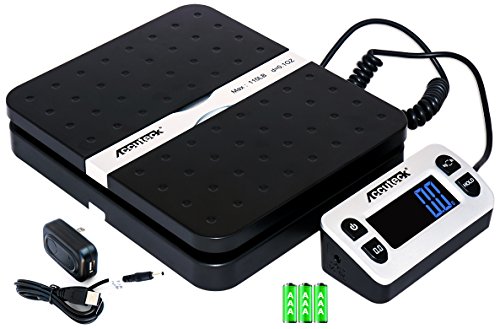
For standard household cooking, the Etekcity EK5250 and Taylor models reach the current price or 5,000 grams. The MOCCO goes much further, with a stated 50-kilogram limit. That capacity is potentially useful for bulk ingredients, packages, pet food, or commercial-style tasks, but it also indicates a larger format. Capacity should not be treated as a quality score by itself: a high-capacity platform may be unnecessary if most of your work involves coffee or small baking additions.
The numbers in a listing need context. The compact models with 0.01-gram readability are the AMIR, JOEAA, Diyife, and MEIYA. These are designed around fine increments and small maximum loads. The Fuzion PT3000, YONCON, and LZPGITGD list 0.1-gram readability while reaching 3,000 grams. The Taylor lists 0.5-gram increments at 5,000 grams, and several larger kitchen scales use 1-gram increments.
Readability is not the same as a guarantee of accuracy in every situation. This is why a shopper should consider the normal size of the ingredients, not simply choose the smallest number shown in a title. For ordinary flour, sugar, produce, and meal-prep portions, capacity and tray size may matter more than ultra-fine increments.
Check what the tray actually does
Tray design varies considerably. Taylor has a removable platform listed as dishwasher safe, making it particularly attractive when cleanup is a major concern. Etekcity EK5250 uses a detachable bowl that flips up for storage and can cover the scale. LZPGITGD documents a small protective tray and a larger tray for bulk items. The AMIR listing gives two tray sizes, while several compact models describe trays that can act as containers or protectors.
Before buying, check whether the tray is removable, whether it is intended for direct food contact, and whether its dimensions fit your normal bowls. A small tray can be helpful for spices but awkward for a mixing bowl. Conversely, a large tray may be more convenient for ingredients but less convenient to store. The MOCCO includes a transparent plastic tray and has an ample stainless steel surface, but its commercial-style capacity makes it a different proposition from a pocket scale.
Look for tare and useful measurement modes
Tare is essential when using a tray or bowl. It lets you place the container on the scale, reset the display, and then weigh ingredients without manually subtracting the container’s weight. Every selected model documents a tare function, although the controls and terminology differ. Auto-zero is also listed on LZPGITGD.
Unit selection is worth checking against your recipes. Taylor and Etekcity support common cooking units and liquid-related measurements. MEIYA, JOEAA, AMIR, Diyife, and the Fuzion models add specialty units such as carats, grains, or troy ounces. Piece counting appears on AMIR, Diyife, Fuzion PT3000, and MOCCO. These functions may be unnecessary for routine baking but useful if one scale will serve several purposes.
Consider cleaning and power
Stainless steel surfaces are common in this group and are generally listed as easy to wipe clean. Taylor goes further by specifying a dishwasher-safe removable tray. Etekcity EK5250 and Etekcity’s bowl model describe wipe-clean stainless surfaces, while MEIYA lists a stainless steel surface and an IPX4 rating. An IP rating is a technical protection statement, not permission to submerge or rinse a scale; follow the product instructions.
Power options range from included AAA batteries to rechargeable or multi-mode designs. Taylor uses USB charging, and MEIYA lists USB, AAA, and plug-in modes. MOCCO documents USB, AC adapter, and AA battery operation. Battery-only models are simple to use, but shoppers should confirm whether batteries are included. LZPGITGD specifically says its batteries are not included, while several other selected listings state that batteries are supplied.
Final Recommendation
Etekcity EK5250 0.1g Food Scale with Bowl ranks first overall in this specification-based comparison under the published weighted criteria.
Taylor USB Rechargeable Kitchen Scale is the highest-scoring returned product and the first overall specification-based choice among the best kitchen scales with trays. Its removable dishwasher-safe tray, 11-pound capacity, USB charging, tare, hold, and readable backlit display give it the most specification-aligned combination for ordinary baking and meal preparation. The Etekcity EK5250 is a close alternative for shoppers who prefer a detachable bowl that stores over the scale, while MOCCO is the more appropriate design for bulk weighing.
For fine small-item work, JOEAA, AMIR, Diyife, and MEIYA provide 0.01-gram readability with compact tray designs. Fuzion PT3000, YONCON, and LZPGITGD are more balanced choices when 3-kilogram capacity is important. In this comparison of the top kitchen scales with trays, the best fit depends on whether you prioritize cleanup, capacity, precision, or portability rather than any single specification.
Frequently Asked Questions
Among the best kitchen scales with trays, are kitchen scales with trays better than flat kitchen scales?
A tray can make small ingredients easier to contain, protect the weighing surface during storage, or provide a dedicated bowl. It is not automatically better for every task. A removable tray may also simplify cleaning, while a flat platform can accommodate a shopper’s own larger bowl more easily. Check the listed tray dimensions and whether the tray is detachable before deciding.
What capacity should I choose for baking?
For small ingredients such as spices, coffee, or yeast, a 500-gram or 1-kilogram model may be adequate. For general baking and meal prep, 3,000 grams or more provides additional room for bowls and multiple ingredients. The 5,000-gram Taylor and Etekcity models offer more headroom for household recipes, while MOCCO’s 50-kilogram range is aimed at much heavier or bulkier tasks.
Do all tray-equipped scales measure liquids?
No. Some selected models specifically list milliliter or liquid modes, including Taylor, Etekcity EK5250, LZPGITGD, and Etekcity’s detachable-bowl model. Other models list volume-related units but may not describe the same density modes. If liquid measurement matters, verify that the listing names the required water, milk, milliliter, or fluid-ounce function.
Is 0.01-gram readability necessary in a kitchen scale?
Usually not for large quantities of flour, vegetables, or meal-prep portions. It can be useful for very small ingredients, coffee, spices, or other tasks where small changes matter. The 0.01-gram models in this comparison generally have lower maximum capacities, so shoppers should balance fine readability against the size of the items they expect to weigh.
How should I clean a scale with a tray?
Remove the tray when the design allows it and follow the supplied care instructions. Taylor specifically lists its removable platform as dishwasher safe, while other models describe wipe-clean stainless steel surfaces. Do not assume every scale is washable or waterproof; even a model with a technical protection rating should not be submerged unless the manufacturer explicitly permits it.