Buying Guide
The best heat-resistant splatter screens are chosen by matching the screen’s documented construction and dimensions to the way you cook. This is a listing-based comparison, not a hands-on test. Product descriptions can explain materials, stated temperature limits, pan ranges, handles, and care instructions, but they do not establish real-world performance beyond those claims.
Start with your pan diameter
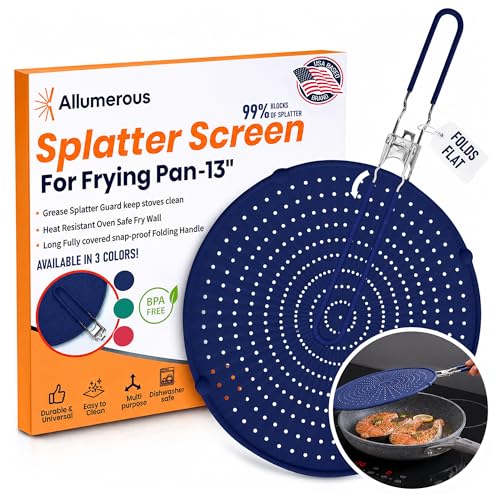
Measure the inside or top diameter of the cookware you use most often. A screen that is too small may leave exposed areas, while one that is too large may sit awkwardly or be difficult to lift. PLACHIDAY provides three separate diameters—9.8, 11.4, and 13 inches—making it useful when one household uses different pans. FOXEL and LORGVEXN use three-level notched rings for 9-, 10-, and 11-inch cookware. Allumerous lists a 13-inch screen for 10- to 12-inch pans and most 13-inch skillets.
Some listings describe a broader universal fit without giving exact cookware measurements. TIEWPANMI measures 13.4 by 10.8 inches and says it fits most standard frying pans, skillets, and saucepans. INYOU lists a 12.6-inch screen as suitable for 13-inch pans. Treat broad fit language as guidance rather than a guarantee for an unusually shaped pan, wok, or deep vessel.
Compare silicone and stainless-steel mesh
Silicone screens are often described as flexible, nonstick, dishwasher safe, and suitable for secondary tasks. INYOU, orhemus, Allumerous, TIEWPANMI, AirHood, and PLACHIDAY document silicone construction. These products may be appealing when easy washing, flexible handling, or trivet and strainer functions matter. Their designs differ: TIEWPANMI is explicitly non-folding, while AirHood, orhemus, and Allumerous document folding features.
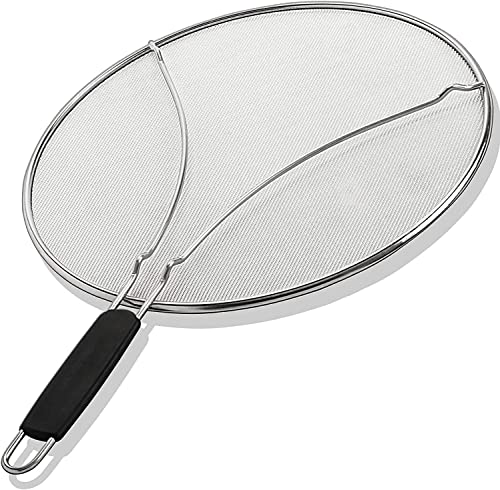
Stainless-steel mesh offers a traditional screen format. BergKoch specifies heavy-duty stainless steel and extra-fine mesh, while FOXEL and LORGVEXN specify micro-mesh or tight-knit mesh. Mesh can be a sensible choice when fine openings and steam release are central priorities. The supplied evidence does not justify declaring one material universally better; selection should follow the pan fit, handling, and care details that matter to you.
Read the heat guidance carefully
A numeric heat limit is more useful than a general “heat-resistant” phrase because it gives a stated reference point. HexClad lists silicone safe up to 480°F. INYOU lists 572°F, and AirHood lists 446°F. Allumerous and orhemus provide a range ending at 230°C, approximately 446°F. Those figures are product-specific and should not be generalized to every screen.
Safety directions also matter. HexClad says to use its screen only on the stovetop and to lock the handle. Allumerous and orhemus say not to place their screens directly on a flame or heating plate. Follow the selected product’s supplied instructions rather than assuming a screen can be used in an oven, microwave, or over an open flame.
Consider coverage and steam release
The purpose of a splatter screen is to cover a pan while allowing cooking vapors to escape. BergKoch and LORGVEXN emphasize fine or tight-knit mesh. Silicone products use perforations, holes, or porous designs. AirHood specifically describes perforated holes for airflow, while INYOU and orhemus describe steam passing through their designs.
Coverage is not the same as a sealed lid. A screen may reduce grease and sauce splashes without trapping moisture in the same way as a solid cover. HexClad describes its design as blocking splatter without trapping moisture, while its listing also explains that it is not a strainer. That distinction is useful if you expect one tool to perform several kitchen tasks.
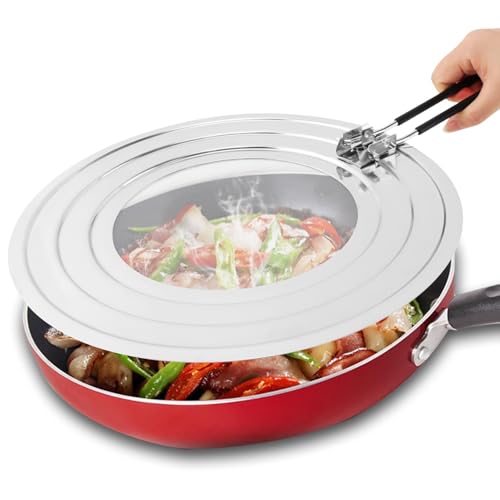
A folding handle can help a screen fit into a shallow drawer. HexClad documents a locking hinge, FOXEL documents a folding silicone handle, and LORGVEXN says its handle folds completely flat. AirHood also uses a folding design with a secure handle lock. These features may make storage easier, but moving parts should be handled according to the listing’s instructions.
Fixed or side-handle designs can be preferable when you want a simple lifting method. BergKoch describes a screen that joins to cookware handles, while Allumerous documents a long ridged silicone-covered handle. TIEWPANMI’s one-piece format avoids a folding mechanism but may take more cabinet or drawer space.
Look for useful secondary functions
Several selected screens independently document extra uses. INYOU can serve as a cooling pad, drain plate, or filter. orhemus describes straining, steaming, and cooling-rack uses. TIEWPANMI lists a strainer, drain board, and insulation mat. Allumerous describes use as a food strainer and colander, while AirHood functions as a trivet.
These additions can increase utility, but they should not be assumed for every model. HexClad specifically says its screen is not a strainer, so it is better suited to splatter control and storage convenience than to draining food. Choose secondary functions only when they are documented for the particular product.
Make cleanup part of the decision
Dishwasher-safe care is documented for all selected products, although the supplied listings do not specify dishwasher-rack placement or long-term results for every model. Smooth silicone surfaces are described as easy to clean by INYOU, Allumerous, TIEWPANMI, and orhemus. Stainless-steel mesh models such as BergKoch, FOXEL, and LORGVEXN also list dishwasher-safe cleaning.
A folding design can save storage space but may create hinges or creases that need attention. Conversely, TIEWPANMI’s non-folding construction is described as easier to clean without creases. Consider both the cooking surface and the storage mechanism when deciding what “easy care” means for your kitchen.
Final Recommendation
HexClad Folding Grease Splatter Screen ranks first overall in this specification-based comparison under the published weighted criteria.
HexClad Folding Grease Splatter Screen is the highest-scoring returned product and the first overall specification-based choice.
HexClad Folding Grease Splatter Screen is the first overall specification-based choice among these best heat-resistant splatter screens. Its 480°F stated heat limit, 12.5-inch coverage, locking folding handle, stainless-steel frame, and dishwasher-safe care create a well-documented profile, although it is not a strainer and is specified for stovetop use.
FOXEL is a suitable alternative for households with 9-, 10-, and 11-inch pans because its three-level notched fit is clearly documented. BergKoch is a good match for shoppers who prefer a traditional 13-inch fine-mesh stainless-steel format. AirHood stands out when a trivet is as important as splatter control, while INYOU has the highest stated temperature limit and several secondary functions.
For a varied cookware collection, PLACHIDAY’s three sizes provide broad documented diameter coverage. orhemus and Allumerous offer useful temperature guidance with folding silicone designs, while TIEWPANMI favors a sturdy non-folding format. LORGVEXN rounds out the top heat-resistant splatter screens with tight-knit mesh, notched fit, and flat-folding storage. Confirm the selected model’s diameter and heat instructions before use.
Frequently Asked Questions
How do I choose among the best heat-resistant splatter screens?
Start with the pan diameter, then compare the documented material, temperature limit, screen coverage, handle design, and cleaning instructions. A three-size set such as PLACHIDAY may suit several pans, while a single screen with a specific range may be simpler for one primary skillet.
Are silicone splatter screens safe over high heat?
Only within the product’s stated guidance. INYOU lists a 572°F limit, HexClad lists 480°F, AirHood lists 446°F, and Allumerous and orhemus list ranges ending at 230°C. Do not place a screen directly on a flame or heating element when the listing prohibits it.
Does a splatter screen replace a pan lid?
Not necessarily. A screen is intended to reduce splashes while permitting steam to escape. It may not seal a pan or retain moisture like a solid lid. HexClad describes its screen as not trapping moisture and not functioning as a strainer, so check the intended use before substituting it for another cover.
Is stainless steel or silicone easier to clean?
The supplied listings describe dishwasher-safe care for both materials, but cleaning experience can depend on the exact mesh, rim, folds, and surface. Smooth silicone models document easy washing, while BergKoch, FOXEL, and LORGVEXN list dishwasher-safe stainless-steel mesh designs. A non-folding screen may avoid creases, whereas a folding model may store more compactly.
Can I use these screens as strainers or trivets?
Only when that function is documented. INYOU, orhemus, TIEWPANMI, and Allumerous list straining-related uses, while AirHood documents trivet use. HexClad specifically says its screen is not a strainer, so do not assume every splatter guard supports draining or resting hot cookware.
Methodology
This is a specification-based comparison, not a hands-on product test. Editorial scores use a published weighted formula: documented heat resistance (25.0%), splatter coverage design (25.0%), cookware fit flexibility (20.0%), handling and storage (15.0%), and cleaning and kitchen versatility (15.0%). A limited non-published marketplace adjustment is applied internally after the editorial formula; its underlying values are not reproduced. The combined result determines rank, while the displayed ranking is based on the selected products’ weighted specification results. Potential limitations are editorial inferences based on documented category-relevant attributes; they are not observations from hands-on testing.