Buying Guide
The best heat-resistant whisks are usually silicone-coated rather than bare metal when they will be used in nonstick cookware. A silicone exterior is intended to reduce scratching, while a steel core can provide internal support. The listings in this comparison use several combinations of those materials, so the useful question is not simply whether a whisk is labeled silicone. Check the stated coating, wire thickness, handle material, and whether the handle connection is sealed.
Start with the heat rating
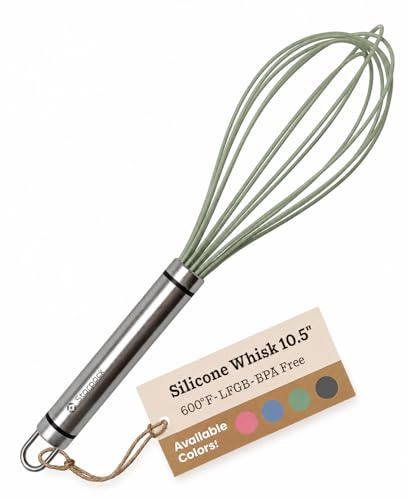
Temperature claims are manufacturer-provided specifications, not independent test results. The selected products range from a stated 392°F for the GreenPan Silicone Whisk to 600°F for the StarPack Home Whip It Good Silicone Whisk. Several models list limits between 446°F and 500°F. A higher number may be useful for hot stovetop work, but it does not mean every part of the utensil has the same limit.
The Zyliss Silicone Large Balloon Whisk illustrates this distinction: its silicone head is listed to 464°F, while its wheatstraw handle is listed to 180°F. That makes the care information important. Similarly, follow any stated precautions, such as avoiding open flames. Do not assume the highest advertised number describes the handle, connection, or storage conditions.
Match the shape to the task
Balloon whisks are the dominant design in this selection. Their open wire layout is presented for whipping eggs, cream, batters, and sauces. A large model such as the 12-inch Zyliss can suit bigger bowls, while an 8- or 9-inch whisk may be easier to control in a smaller container.
Flat whisks serve a different purpose. The Walfos four-piece set includes an 11-inch flat whisk, and the Webake Silicone Flat Whisk Set uses a fan-shaped design. Their listings specifically describe flat wires as useful for sauces, gravies, and reaching pan corners, bottoms, and sides. Choose this format when pan coverage matters more than maximum balloon volume. A multi-piece set may be practical if you regularly switch between baking bowls and stovetop pans.
Inspect the wire and handle construction
Wire thickness is one of the more useful technical details supplied in these listings. TEEVEA and Walfos list 1.65 mm stainless steel wires, OYV lists 1.75 mm or 1.8 mm wires depending on the model, and Eddeas lists 1.4 mm wire. These figures describe the underlying wire specification; they do not prove how a product will feel or perform in use.
Handle design also varies. The OYV 10-Inch Pink Silicone Whisk specifies a 304 stainless steel handle, while several Walfos and TEEVEA models use plastic handles with non-slip or ergonomic descriptions. The StarPack Home model is described as one piece with a heavy-gauge stainless steel interior. If you prefer a metal handle, OYV offers the clearest specification in this group. If grip comfort and a lighter feel are priorities, compare the listed handle shape and material rather than assuming one design is universally better.
Consider cleanup and storage
Silicone surfaces are commonly described as easy to rinse, and many selected products are listed as dishwasher safe. Sealed connections are especially relevant because they are intended to reduce spaces where water or food can enter. Both OYV models document a sealed or seamless connection, while the StarPack Home and GreenPan products also list dishwasher-safe cleaning.
Storage details are more limited. The Walfos sets document hanging hooks, and Webake lists a hooking design. A three- or four-piece set can add useful coverage but also requires more drawer or wall space. A single 10- or 11-inch whisk is simpler if your kitchen already has other tools and you want one dedicated pan-safe utensil.
Decide between a single whisk and a set
A single whisk is suitable when you know the size and shape you use most. The GreenPan, StarPack Home, OYV, TEEVEA, and Zyliss models are single-tool choices with different handle, size, and heat specifications. Sets are more flexible: Walfos provides three balloon sizes in one option and three balloon sizes plus a flat whisk in another, while Webake focuses on three flat whisks.
For a mixed cooking routine, prioritize documented size coverage and shape variety. For a compact kitchen, compare the storage trade-off before choosing a set. Generic affordability language can help frame the decision, but the supplied evidence does not support a cost-per-use calculation or a claim about long-term value.
Final recommendation
StarPack Home Whip It Good Silicone Whisk ranks first overall in this specification-based comparison under the published weighted criteria.
The final choice among the best heat-resistant whisks depends on the documented features that match your intended use.
StarPack Home Whip It Good Silicone Whisk is the highest-scoring returned product and the first overall specification-based choice. Its listed 600°F heat limit, heavy-gauge stainless steel interior, silicone exterior, one-piece design, and dishwasher-safe care give it the most specification-aligned combined specification profile in this comparison.
The top heat-resistant whisks are not identical, however. Choose the OYV 10-Inch Pink Silicone Whisk if a stainless steel handle and sealed connection matter most. Choose the Walfos four-piece set or Webake set when different whisk shapes are more useful than a single-tool format. TEEVEA is a balanced balloon whisk for general baking, while Zyliss provides a large format with a separately stated head and handle temperature limit. GreenPan is the simplest everyday option when its 392°F specification is sufficient.
Because this guide uses public listing data, the rankings should be read as editorial comparisons of documented specifications. They are not hands-on performance results, durability tests, or summaries of customer experiences. Recheck the manufacturer-provided instructions and current listing details before purchase, especially if you plan to leave a utensil in a hot pan.
Frequently Asked Questions
What makes the best heat-resistant whisks different from ordinary whisks?
The selected models document heat-resistant silicone, often around a stainless steel wire core, and several are specifically described as non-scratch for nonstick cookware. The useful difference is the combination of a stated temperature limit, cookware protection, construction, and care instructions. A heat label alone does not establish independent performance, so compare the full specification set.
Can these whisks be used directly in nonstick pans?
The silicone-coated models in this comparison are listed as non-scratch or suitable for nonstick cookware. That includes the StarPack Home, OYV, TEEVEA, Walfos, Zyliss, Webake, Eddeas, and GreenPan products. Use them according to their individual instructions, and avoid treating a silicone coating as protection against sharp tools, open flames, or misuse.
Is a balloon whisk or flat whisk better for sauces?
Either can be suitable, depending on the pan and sauce. The Webake and Walfos flat designs are specifically described for reaching corners, bottoms, and sides of pans. Balloon whisks such as TEEVEA and Zyliss are described for broader mixing jobs including sauces, eggs, cream, and batters. Select flat wires for pan coverage and a balloon shape when you also want general-purpose aeration.
Does a higher heat rating always mean a better whisk?
No. The rating is only one criterion. Wire construction, cookware protection, handle material, sealing, cleaning, and size also affect the specification-based ranking. The Zyliss listing demonstrates why users should check whether a temperature limit applies to the silicone head or the handle. The highest number should not replace careful reading of the complete care guidance.
Should I buy a single whisk or a multi-piece set?
Buy a single whisk when one size and shape meets your needs or storage space is limited. A set can be more useful for households that alternate between small bowls, large batches, sauces, and flat-pan stirring. Walfos offers both three-piece balloon coverage and a four-piece combination with a flat whisk, while Webake supplies three flat whisks. Consider the documented tasks and storage requirements before choosing.