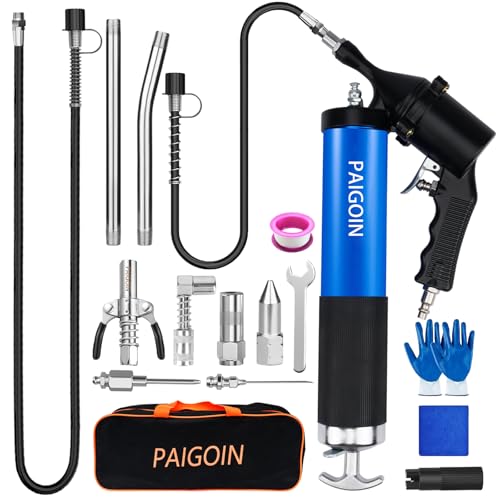
Buying Guide
Choosing among the best high-pressure grease guns starts with the type of power source and the fittings you need to service. The selected products span cordless electric, pneumatic, pistol-grip manual, and lever-action designs. Their pressure specifications range from 6,000 PSI working pressure on the FIXSMITH and 6,000 PSI on the Lincoln to 12,000 PSI on the DIYtoolifz. Those figures are supplied specifications, not independent measurements, so they should be matched with the requirements of the grease points and equipment being maintained.
Match the power source to the work
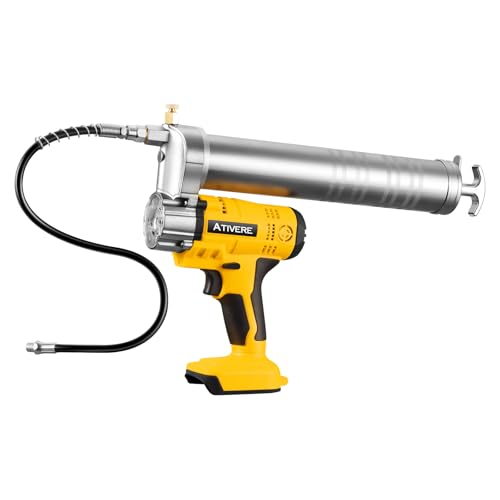
Cordless models are useful when equipment is spread across a yard, vehicle, farm, or worksite. The DEWALT DCGG571B, Milwaukee 2646-20, DIYtoolifz, and ATIVERE models all use battery power, but their battery situations differ. The DEWALT is a 20V MAX tool-only model, the Milwaukee is an M18 bare tool, and both the DIYtoolifz and ATIVERE models are supplied without batteries or chargers. The DIYtoolifz and ATIVERE products are described as compatible with DeWalt 20V batteries, while the DEWALT itself belongs to the DEWALT 20V MAX platform.
Pneumatic operation suits a fixed shop or maintenance area that already has compressed air. The Lincoln 1162 is specifically described for continuous operation and includes a variable-speed trigger. That makes it a different proposition from a battery gun: the practical question is not just maximum pressure, but whether the surrounding setup supports sustained air-powered work.
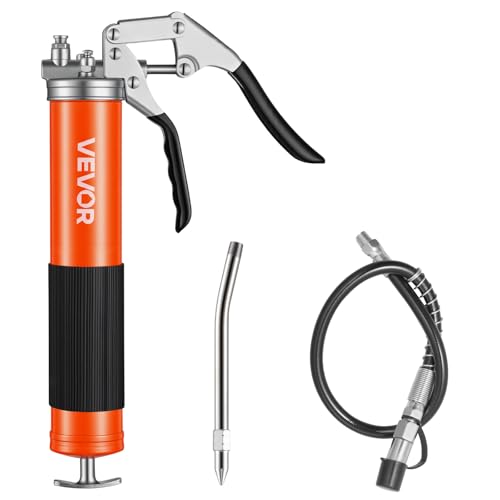
Manual guns remain useful when portability and simple operation matter. The Alemite 555-E, Milton S-3101, LockNLube LNL153, FIXSMITH AKL-460, and VEVOR MM0101 do not require a battery or compressor. They can be appropriate for occasional lubrication, roadside maintenance, or locations where powered equipment is inconvenient. Manual pumping does require operator input, and the supplied information does not establish how much force any model requires in actual use.
Treat pressure specifications as one part of the decision
A high PSI number does not by itself determine whether a grease gun is suitable. The DEWALT and Milwaukee list 10,000 PSI, the Alemite lists 7,500 PSI, the Milton lists 7,000 PSI, and the VEVOR lists 8,000 PSI. The FIXSMITH distinguishes between 6,000 PSI working pressure and 10,000 PSI burst pressure, which should not be interpreted as a 10,000 PSI working specification. The Lincoln is listed at 6,000 PSI, while the DIYtoolifz documents 12,000 PSI.
Look for a clear working or maximum operating figure and compare it with the equipment manufacturer’s lubrication requirements. Also consider output control. The DIYtoolifz lists three flow settings, the DEWALT uses a variable-speed trigger, the Lincoln has a variable-speed trigger, and the Alemite changes between volume and pressure modes through its dual-leverage feature. These controls can be more relevant to a particular fitting than selecting a gun solely by the largest pressure number.
Measure the access problem before choosing a hose
Hose length is one of the most useful differentiators in this category. The Milwaukee provides a documented 48-inch hose, the DEWALT 42 inches, and the DIYtoolifz 39.4 inches. The Lincoln reaches 30 inches, while the LockNLube provides 20 inches. The Alemite, Milton, and VEVOR models each list an 18-inch hose. ATIVERE includes a 12-inch flex hose plus a 6-inch rigid tube, and the FIXSMITH combines a 12-inch reinforced flex hose with a 7-inch rigid extension.
Longer is not always better. A long flexible hose can reach fittings without moving the tool body into a cramped area, but a shorter hose may be easier to manage around a workbench. Rigid extensions can help with direct alignment, while flexible hoses are better suited to offset or concealed fittings. The FIXSMITH, ATIVERE, and VEVOR provide combinations of delivery pieces; the DEWALT, Milwaukee, and DIYtoolifz emphasize longer flexible hoses.
Check the loading and priming system
Grease loading can affect how smoothly a maintenance routine proceeds. The Milton accepts standard 14-ounce cartridges, bulk grease, or a dispenser pump. The FIXSMITH supports a standard 14-ounce cartridge and bulk suction fill. The DIYtoolifz and ATIVERE also document cartridge and bulk loading. These options help users match the tool to the grease supply already used in the shop.
Priming features deserve separate attention. The DEWALT and Milwaukee include air-bleeder valves, the Lincoln combines a filler coupler with an air bleeder, and the Alemite lists quick priming, a follower spring, and a bleeder valve. The supplied information for the DIYtoolifz mentions quick purging, while the ATIVERE describes automatic exhaust. The LockNLube and VEVOR information does not provide the same level of priming detail, so their scores reflect that evidence gap rather than an assumption about how they operate.
Compare couplers, flow control, and handling details
The coupler is the part that connects the gun to the fitting, so its documented design can matter in awkward positions. LockNLube centers its LNL153 around a locking coupler and adds an inline swivel. The DIYtoolifz includes four couplers, including 90-degree, lock-on, pointed-tip, and standard types. The VEVOR includes a coupler, rigid pipe, and sharp-type nozzle. Other selected models list universal or durable couplers, but the supplied information does not establish that every included coupler will suit every fitting.
Control features also vary. The DEWALT has a variable-speed trigger and integrated foot. The Milwaukee lists lock-on and lock-off trigger functions plus a preset grease counter dial. The Milton uses an adjustable-stroke handle, and the FIXSMITH has non-slip knurling and a T-handle. The Lincoln’s variable-speed trigger supports continuous pneumatic operation. These features should be considered alongside the grip and position needed to keep the coupler aligned.
Use the ranking as a specification guide
This comparison weights pressure capability, power and operating mode, reach, loading and priming flexibility, and control or ergonomics. It does not represent hands-on testing. The ranking favors products whose supplied information documents several useful features clearly, while conflicting or missing specifications lower confidence in a category score. For example, the LockNLube information references two different pressure figures, so its pressure score is conservative. The VEVOR information is detailed about included delivery parts but provides less information about priming and handle controls.
Before selecting one of the top high-pressure grease guns, confirm the required grease type, fitting style, battery platform or air connection, hose length, and operating-pressure requirement. Follow the product instructions and use appropriate protection around high-pressure grease equipment. The ATIVERE information specifically warns that improper use may cause injection injury or hose rupture, a reminder that a pressure specification also calls for careful handling.
Final recommendation
Among the top high-pressure grease guns, the ranked products differ under documented pressure capability, power and operating mode, reach and access, loading and priming flexibility, and control and ergonomics.
DIYtoolifz 12,000 PSI Cordless Grease Gun ranks first overall in this specification-based comparison under the published weighted criteria.
DIYtoolifz 12,000 PSI Cordless Grease Gun is the first overall specification-based choice among the best high-pressure grease guns.
It combines the highest documented pressure in this comparison with three flow settings, a brushless motor, cartridge-or-bulk loading, a 39.4-inch hose, four couplers, an LED, and a kickstand. Its main limitation is the need for a compatible DeWalt 20V battery and the absence of a battery and charger in the package.
The DEWALT DCGG571B is a close alternative for users who want a 42-inch hose, 10,000 PSI output, variable triggering, an LED, high-flow delivery, and an air-bleeder valve. The Milwaukee 2646-20 is a strong fit for M18 users who want a 48-inch hose, two-speed operation, and a grease counter dial. For a compressor-equipped shop, the Lincoln 1162 stands out for continuous pneumatic operation and controlled flow.
Manual users have several distinct paths. The Alemite 555-E is the most flexible for switching between pressure and volume modes, the Milton S-3101 offers three filling methods, the LockNLube LNL153 emphasizes its locking coupler, and the FIXSMITH AKL-460 combines cartridge and bulk loading with rigid and flexible delivery. The VEVOR MM0101 is notable for its 8,000 PSI specification and included access pieces, while the ATIVERE provides a compact cordless alternative with cartridge-or-bulk filling.
The best high-pressure grease guns are not interchangeable in every setting. Battery platform, air supply, hose length, and loading method can change which specification matters most. The questions below address the main distinctions without relying on unverified performance claims.
Frequently Asked Questions
Among the best high-pressure grease guns, what pressure specification should a high-pressure grease gun have?
There is no single specification that fits every machine. The selected products list working or maximum figures from 6,000 PSI to 12,000 PSI, but the correct choice depends on the equipment and fitting requirements. Treat burst pressure separately from working pressure: the FIXSMITH lists 6,000 PSI working pressure and 10,000 PSI burst pressure. Check the equipment documentation and the grease gun instructions before use.
Are cordless or pneumatic grease guns better for regular maintenance?
The answer depends on the work environment. Cordless models such as the DEWALT DCGG571B, Milwaukee 2646-20, DIYtoolifz, and ATIVERE can be carried to equipment, but the selected products are supplied without batteries or chargers. The Lincoln 1162 is pneumatic and documents continuous operation, making it a logical match for a shop with a suitable air supply. Neither format is universally preferable based on the supplied specifications alone.
How much hose length do I need?
Measure the distance from where the tool can be positioned to the fitting, then allow enough flexibility to align the coupler. The selected range includes 12-inch, 18-inch, 20-inch, 30-inch, 39.4-inch, 42-inch, and 48-inch hoses. Longer hoses on the Milwaukee, DEWALT, and DIYtoolifz can help with remote fittings, while shorter hoses and rigid extensions may be easier to control in a compact workspace.
Can these grease guns use bulk grease instead of cartridges?
The supplied information explicitly documents bulk compatibility for the DIYtoolifz, ATIVERE, Milton S-3101, FIXSMITH AKL-460, and Alemite 555-E through their stated loading or filling features. The LockNLube, Milwaukee, Lincoln, and VEVOR information does not provide equivalent detail about bulk loading. Confirm the loading instructions and grease-container compatibility before switching from cartridges.
What features help with hard-to-reach fittings?
A long flexible hose, rigid extension, swivel, angled coupler, or work light can help. The DEWALT lists a 42-inch hose and LED, the Milwaukee lists a 48-inch hose, and the DIYtoolifz includes a 39.4-inch hose with four coupler types. The ATIVERE and FIXSMITH combine flexible hoses with rigid tubes, while LockNLube adds an inline swivel. These features improve access options, but correct coupler alignment and safe handling remain necessary.