Buying Guide
Choosing among the best i-beam levels starts with the work surface, not the brand name. An I-beam frame is a useful format for general construction because it provides a broad, rigid body while keeping the tool relatively straightforward to position. The supplied listings include aluminum frames, a wood I-beam, several V-groove bases, and both magnetic and nonmagnetic designs. Those differences affect where each level is most practical.
Match the length to the surface
A 24-inch level is the most versatile size in this selection. The DEWALT DWHT42151, CHANNELLOCK 24-Inch Magnetic I-Beam Level, Johnson Level & Tool 1253-2400, Mayes 10112, Kapro 140, and Kapro 170 are compact enough for general layout, drywall, trim, and smaller work areas. A shorter level is easier to carry and position, but it covers less of a surface in one placement.
The IRWIN Tools 1000 extends that coverage to 36 inches. That length can be useful when a 24-inch tool feels too short, while remaining easier to handle than a 48-inch model. The CHANNELLOCK 48-Inch and Kapro 176 MaxPro Magnetic 48-Inch are better suited to long walls, broad framing, cabinetry, and other surfaces where a longer reference reduces repositioning. The 72-inch CHANNELLOCK is the specialist option for very long surfaces. Its reach is useful, but storage, transport, and handling space become more important.
Check the stated accuracy carefully
Accuracy claims are not presented in one uniform format across the listings. The CHANNELLOCK 24-Inch, CHANNELLOCK 48-Inch, and CHANNELLOCK 72-Inch models state a 0.0005 in./in. tolerance in all ten working positions. The DEWALT DWHT42151 also lists 0.0005 inch per inch, while the Mayes 10112 states 0.001 inch accuracy and the Kapro 140 lists accuracy below 0.001 inch per inch. The Kapro 176 gives a 1mm/m figure for its dual-view plumb site, and the IRWIN listing provides a lifetime accuracy guarantee without a numerical tolerance.
These figures should be read as listing specifications rather than independent verification. For a specification-based comparison, a clearly stated tolerance is useful, but it does not replace checking the tool before critical work. Buyers should also avoid treating different units or wording as directly interchangeable without doing the conversion themselves.
Consider vial layout and reading position
The number and arrangement of vials can make a difference when a task involves more than ordinary horizontal and vertical checks. The Kapro 140 documents horizontal, vertical, and 45-degree vials, while the Kapro 176 adds those three orientations with a dual-view plumb site. The Kapro 170 focuses on horizontal and plumb readings, with its plumb vial viewable from the front and side.
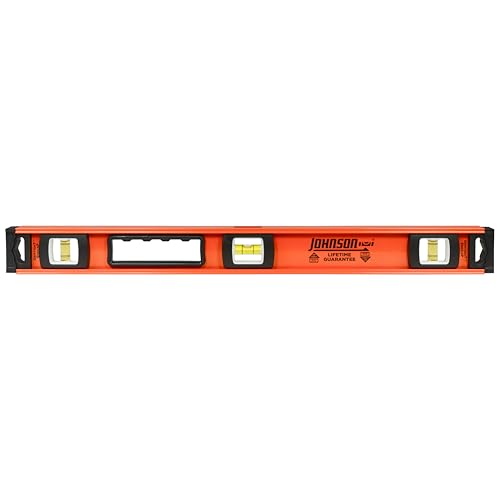
Top-view windows help when the level is placed where a side view is awkward. The CHANNELLOCK models, Johnson Level & Tool 1253-2400, Mayes 10112, DEWALT DWHT42151, Kapro 140, and Swanson are documented with top-view or top-read features, although Swanson is not among the selected products. The Johnson model emphasizes oversized vials and SurroundView vial construction, making it a sensible choice when reading visibility is a priority. The CHANNELLOCK models use high-contrast vial surrounds, and the DEWALT uses solid block vials.
Decide whether magnetic holding is useful
A magnetic base can hold a level against compatible metal surfaces, leaving a user’s hands available for positioning or marking. The CHANNELLOCK 24-Inch Magnetic I-Beam Level has a magnetic strip, and the Kapro 176 uses a magnetic V-groove base. These designs are particularly relevant to metal framing, pipe, and conduit work. Magnetic capability is not automatically better for every task; it may add weight and offers no advantage on nonmetallic surfaces. A nonmagnetic level can be the simpler choice for general wood, drywall, and finish work.
The V-groove deserves separate attention. The DEWALT DWHT42151, Mayes 10112, IRWIN Tools 1000, and Kapro 176 document designs for rounded surfaces, pipe, or conduit. A groove can help the level sit against cylindrical stock instead of resting only on a narrow edge. The exact usefulness depends on the shape and diameter of the workpiece, so the feature should be viewed as an application aid rather than a guarantee of better results.
Look at frame and end-cap protection
Most selected levels use aluminum I-beam construction, which is documented as heavy duty, rigid, or durable depending on the listing. Protective end caps are common: the DEWALT, CHANNELLOCK, Johnson, Mayes, Kapro, and other selected models specify shock-absorbing or impact-resistant protection. Those caps may help protect the frame and the nearby work surface from ordinary bumps, but the supplied data does not establish performance under a particular drop or impact.
The Sands Level & Tool SLMA48 was not selected because the final comparison prioritizes the broader feature evidence of the ten chosen products, but its wood frame illustrates that I-beam construction is not limited to aluminum. For the selected products, aluminum is the dominant documented frame material. Buyers who work in demanding environments should also consider whether the level has handles, hang holes, removable caps, or a design that is easy to clean and store.
Use the application clues in each listing
For general 24-inch work, the DEWALT, CHANNELLOCK magnetic model, Johnson, Mayes, Kapro 140, and Kapro 170 cover different priorities. Choose DEWALT for the stated tolerance and V-groove, CHANNELLOCK for magnetic holding and top viewing, Johnson for oversized readable vials, Mayes for pipe-oriented use and storage features, Kapro 140 for a three-angle layout, and Kapro 170 for dual-view plumb reading.
For longer work, the IRWIN 36-inch model offers a rotating dial vial, the CHANNELLOCK 48-inch emphasizes a consistent tolerance and viewing package, the Kapro 176 adds magnetic multi-angle functionality, and the CHANNELLOCK 72-inch provides the longest reach in this comparison. These are documented design distinctions; they are not hands-on performance conclusions.
Final recommendation
CHANNELLOCK 24-Inch Magnetic I-Beam Level ranks first overall in this specification-based comparison under the published weighted criteria.
CHANNELLOCK 24-Inch Magnetic I-Beam Level is the highest-scoring returned product and the first overall specification-based choice. It combines the stated 0.0005 in./in. tolerance, magnetic strip, three high-contrast vial surrounds, top-view window, ergonomic grips, and impact-resistant end caps in a manageable 24-inch format.
The best i-beam levels for longer surfaces are the CHANNELLOCK 48-Inch and 72-Inch models, while the Kapro 176 is the more feature-rich magnetic option for pipe, conduit, and multi-angle work. For a nonmagnetic 24-inch tool, the DEWALT DWHT42151, Johnson 1253-2400, and Mayes 10112 each have a distinct documented reason to consider them. The top i-beam levels are therefore not one-size-fits-all: length, magnetic need, vial arrangement, and the stated accuracy format should drive the final choice.
Frequently Asked Questions
What size should I choose among the best i-beam levels?
A 24-inch model is a practical starting point for general construction, drywall, trim, and household work. It is compact enough for many indoor spaces while still providing a useful reference length. Move to 36 inches for somewhat broader surfaces, 48 inches for long walls and framing, or 72 inches when extended coverage is the main requirement. Longer levels can reduce repositioning, but they also require more room to carry, use, and store.
Are magnetic i-beam levels better?
They are better suited to tasks where the level needs to hold against a compatible metal surface. The CHANNELLOCK 24-Inch Magnetic I-Beam Level and Kapro 176 document magnetic features, with the latter also specifying a magnetic V-groove. On wood, drywall, or other nonmetallic surfaces, magnetic holding does not provide the same benefit. A magnetic model may also be heavier, so the choice depends on the work rather than the feature alone.
Why are top-view windows useful?
A top-view window lets the user read a vial when the side of the level is blocked or the tool is positioned in a tight location. The CHANNELLOCK models, Johnson 1253-2400, Mayes 10112, and Kapro 140 document top-view or top-read features. This is a visibility aid, not an independent accuracy improvement. It is most useful when the normal viewing angle is inconvenient.
What is a V-groove used for?
A V-groove is shaped to seat against rounded material such as pipe, conduit, PVC, or curved trim. The DEWALT DWHT42151, Mayes 10112, IRWIN Tools 1000, and Kapro 176 listings document this type of use. It can provide a more suitable contact surface than a flat edge on cylindrical stock. The listing evidence does not specify a universal pipe diameter range, so users should check the fit for their particular application.
How should I interpret the accuracy specifications?
The listings use different forms of accuracy language, including 0.0005 in./in., 0.001 inch, below 0.001 inch per inch, and 1mm/m. These should not be treated as identical without unit conversion and context. A stated tolerance is useful for comparing published specifications, but this guide did not independently test any level. For critical work, follow the manufacturer’s use and verification guidance and inspect the level before relying on it.