Buying Guide
Choosing the best incandescent floor lamps starts with the socket and bulb limit, then moves to control style, light direction, footprint, and construction. The listings in this comparison describe several useful formats: torchiere lamps for upward ambient light, shaded poles for general room illumination, multi-head fixtures for selectable coverage, and arc designs for lighting over furniture.
Check the bulb specification first
Incandescent compatibility is not identical across every lamp. Some listings directly specify incandescent wattage, such as the Adesso three-light lamp’s three 60W bulbs, the Adesso five-shade model’s five 25W bulbs, and the LIGHTACCENTS torchiere’s 150W three-way bulb. Other fixtures identify an E26 socket and a maximum wattage. An E26 socket is useful because it is a common medium-base format, but the lamp’s stated wattage limit still matters.
The HonoDing Medusa uses five E26 heads rated for bulbs up to 40W incandescent each. The GOEBLESON lamp lists a 60W maximum, while O’Bright Ted supports up to 100 watts. Always match the bulb to the fixture’s documented limit. Bulbs are not included with most of these products, so the intended incandescent bulb generally needs to be purchased separately.
Match the light pattern to the room
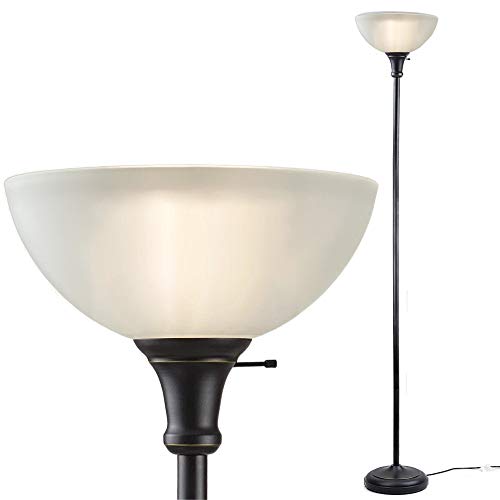
A torchiere sends light upward and is suited to broad ambient illumination. The Globe Electric 72-inch model adds a separate pivoting reading arm, making it more useful when one fixture needs to serve both a room and a chair. LIGHTACCENTS and the HonoDing glass-bowl lamp use frosted glass shades for a more traditional upward-lighting approach, but neither documents a movable reading arm.
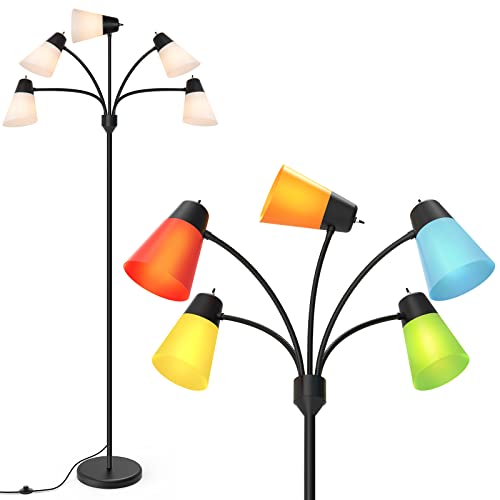
A multi-head lamp spreads light across several directions. The Adesso five-shade lamp uses movable gooseneck arms, while the HonoDing Medusa provides flexible heads and grouped switching. These are useful for desks, art areas, reading chairs, or rooms where one fixed beam is not enough. Their trade-off is a larger visual presence and, in most cases, the need for several bulbs.
Shaded single-lamp designs are easier to place. O’Bright Ted has a 12-inch drum shade and a 12-inch base, while GOEBLESON uses a narrow 7.9-by-7.9-inch base. The LEPOWER tripod is more decorative and stable-looking, but its 19-inch width requires more open space.
Choose the right control
Switch design affects everyday usability. A foot switch is convenient beside a sofa or bed because it avoids reaching toward the socket. GOEBLESON, LEPOWER, and the Gold Arc lamp document foot-operated switching. O’Bright Ted uses a pull chain, which keeps the control close to the shade and suits a straightforward bedroom or office setup.
Multi-level switching is more useful when you want different amounts of light without replacing the bulb. The Adesso three-light model selects one, two, or all three bulbs. The Adesso five-shade lamp selects two, three, or all five. The Globe Electric torchiere and reading light use separate switches, while the two traditional bowl lamps specify three-way incandescent bulb compatibility.
A standard rotary or on/off switch is simpler and may be preferable when you want fewer controls. The HonoDing adjustable-head lamp and several single-shade designs use this type of operation. A lamp itself may not be dimmable, even if a compatible smart bulb or smart outlet can add control; do not assume that feature unless the listing states it.
Consider adjustment and reach
Adjustability is particularly important for reading. The Gold Arc lamp’s shade can rotate horizontally and vertically, allowing it to reach over a sofa or chair. The Globe Electric reading arm pivots separately from the torchiere. The Adesso and HonoDing multi-head lamps provide still more directional control through gooseneck shades or adjustable heads.
By contrast, the Adesso three-light, LIGHTACCENTS, HonoDing glass-bowl, O’Bright Ted, and GOEBLESON models are primarily fixed-shade fixtures. They can still work well for general illumination, but they are less suitable when the light must be aimed at a particular page or work surface.
The best incandescent floor lamps are often tall, but height alone does not determine suitability. Models around 71 to 72 inches can provide a strong vertical presence, while a 55- to 64.6-inch lamp may blend more easily beside furniture. Measure both the available floor area and the shade’s reach. The Gold Arc lamp occupies a listed 23-by-23-inch area, whereas GOEBLESON is much narrower.
Also consider the shade width and the route for the power cord. Cord length and switch position can matter as much as the lamp’s appearance when outlets are limited.
Review construction details
Construction information varies by listing. Metal poles and weighted bases appear across several selections. The LIGHTACCENTS and HonoDing bowl models specify solid-metal construction, the Gold Arc model identifies a weighted base, and LEPOWER documents a rubber-wood tripod. O’Bright Ted lists a weighted base, while GOEBLESON identifies a metal post and base and an ETL listing.
Glass shades can provide a traditional appearance but may require more care during setup and relocation. Linen, paper, plastic, and acrylic shades offer different visual effects and handling considerations. The Adesso three-light model uses a crinkle paper shade; the Gold Arc and GOEBLESON models use textile shades; the Medusa uses frosted acrylic. These are specification distinctions, not hands-on durability findings.
Final Recommendation
Globe Electric 72-Inch Torchiere with Reading Light ranks first overall in this specification-based comparison under the published weighted criteria.
The final choice among the best incandescent floor lamps depends on the documented features that match your intended use.
Adesso 5-Light Floor Lamp with Movable Shades is the highest-scoring returned product and the first overall specification-based choice. Its five adjustable shades, selectable bulb groups, and explicit incandescent support make it the most versatile of these top incandescent floor lamps for users who need several lighting directions.
Choose the Adesso 3-Light Floor Lamp for a compact, warm layered-light format, or the Globe Electric Torchiere when a room needs both uplight and a reading arm. LIGHTACCENTS and HonoDing’s glass-bowl model are better suited to classic torchiere styling. For directional reach over a sofa, the Gold Arc lamp is the more specialized choice. The HonoDing Medusa and Adesso five-shade lamp offer the most head-level flexibility, while O’Bright Ted and GOEBLESON keep the design simpler. LEPOWER is the décor-led tripod option with clear incandescent guidance.
Frequently Asked Questions
What should I look for in the best incandescent floor lamps?
Look for a documented incandescent wattage limit, the correct E26 or other socket type, a suitable switch, and dimensions that fit the intended location. Also check whether the lamp uses one bulb or several and whether the shade can direct light.
Are all E26 floor lamps compatible with incandescent bulbs?
Not necessarily. E26 describes the medium-base socket, but the listing should identify supported bulb types and wattage. In this comparison, several products explicitly mention incandescent bulbs, while others document a compatible E26 base and maximum wattage. Follow the manufacturer’s stated limit.
Which selected lamp is best for reading?
The Globe Electric Torchiere includes an adjustable reading arm, while the Gold Arc lamp offers broad shade movement over furniture. The Adesso five-shade and HonoDing Medusa fixtures are also useful when multiple heads need to be aimed at different areas.
Do these floor lamps include bulbs?
Most selected listings state that bulbs are not included. The comparison therefore evaluates the documented socket and bulb compatibility rather than assuming a bulb comes with the lamp. Check the individual listing before ordering.
It depends on placement. A foot switch is convenient beside seating or a bed, while a rotary switch keeps operation at the socket and may be preferable for a traditional lamp. Multi-level or separate switching is more useful when you want to change the amount or area of illumination.