Buying Guide
The best horizontal fishing rod racks should be selected by the way you store rods, not by capacity alone. A rack mounted on a garage wall has different requirements from one installed overhead, in a boathouse, or across a compact storage room. Start by measuring the usable surface, checking whether studs or joists are available, and deciding whether rods will be stored with reels attached.
Choose capacity around your real collection
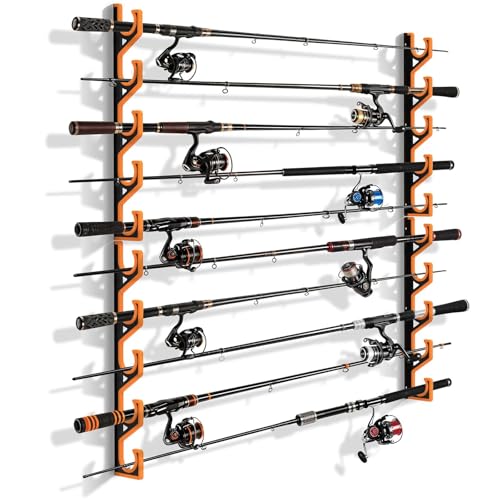
Capacity claims in this category range from six rods to 16 rods, while multi-piece systems can cover more space or hold more equipment when their stated per-piece capacities are combined. Berkley is a compact six-rod option for a smaller collection. Aventik also starts at six rods but documents a sliding-track expansion path. Ghosthorn lists capacity for up to 12 rods, and HangEase lists up to 16.
Do not assume that the highest number is automatically the best fit. A densely packed rack may be less convenient if reels, handles, or lines interfere with one another. Check whether the listing refers to rods only, complete rod-and-reel combos, or some fishing nets. PLUSINNO H5, Gocozer, Roylvan, bruwaa, and Ghosthorn all provide capacity language that includes rods or combos, but their holder layouts differ.
Compare wall, ceiling, and mixed mounting
Wall and ceiling compatibility is useful when floor space is limited. PLUSINNO H5, Ghosthorn, Gocozer, Roylvan, OJY, HangEase, and bruwaa all document wall or ceiling installation. That flexibility does not remove the need to verify the mounting surface. A ceiling installation may require different positioning than a wall installation, particularly when long rods must be lifted into place.
Look closely at the mounting-hole information. PLUSINNO H5 documents three holes per wall rack, including two positioned 16 inches apart for standard wall studs or ceiling joists. Roylvan lists five mounting holes with 16-inch spacing. Other listings mention included screws, anchors, or hardware without providing the same spacing detail. This distinction matters when planning placement before drilling.
Rod finishes can rub against hard or poorly shaped contact points, so protective materials are an important specification. Berkley uses soft foam grip pads, while bruwaa uses a PU lining. PLUSINNO H5 documents a protective pad at the contact surface.
Protection claims should be read as design features rather than proof of performance. They indicate that the manufacturer has added a softer contact layer, but they do not establish how every finish or rod diameter will behave. If your collection includes valuable rods, compare the holder opening and lining material with the rod and reel dimensions before installation.
Match materials to the storage environment
The supplied products use aluminum, steel, solid wood, polypropylene, ABS, and other plastics. Aluminum and steel may appeal to buyers looking for metal construction; PLUSINNO H5 describes aircraft-grade aluminum with an anodized surface, while HangEase lists steel. Roylvan describes rust-proof metal construction. Plastic and ABS options such as Berkley, Gocozer, and bruwaa emphasize lightweight or moisture-related properties in their listings.
Wood has a different appearance and maintenance profile. PLUSINNO H5W uses solid wood, and Ghosthorn uses solid hardwood with a waterproof and moisture-resistant coating. These designs may fit a home, cabin, or finished fishing room where a natural material is preferred. For any damp environment, read the product’s moisture or coating language carefully and consider how the mounting surface itself will handle humidity.
Decide between fixed holders and adjustable systems
Fixed holders are straightforward when your rod collection and available wall space are stable. Gocozer’s four-piece format can be distributed across multiple mounting points, while the two-piece systems from PLUSINNO, Ghosthorn, and Roylvan provide a more conventional paired layout. OJY takes a different approach with rubber-band clamp technology, which the listing positions as an alternative to EVA foam.
Aventik is the clearest choice when expansion or spacing adjustment is central to the decision. Its sliding track allows additional racks to be added, and its adjustable spacing is intended for rods of varying lengths. That versatility may be more useful than a larger fixed capacity if your collection changes over time.
Check installation details before ordering
Count the included pieces and hardware, then compare them with the mounting surface. bruwaa lists screws and expansion anchors. A rack that fits the rods but cannot be positioned securely on the intended wall or ceiling is not a practical choice.
Also check dimensions and opening sizes. PLUSINNO H5 lists a 45 mm holder diameter, Gocozer lists 44 mm, and bruwaa describes a standardized opening. Those figures can help with initial comparison, but they should not replace measuring your own rod handles and reel combinations. The rack’s stated capacity may assume alternating rod directions or a particular arrangement.
Consider access and organization
A rack is easier to live with when rods can be placed and removed without forcing adjacent equipment aside. Berkley provides a simpler foam-grip layout. Aventik adds sliding clips and detachable handle caps for more customization.
Think about how often you retrieve each rod. Frequently used combinations belong where the opening is easy to reach, while infrequently used gear can occupy higher or more crowded positions. Keep enough clearance for handles, reels, and line guides, and avoid placing a rack where a falling rod could obstruct a walkway.
Final recommendation
Among the top horizontal fishing rod racks, the ranked products differ under documented storage capacity, rod protection, mounting flexibility, material durability, and access and expandability.
Ghosthorn 12-Rod Hardwood Rack ranks first overall in this specification-based comparison under the published weighted criteria.
Ghosthorn 12-Rod Hardwood Rack is the first overall specification-based choice in this comparison.
Among the best horizontal fishing rod racks, the final choice depends on the documented features that match your intended use.
Ghosthorn is a strong fit when the priority is a larger hardwood system for up to 12 rods. Choose HangEase for the highest stated capacity in a selected rack, or Aventik if adjustable spacing and future expansion matter more than a large starting capacity. PLUSINNO H5 offers aircraft-grade anodized aluminum, 10-rod capacity, protective padding, and wall or ceiling mounting. Roylvan and bruwaa are alternatives for metal or soft-lined designs, while Berkley is better suited to a smaller six-rod collection. Gocozer is useful when a four-piece layout can solve a difficult wall arrangement, and PLUSINNO H5W fits buyers who prefer solid wood.
These recommendations are based on the supplied public listing specifications. They do not represent hands-on testing, independent load verification, or customer-opinion analysis. Before installation, confirm the selected rack’s dimensions, opening size, hardware, and compatibility with your mounting surface and rod-and-reel combinations.
Frequently Asked Questions
What should I measure before choosing a horizontal fishing rod rack?
Measure the available wall or ceiling length, the distance between suitable studs or joists, and the diameter or shape of the rod handles and reel combinations. Also note whether the rack will hold rods alone or complete combos. A stated capacity may depend on alternating rod directions, holder spacing, or the type of equipment being stored.
Are horizontal racks suitable for ceiling mounting?
Several selected products document both wall and ceiling mounting, including PLUSINNO H5, Ghosthorn, Gocozer, Roylvan, OJY, HangEase, and bruwaa. Ceiling installation requires careful consideration of access, clearance, and the strength of the mounting surface. Follow the supplied hardware and installation instructions rather than relying only on a capacity claim.
Which materials are represented in the best horizontal fishing rod racks?
The selected products include aircraft-grade aluminum, steel, solid wood, hardwood, polypropylene, and ABS-based construction. Aluminum and steel provide metal alternatives, while wood offers a natural finish. Plastic and ABS designs may be useful where lightweight or moisture-related properties are important. The listing evidence does not establish a universal best material for every environment.
Is a six-rod rack enough for a small collection?
A six-rod design can be suitable when the collection is limited and the rods are stored with enough separation for access. Berkley provides a straightforward six-rod format, while Aventik offers six-rod starting capacity with a documented sliding-track expansion option. If you already have more than six combos, compare the complete system capacity rather than only the capacity of one rack section.
When is an expandable rack preferable?
An expandable rack may be preferable when your collection changes or when wall length is available in stages. Aventik specifically documents adding sections for 12, 18, 24 rods, and beyond. Multi-piece systems such as Gocozer can also distribute storage across several mounting points, but their layout is not the same as a track-based expansion system.