Buying Guide
The best kids’ standing shelf units are not defined by height alone. A useful choice should match the child’s reach, the types of items being stored, the room’s available footprint, and the safety hardware documented by the listing. This comparison covers low open shelves, cube organizers, corner ladders, and taller storage towers. Because the evidence comes from public product listings, the recommendations focus on stated specifications and design features rather than hands-on results.
Start with child reach
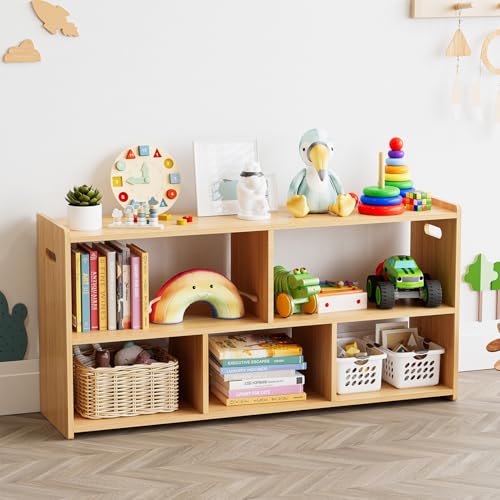
For toddlers and preschoolers, a low shelf generally makes more sense than a tall bookcase. SpaceAid is the clearest low-profile example at 22 inches high, while SONGMICS measures 25.6 inches and both HAVLOTII and HOOBRO are 29.5 inches high. These layouts place books and toys closer to the floor and support the child’s ability to select and return items independently.
A taller unit can still be useful when the room must serve children across several ages, but parents should expect to reserve upper shelves for adult-managed items or less frequently used supplies. PTINFLUCE rises to 44.49 inches, Furinno to 41.7 inches, RiverRidge to 54 inches, and HITHOS to 55.3 inches. Those products offer more vertical storage, but their upper areas may not be accessible to younger children.
Match the layout to the clutter
Open shelves make books and favorite toys visible. Cube designs divide categories and can make it easier to assign one space to blocks, art supplies, dolls, or bins. Furinno provides seven fixed cubes in a narrow format, while VECELO uses staggered, mixed-size cubbies for different-sized books and toys.
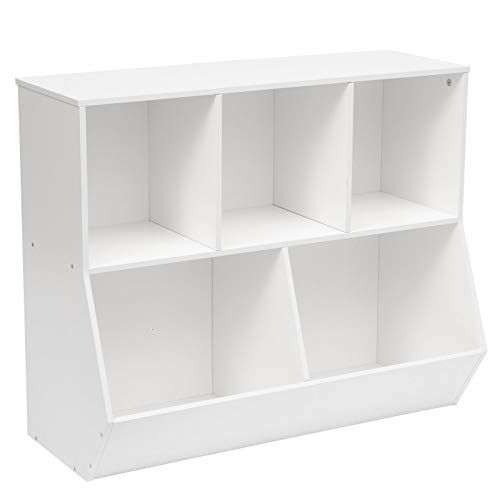
For mixed storage, look for a combination of shelves, compartments, and drawers. HOOBRO combines three open compartments with two tiltable boxes. HITHOS adds three open shelves, three cubbies, and three wheeled drawers. FINETONES offers seven cubes with four mobile chests, making it particularly suited to sorting loose toys into separate groups. These designs can conceal visual clutter, but they also require enough clearance for drawers or boxes to be used comfortably.
Forward-facing book storage is a distinct design type documented by HAVLOTII. It displays covers rather than only book spines, which may be useful when a young child chooses books visually. SpaceAid also presents a low, accessible Montessori-style format with five sections. Choose this style when reading materials are the main priority and you want the contents easy to see.
Check floor and wall dimensions
Measure the intended wall before choosing a shelf. Width varies substantially: VECELO is listed at 11.8 inches wide, Furinno at 19.5 inches, and RiverRidge at 14.63 inches across its stated assembled dimensions. By contrast, SpaceAid is 44.5 inches wide, SONGMICS is 44.2 inches wide, and FINETONES is 49.6 inches wide. A wide low shelf can be excellent for shared toy storage but may overwhelm a narrow bedroom.
Depth also affects walkways and placement near doors. Furinno is listed at 9.4 inches deep, VECELO at 9.5 inches, and SpaceAid at 11.7 inches. RiverRidge extends 20 inches deep according to its assembled dimensions and is shaped for corner placement. For a hallway, reading nook, or small bedroom, prioritize a narrow footprint and confirm that nearby furniture will not block access.
Treat anchoring as essential
A standing shelf should not be treated as freestanding simply because it can stand on the floor. Several selected products document wall-stabilization features. SONGMICS includes an anti-tip kit; HAVLOTII lists anti-tip straps and nonslip pads; HOOBRO includes an anti-tip device; RiverRidge includes wall-anchor and anti-tip hardware; and FINETONES lists a wall-mounting device.
Before use, follow the product’s assembly and anchoring instructions and identify the appropriate wall connection for the room. Weight distribution matters as well. RiverRidge supplies a per-shelf limit, Furinno states both per-shelf and total limits, and SONGMICS provides compartment and top-shelf capacities. Where no shelf-by-shelf capacity is supplied, avoid assuming that every opening can carry the same load.
Consider materials and cleaning
The selected products use several construction approaches. HAVLOTII and SpaceAid describe wooden construction, PTINFLUCE specifies plywood, and SONGMICS, FINETONES, and HITHOS use particleboard or MDF. VECELO describes a smooth, water-resistant surface, while FINETONES states that its smooth surface can be cleaned with a cloth. Those details are useful in craft areas and playrooms, where fingerprints and spills are common.
Fabric components can add flexibility but may feel different from rigid cubbies. HAVLOTII uses cotton-linen fabric organizers, while HITHOS and FINETONES use fabric drawers or chests. Wheeled drawers are helpful for moving toys, although they need clearance and may be less suitable when a child could pull them aggressively. Rounded corners appear in SONGMICS, HITHOS, HAVLOTII, and VECELO’s evidence, but rounded edges should complement—not replace—proper anchoring and careful placement.
Final recommendation
SONGMICS Kids’ Toy Storage Shelf ranks first overall in this specification-based comparison under the published weighted criteria.
SONGMICS Kids’ Toy Storage Shelf is the first overall specification-based choice among these best kids’ standing shelf units because it combines a low child-accessible height, varied compartments, rounded corners, raised edges, and an anti-tip kit. SpaceAid is the better fit for a very low, wide Montessori-style book display, while HAVLOTII and HOOBRO offer particularly approachable layouts for toddlers and preschoolers.
For a compact room, VECELO and Furinno make more efficient use of limited floor width. Choose RiverRidge when corner placement and vertical capacity matter more than toddler access. HITHOS and FINETONES are suited to families managing a large quantity of mixed toys, especially when concealed or mobile storage is useful. PTINFLUCE sits between the low and tall categories, offering varied compartments that can remain useful as storage needs change. The top kids’ standing shelf units therefore differ mainly by layout, reach, and footprint—not by a single universal design.
Frequently Asked Questions
What height is best for the best kids’ standing shelf units?
There is no single correct height. A 22- to 29.5-inch unit, such as SpaceAid, SONGMICS, HAVLOTII, or HOOBRO, is more directly suited to young children’s reach. Taller shelves such as Furinno, PTINFLUCE, RiverRidge, HITHOS, and FINETONES provide more vertical capacity but may require adults to manage the upper levels.
Are kids’ standing shelf units safer with open shelves or cubes?
The listing evidence does not establish that one layout is universally safer. Open shelves can make contents visible, while cubes can separate and contain items. Safety depends more on stable construction, correct assembly, sensible loading, and the use of supplied anti-tip or wall-anchor hardware. SONGMICS, HAVLOTII, HOOBRO, and RiverRidge document specific stabilization features.
Which of the top kids’ standing shelf units is best for a small room?
VECELO and Furinno have especially narrow listed widths and depths. VECELO is a short, compact cubby unit, while Furinno is a taller seven-cube shelf. RiverRidge is another space-conscious option when a corner can be used, though its 20-inch stated depth and 54-inch height should be checked against the room.
Should a children’s shelf include drawers?
Drawers are useful for hiding small toys and reducing visible clutter, but they add moving parts and need clearance. HITHOS provides removable wheeled drawers, and FINETONES provides four mobile chests. Choose drawers when toy sorting is a priority; choose open cubbies when visibility and quick access matter more.
What should be measured before buying a standing shelf?
Measure available width, depth, and height, then check doorway access and nearby furniture. Also compare the shelf’s height with the child’s reach, identify whether the design needs wall anchoring, and review any stated shelf or total capacity. Wide low units need more wall space, while tall narrow units require careful stability planning.