Buying Guide
The best men’s knee-high rain boots should be chosen by the conditions they need to handle, not by height alone. Public listings show meaningful differences among seamless PVC work boots, neoprene hunting boots, and flexible rubber designs. Start with water exposure, then consider traction, calf fit, insulation, and the type of protection required.
Choose the waterproof construction for the job
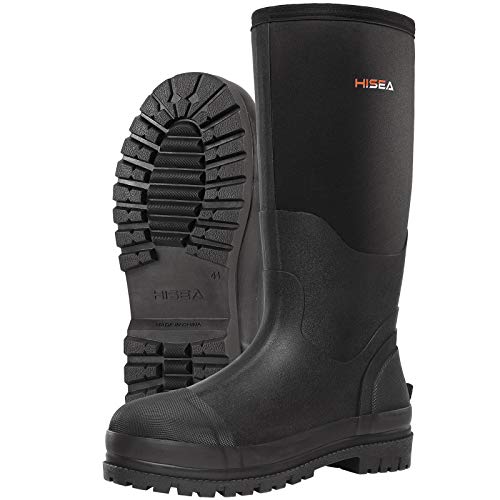
Seamless molded PVC is a recurring construction in this comparison. The SUREWAY P1300, HISEA Steel-Shank PVC Rain Boots, HISEA Steel-Toe Rain Boots, and GIEESHIELD Seamless PVC Work Boots all describe one-piece or injection-molded construction intended to prevent leaks. This design is particularly appropriate for standing water, muddy yards, farm chores, and cleanup-heavy work because smooth PVC is also generally easy to rinse, as noted for GIEESHIELD.
Neoprene-and-rubber boots address a different need. The Trudave 5mm Neoprene Steel-Shank Knee Boots and HISEA 5mm Neoprene Hunting Boots combine a rubber shell with 5mm neoprene. Their listings emphasize insulation, flexibility, and moisture management, making them better suited to colder outdoor conditions than an uninsulated PVC boot. The LaCrosse Burly Air Grip 18-Inch Boots use a wool felt midsole for another form of documented insulation.
Match shaft coverage and calf fit
Knee-high coverage helps protect the lower leg from splashes, mud, and wet vegetation, but shaft fit still matters. The LaCrosse Grange and LaCrosse Burly Air Grip each specify an 18-inch shaft. The DUNLOP Chesapeake instead highlights a wide-calf design, which may be more useful for wearing boots over work pants or accommodating a roomier calf. The HISEA Steel-Toe Rain Boots and HISEA Steel-Shank PVC Rain Boots document scalloped or foldable shaft details that allow some height adjustment.
Adjustable openings are another useful detail. The Trudave boots use wide pull tabs rather than a listed drawstring, while the HISEA neoprene hunting boots specify stretch-fit top-line binding. The Pelbiuqik Foldable PVC Knee-High Boots use a drawstring opening to help close the top around the leg. Check the supplied size chart and calf measurements before ordering; a tall boot cannot protect well if the opening is too tight or loose for the intended clothing.
Prioritize tread for the surface
Wet grass, mud, slick concrete, and rocky ground call for different levels of outsole definition. The Trudave, HISEA 5mm Neoprene Hunting, LaCrosse Burly Air Grip, SUREWAY, HISEA Steel-Shank PVC, and GIEESHIELD listings all describe deep, aggressive, rugged, or self-cleaning tread. These features are relevant when mud packing and surface grip are central concerns, although the supplied evidence does not establish a measured slip-resistance result.
The DUNLOP Chesapeake lists a rugged tread pattern and the Pelbiuqik boots list a slip-resistant outsole. Those details fit gardening, fishing, yard work, and general rain use. For occasional commuting or walking the dog, a flexible lightweight design may be easier to live with than a heavy lugged hunting boot. For uneven farm or trail surfaces, a boot with a steel shank and aggressive tread offers more documented support features.
Consider comfort and support separately
A lightweight listing does not automatically mean a better fit for every task. The DUNLOP Chesapeake emphasizes lightweight PVC and a flexible soft toe. GIEESHIELD describes flexible PVC and a slip-on format, while Pelbiuqik lists a cotton lining and supportive footbed. These features may suit shorter chores and repeated on-off use.
For longer standing or uneven ground, look for more structural support. SUREWAY includes a built-in steel shank for arch support. Trudave also lists a steel shank, and HISEA’s steel-shank PVC model describes support and stability on rocky terrain. Removable footbeds appear in the HISEA Steel-Toe Rain Boots and SUREWAY’s design includes a soft toe rather than a steel toe. These are specification differences, not proof of personal comfort, so fit remains important.
Neoprene can add warmth and flexibility but may be excessive in mild weather. The HISEA 5mm Neoprene Hunting Boots list thermal insulation, while Trudave lists a moisture-wicking lining. The LaCrosse Burly Air Grip lists a wool felt midsole. Use those features when warmth is a priority, and consider uninsulated PVC when the main requirement is keeping feet dry during warmer rain.
Select protection based on workplace hazards
A steel toe is a specific protection feature, not a universal requirement for rain footwear. The selected HISEA model is included because its evidence also describes customized shaft height and reinforced stress points.
Soft-toe boots can be preferable when flexibility and lower weight are more important, but they should not be treated as equivalent to steel-toe protection. SUREWAY combines a soft toe with listed electrical-hazard standards, while DUNLOP uses a flexible soft toe. Trudave adds a reinforced rubber toe rather than a listed safety-toe standard. Choose only the protection type supported by the work requirement and the product’s stated specifications.
Think about storage and maintenance
Smooth PVC and rubber surfaces are practical for muddy use because several listings describe easy cleaning or rinsing. GIEESHIELD specifies a smooth exterior and easy hose-down care, while SUREWAY states that the boots can be spray cleaned. LaCrosse also describes easy care for the Burly Air Grip. Follow the manufacturer’s care directions and allow wet interiors to dry fully before storage.
For limited storage, Pelbiuqik and the LaCrosse designs provide useful distinctions: Pelbiuqik explicitly folds, while the LaCrosse Grange and Burly Air Grip specify tall 18-inch shafts. Foldability improves portability, but the listing does not establish that it delivers the same structural feel as a steel-shank work boot. Make the trade-off according to whether the boots live in a vehicle, shed, closet, or working kit.
Final Recommendation
Trudave 5mm Neoprene Steel-Shank Knee Boots ranks first overall in this specification-based comparison under the published weighted criteria.
The final choice among the best men’s knee-high rain boots depends on the documented features that match your intended use.
Trudave 5mm Neoprene Steel-Shank Knee Boots are the highest-scoring returned product and the first overall specification-based choice. Their combination of 5mm neoprene, reinforced waterproof shell, steel shank, reinforced toe, pull tabs, and deep tread gives them broad documented coverage for cold, muddy outdoor work. They are not necessarily the right format for every wearer: choose HISEA Steel-Toe Rain Boots when certified toe protection is required, DUNLOP Chesapeake when a wide calf is the priority, or Pelbiuqik when compact storage matters.
For colder hunting and fishing, HISEA 5mm Neoprene Hunting Boots and LaCrosse Burly Air Grip 18-Inch Boots provide listed insulation and tall coverage. For wet worksites, SUREWAY P1300 and HISEA Steel-Shank PVC Rain Boots add support-focused features. GIEESHIELD suits quick-clean outdoor jobs, while LaCrosse Grange emphasizes an 18-inch shaft and reinforced rubber. These are the top men’s knee-high rain boots in this specification-based comparison because each has a distinct, documented reason to consider it.
Frequently Asked Questions
What should I look for in the best men’s knee-high rain boots?
Look for a waterproof construction suited to the task, adequate shaft coverage, a calf opening that fits over intended clothing, and tread appropriate for mud or wet pavement. Add insulation for cold conditions and a steel toe or steel shank only when those features match the work requirement.
Are PVC or neoprene boots better for rainy weather?
Neither material is universally better. Seamless PVC models such as GIEESHIELD and SUREWAY emphasize waterproof molded construction and easy cleaning. Neoprene-and-rubber models such as Trudave and HISEA 5mm Neoprene Hunting Boots add insulation and flexibility. Choose based on temperature, exposure, and desired support.
Which selected boots are suited to wide calves?
DUNLOP Chesapeake is the clearest choice because its listing specifically identifies a wide-calf design. Other selected boots use adjustable straps, drawstrings, or stretch-fit top lines, but those details do not establish the same calf room. Check the manufacturer’s sizing information before choosing.
Do knee-high rain boots need steel toes?
No. Steel toes are relevant when the work environment requires toe protection; they are not necessary for ordinary rain, gardening, or fishing. HISEA Steel-Toe Rain Boots document an ASTM 2413-18 steel toe, while DUNLOP Chesapeake and SUREWAY use soft-toe designs for different priorities.
How should tall rain boots be stored after use?
Rinse mud from the exterior, follow the listed care instructions, and let the interior dry before putting the boots away. A foldable design such as Pelbiuqik may save space, while tall models such as LaCrosse Grange and LaCrosse Burly Air Grip need more storage height.