Buying Guide
Picking the best large embroidery hoops starts with matching hoop size and construction to the kind of stitching you do most. Large hoops open up wall art, wreaths, dream catchers, and quilt-sized projects that simply do not fit on a 4 or 6 inch frame. As you compare options, focus on diameter coverage, frame material, tension hardware, and whether the hoop is built for stitching in hand or for finished display.
Choosing the Right Diameter Range
The diameter printed on a hoop is the inner working area, and it sets the ceiling for how large a pattern can be stitched in one pass. For most cross-stitch and crewel work, 10 to 12 inch hoops are the practical floor for what people call “large.” When projects move into wreath and dream catcher territory, 14 to 18 inch diameters become useful. Hoop sets that include several diameters are handy because the same collection can handle a small ornament and a 12 inch sampler, removing the need to buy multiple packs.
For stitchers focused on top large embroidery hoops for quilt work, look at 12 to 16 inch wooden hoops that span roughly the size of a lap-friendly quilt panel. Mixed-size packs, like a 4 to 12 inch set, are convenient but the larger end of that range still caps at 12 inches, so projects beyond that require an extra-large kit.
Frame Construction and Finish
Most large hoops fall into three material families. Natural bamboo offers a light feel, smooth sanding, and a warm finish, which is why it dominates the multi-size and 12 inch packs in this category. Hardwood rings, often labeled as wood or beechwood, tend to feel sturdier and are common in quilting-specific kits. Resin or rubber-plastic hoops, frequently given a faux-wood finish, are lighter still and often ship with built-in hanging hardware for displaying finished pieces.
A burr-free, sanded finish matters more than material alone because rough edges can snag threads and distort stitches on fine Aida or linen. Listings that mention sanded smooth, polished, or burr-free finishes are generally a safer bet when fabric contact quality is a priority.
Grip and Tension Hardware
The screw is what keeps a large hoop drum-tight, and on bigger diameters the lever arm on that screw grows. Stainless steel screws are the most common standard, sometimes paired with an anti-skid embossed texture on the screw head or surrounding ring to keep the hoop from rotating mid-stitch. Brass adjustment screws appear on some extra-large kits, and they tend to feel slightly smoother when tightening wide fabric panels.
Tool-free hoops use press-fit construction instead of screws. They are quick to assemble and easy to disassemble, but on very large fabric pieces the grip may feel less rigid than a screw-tightened hoop. Hoops that ship with a dedicated screwdriver give finer tension control, especially when working with thicker quilt layers.
Fabric and Project Compatibility
A hoop’s usefulness is shaped by what you plan to stitch through. Standard 12 inch bamboo and wooden hoops handle cross-stitch, crewel, ribbon embroidery, and light quilting comfortably. Quilt-specific kits with 14 to 16 inch rings address heavier layered fabric and lap-quilting workflows. Extra-large 18 inch bamboo hoops are tuned for dream catchers, garlands, and wall hangings rather than dense stitch coverage.
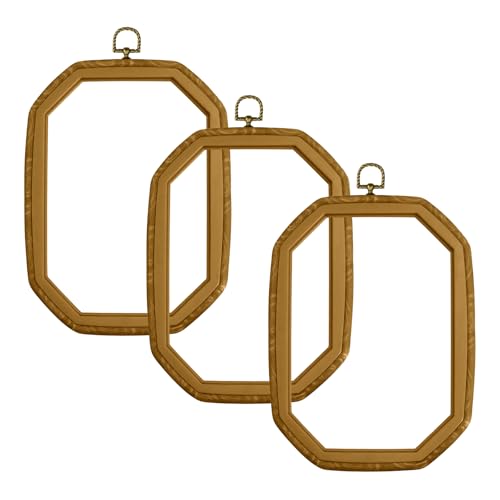
If a project doubles as décor, hoops with rectangular, oval, or octagonal shapes add framing variety. Those shapes often come with built-in hanging rings and a vintage finish, so the finished piece can move directly from hoop to wall.
Pack Value and Workflow
Pack size affects how many projects you can run at once. A three-pack gives enough hoops for a small series or a gift set, while seven- and nine-piece kits cover a full size ladder or multiple shapes. Bulk 18-piece packs make sense for workshops, classes, and event favors where every participant needs the same hoop.
For solo stitching, a multi-size pack can replace several smaller purchases, since the same set covers ornaments and large wall pieces. Buyers focused only on one diameter, on the other hand, may prefer a dedicated three-pack so they are not paying for sizes that will sit unused.
Display and Hanging Readiness
Some hoops are designed to stay on the wall once stitching is finished. Press-fit hoops with faux-wood finishes frequently include an integrated brass or antique brass hanging ring, removing the need to mount the hoop in a separate frame. Screw-tightened bamboo and wooden hoops often lack that hardware, which leaves more finishing flexibility but requires an extra step before hanging.
Final Recommendation
Caydo 7-Piece Bamboo Embroidery Hoop Set 4-12 Inch ranks first overall in this specification-based comparison under the published weighted criteria.
The final choice among the best large embroidery hoops depends on the documented features that match your intended use.
After comparing specifications side by side, the CroBlissful 12/14/16 Inch Wood Quilting Hoop Kit earns the most specification-aligned balance of size range, frame construction, and project compatibility for stitchers who want top large embroidery hoops suited to both embroidery and hand quilting. Its three diameters are tuned to lap-friendly quilt panels, the wooden rings are described as burr-free, and the stainless steel screws support the wider fabric area. For buyers prioritizing the largest possible diameters in a single kit, the Caydo 14/16/18 Inch Extra-Large Bamboo Hoop Kit is the better fit, with diameters reaching 18 inches for wreath and wall-hanging work. Together, these two kits represent the practical center of gravity in this category: one tuned to quilting scale, the other tuned to decorative scale.
Frequently Asked Questions
Among the best large embroidery hoops, what size counts as a large embroidery hoop?
In practice, a hoop is considered large once it reaches roughly 10 to 12 inches in diameter. Anything from 12 inches upward is widely used for sampler-scale cross-stitch and crewel work, while 14 to 18 inch hoops are typically reserved for quilt-sized pieces, wreaths, and wall hangings. The best large embroidery hoops for most stitchers therefore start at 10 inches and run upward.
Is bamboo or wood better for large embroidery hoops?
Both materials work well at large diameters, and the choice usually comes down to weight and feel. Bamboo is lighter and easier to sand smooth, which is why it dominates multi-size packs. Hardwood rings can feel sturdier and may be preferred for heavier quilt layers. Among the best large embroidery hoops compared here, bamboo dominates multi-size kits while hardwood leans toward quilting-specific sets.
Do I need a screw-tightened hoop for large projects?
Screw-tightened hoops are generally recommended for large projects because the wider fabric area is harder to keep drum-tight without mechanical pressure. Press-fit hoops can still work, but on bigger diameters they may loosen more easily mid-stitch, especially with thicker fabric or layered quilt work.
Can the same hoop be used for stitching and display?
Yes, particularly with press-fit hoops that include an integrated hanging ring. Hoops like those in the Holyenten and Qunclay sets ship ready to hang once stitching is complete. Screw-tightened bamboo and wooden hoops can also be used for display, though they often need separate mounting hardware because they are not listed with built-in rings.
How many hoops should I buy at once?
The right quantity depends on workflow. A three-pack is enough for working on one project at a time while keeping a spare. Seven- and nine-piece packs cover multi-size needs or several parallel projects. Bulk packs of 18 or more are best for classes, workshops, and gift production rather than solo stitching.