Buying Guide
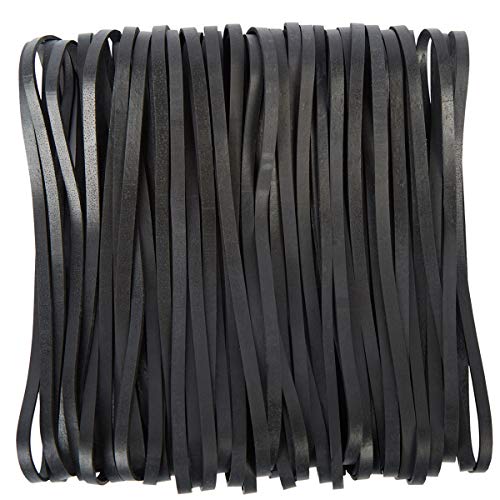
Large rubber bands are not one uniform product. A 7-inch office band, an 8-inch liner band, a 17-inch supersize band, and a wide silicone band can all be described as large while serving very different jobs. The best large rubber bands for your project should be chosen from the dimensions and applications that match the object being secured.
Start with flat length and circumference
Flat length is the first useful comparison point. The conventional options in this selection measure about 7 inches, while the Foshine and AMUU liner-focused products measure 8 inches. Alliance Rubber 08995 SuperSize Bands extend to a documented 17-inch size, making them the clearest fit for large coverings, bulky bundles, and unusually shaped objects.
Flat length does not tell the entire story. AMUU 8-Inch Black Rubber Bands and Foshine 8-Inch Large Rubber Bands both document an approximately 16-inch circumference and a pulled length of roughly 59 to 61 inches. Those figures are directly relevant when securing a trash liner, but the listing still advises measuring the container before buying. A stated maximum is not a substitute for checking the object’s circumference.
Compare width and thickness
Width changes how a band contacts the item and helps distinguish ordinary office bands from wide heavy-duty designs. Most conventional choices here measure 1/8 inch wide. Alliance Rubber 27405 Advantage #117B, Alliance Big Rubber Bands, Bilinny, and AMUU Size 117B all use that familiar format.
The AIWOQI Size 107 and Nliyeisu Size 107 options are much wider at approximately 0.625 and 0.6 inches. Moreik’s silicone bands measure about 0.4 inches wide. These wider designs may be more appropriate when a broad band is useful around boxes, furniture, cables, books, or outdoor gear. They also come in smaller packs, so choose them for the shape and contact area rather than assuming a higher count is always better.
Thickness information is not equally complete across every listing. Where a product documents width and thickness, use both measurements. Where only a size designation or width is supplied, avoid treating the band as equivalent to a thicker model without additional evidence.
Match elasticity to the job
Elasticity descriptions vary from general wording to specific figures. Alliance Rubber 27405 Advantage #117B states up to 700% elongation. Bilinny states stretch up to four times the base length, while AMUU 8-Inch Black Rubber Bands, Foshine, and AMUU Size 117B provide circumference and pulled-length details.
These figures are useful for comparison, but they do not guarantee the same result in every situation. Rubber condition, object shape, temperature, and repeated use can affect how a band behaves. For a job involving frequent removal, the reusable claims in the listings are relevant. For a specific liner or container, measure first and avoid stretching a band beyond the stated guidance.
Choose traditional rubber or silicone
Most products in this comparison are conventional rubber or natural rubber designs. Moreik Extra-Wide Silicone Rubber Bands and the selected wide silicone format are different: the listing identifies silicone material, a 7.8 x 0.4-inch size, stretch up to 16 inches, and repeated-use positioning. Silicone can make sense for books, boxes, outdoor gear, and color-coded organization when a broad, smooth band is preferred.
Traditional rubber bands offer more choices for office paperwork, food packaging, trash liners, and bulk storage. Alliance Big Rubber Bands also documents freezer and microwave safety, which gives that product a more specific food-storage role than the general-purpose listings. Do not transfer that safety claim to other products in this comparison.
Consider quantity and color
Pack size ranges from small targeted assortments to approximately 200 bands. The 12-count Alliance Big Rubber Bands pack and the approximate 12-band Alliance Rubber 08995 bag are suited to defined projects. AIWOQI’s 30-piece pack and Nliyeisu’s 36-piece pack focus on wider bands for less routine use. The 45-count Foshine and 50-count AMUU black packs provide more units for recurring liner work.
For office sorting, color may be more useful than maximum count. Bilinny supplies four bright colors, while Moreik lists 10 colors and several other products provide assorted colors. A single-color pack can still be preferable when appearance or a consistent system matters. Quantity should be judged alongside the size and task, not separately.
Check the intended object before ordering
For folders, mail, and paperwork, a 7 x 1/8-inch band is usually the most directly documented format. For trash cans, prioritize products with stated container compatibility, such as the 8-inch AMUU, Foshine, and AMUU Size 117B listings. For furniture coverings, carpets, mats, and large awkward shapes, Alliance Rubber 08995 provides the most specification-aligned documented application match.
For boxes and bulky bundles, compare the wide AIWOQI, Nliyeisu, and Moreik options with the standard 7-inch bands. A wide band can offer broader contact, but the smaller pack may be less convenient for high-volume filing. Finally, inspect the listed dimensions rather than relying only on labels such as heavy duty, giant, or extra large.
Final recommendation
Alliance Rubber 08995 SuperSize Bands 17-Inch ranks first overall in this specification-based comparison under the published weighted criteria.
Alliance Rubber 08995 SuperSize Bands is the first overall specification-based choice among these best large rubber bands because it combines the longest documented size with a 1/4-inch width and clearly stated uses for oversized, irregular, and large-liner tasks. It is not the best fit for routine paperwork or buyers who need hundreds of pieces.
For general office and household work, Alliance Rubber 27405 Advantage #117B offers a conventional 7 x 1/8-inch format, approximately 200 bands, and a documented elongation figure. For liner work, Foshine and AMUU’s 8-inch options provide the clearest reach information. AIWOQI and Nliyeisu are better suited to buyers who specifically want a very wide band, while Moreik is the selected silicone alternative.
The top large rubber bands therefore depend on the object’s circumference, the desired width, the need for color coding, and how often the bands will be replaced. Measure the target item, review the material, and select a pack that matches the job rather than choosing solely by the word large.
Frequently Asked Questions
What size should I choose for a trash can?
Start by measuring the can’s circumference and comparing it with the listing. Foshine 8-Inch Large Rubber Bands, AMUU 8-Inch Black Rubber Bands, and AMUU Size 117B each document compatibility with trash cans up to 33 gallons, but the listings also advise measuring before purchase. Larger cans or unusual rims may call for Alliance Rubber 08995 SuperSize Bands, which are listed for 44- and 55-gallon bins.
Are the best large rubber bands always the widest?
No. Width should match the task. AIWOQI and Nliyeisu use approximately 0.6-inch-wide profiles for broad wrapping, while many office and filing bands use 1/8-inch widths. A conventional band may be easier to use around folders, mail, and documents, while a wide band may better suit boxes, furniture, or bulky objects.
Which selected product is best for color-coded organization?
Bilinny provides four assorted colors in a 120-count pack and specifically documents color-coding for documents and boxes. Moreik provides 10 silicone colors in a smaller pack. These options are more suitable for visual sorting than the single-color beige, red, blue, or black products.
Which of the best large rubber bands is suitable for food storage?
Alliance Big Rubber Bands is the only selected product whose listing specifically states freezer and microwave safety. It is also described for securing food containers and closing chip or cracker bags. That claim should not be extended to the other products without separate documentation.
What should I check before buying large rubber bands?
Check flat length, width, thickness when supplied, material, stated stretch or circumference, intended application, and pack quantity. For liners and containers, measure the circumference. For files and paperwork, a 7 x 1/8-inch profile may be more practical. For oversized or irregular items, compare the wider or longer designs and confirm that the pack contains enough bands for the project.