Buying Guide
The best led continuous-output lighting is not automatically the fixture with the largest wattage. A useful choice depends on the light level you need, whether color must change during a shoot, how you will control the fixture, and whether the light stays in a studio or travels. The products in this comparison are listed as LED video or photography lights with continuous output, so the ranking uses documented specifications rather than hands-on impressions or customer opinions.
Start with the required light level
Output figures are not directly interchangeable unless the measurement conditions match. Several listings report illuminance at 1 meter with a reflector, while the SmallRig RC 60B reports bare-light and covered figures. Reflectors and modifiers change distribution, so treat lux as a listing reference for initial comparison rather than a guarantee for a particular softbox setup.
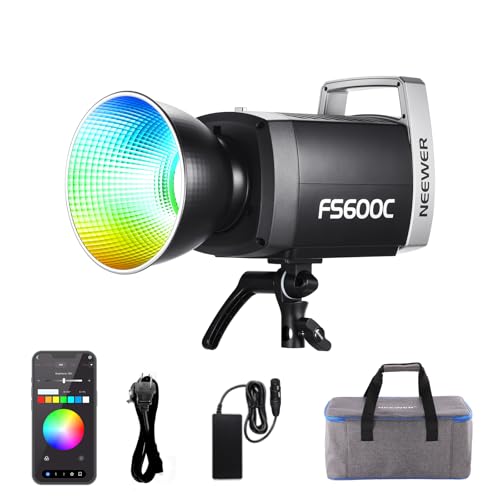
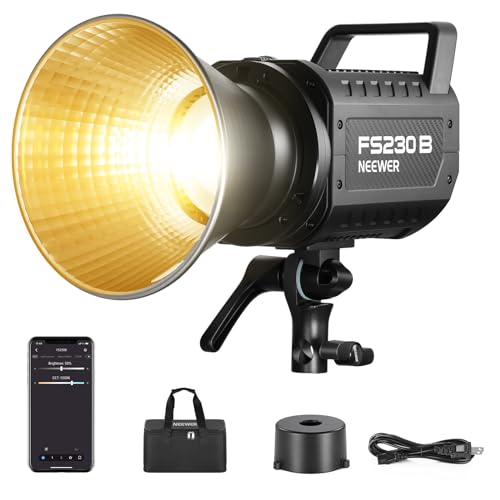
The NEEWER FS600C lists 600W and 52,500 lux at 1 meter with reflector. The HS200B lists 84,400 lux at 1 meter in 280W Boost mode, while the FS230B lists 110,000 lux at 1 meter with maximum output. These differences show why wattage alone should not decide the purchase. If you are lighting a larger scene or working through diffusion, begin with the stated output and intended modifier.
For smaller rooms, interviews, or mobile use, the MS60B, HB80C, and RC 60B reduce the physical burden. Their listed outputs are lower, but compact bodies and battery options may be more useful than a larger fixture that remains near AC power.
Choose daylight, bi-color, or RGB
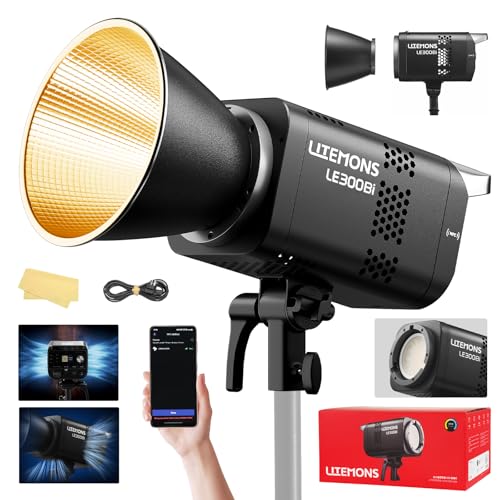
Daylight-only lighting can be straightforward when a scene uses one color temperature. Most selected products here offer bi-color or RGB control. Bi-color models such as the HS200B, FS230B, CB200B, LE300Bi, and LE200Bi provide adjustable warm-to-cool ranges. This can help match room lighting or shift the look without changing gels.
RGB models add hue and saturation control. The FS600C documents RGBWW modes, while the CB100C and HB80C provide CCT, HSI, and effects modes. RGB is useful for colored backgrounds, accents, and creative effects, but it does not replace checking white-light color specifications. For production color, the LE200Bi lists CRI and TLCI values up to 98; the FS230B, CB100C, HB80C, MS60B, and RC 60B also document high CRI or TLCI figures.
Match control to your workflow
On-body controls are simple for one fixture. App control is more useful when a light is mounted overhead, placed out of reach, or used with several compatible fixtures. The FS600C provides panel, app, 2.4G, and DMX control. The HS200B adds a separated controller and supports AC/DC operation, optional battery use, app, 2.4G, and DMX control.
Godox models emphasize Bluetooth app control and wired DMX or CRMX integration. Check the exact protocol and required accessories before building a networked lighting system. A listing can document compatibility, but it does not establish that every accessory or transmitter is included.
Check modifier compatibility
A Bowens mount is useful for users who already own softboxes, reflectors, snoots, or beauty dishes. The FS600C, HS200B, FS230B, CB200B, LE300Bi, LE200Bi, CB100C, HB80C, and MS60B document Bowens-related compatibility. Several also list umbrella sockets. Confirm whether the mount is native or adapter-supported.
The SmallRig RC 60B needs particular attention: its listing says a standard Bowens softbox requires the SmallRig Bowens Mount Adapter, while the mini softbox is directly compatible. This changes the accessory path, so verify the exact connection before ordering.
Plan power, cooling, and portability
For a permanent studio, AC operation and cooling may matter most. The FS600C uses an adapter and power cord and includes a cable-locking XLR input. The CB200B also documents a cable-locking power input. The Godox LE300Bi uses an integrated power supply, which may simplify the light body and reduce external hardware.
For location work, the HS200B supports an optional V-mount battery plate, the FS230B documents dual power sources, and the MS60B supports NP-F or V-mount battery arrangements through its battery box. The HB80C and RC 60B have built-in batteries. The HB80C lists a 72Wh battery and USB-C PD charging; the RC 60B lists a built-in 3400mAh battery, 45-minute full-power runtime, and 75-minute ECO runtime.
Cooling modes also affect a quiet recording environment. The FS600C lists silent cooling, the CB200B lists an ultra-silent fan, and the RC 60B documents approximately 26dB within 1 meter under its stated condition. These are product specifications, not independent noise tests, so use them for initial screening rather than as assurances for every setup.
Final recommendation
NEEWER FS600C 600W RGB COB Light ranks first overall in this specification-based comparison under the published weighted criteria.
NEEWER FS600C 600W RGB COB Light is the first overall specification-based choice in this comparison. It combines substantial listed output, RGB modes, broad CCT adjustment, multiple control paths, and Bowens compatibility.
The best led continuous-output lighting choice depends on the features that match your intended use. Among the top led continuous-output lighting choices, the HS200B suits users who need high output and a portable separated controller, while the FS230B fits precise PWM dimming and strong illuminance specifications.
Choose the Godox LE200Bi when documented color fidelity is the priority, the CB100C when RGB control is needed in a smaller studio, or the HB80C when a built-in battery matters more than maximum output. The MS60B and RC 60B are mobile options, with the SmallRig requiring attention to its Bowens adapter requirement. Before ordering, verify the included power hardware, reflector, battery plate, and modifier connection for the exact configuration.
Frequently Asked Questions
What should I look for in the best led continuous-output lighting?
Start with the documented illuminance and the conditions used for that measurement, then check color-temperature range, CRI or TLCI, dimming, control methods, modifier mount, and power options. A compact battery light can be a better match for mobile production even when a larger fixture lists more watts.
Is bi-color or RGB better for video lighting?
Bi-color is a direct choice when you need to match warm and cool sources. RGB adds hue and saturation control for colored backgrounds and creative effects. The FS600C, CB100C, and HB80C document RGB modes, while the HS200B, FS230B, CB200B, LE300Bi, and LE200Bi document bi-color operation.
Do these lights include a Bowens mount?
Many selected products document a Bowens mount or Bowens compatibility, including the FS600C, HS200B, FS230B, CB200B, LE300Bi, LE200Bi, CB100C, and HB80C. The MS60B uses an included Bowens mount adapter. The RC 60B listing says a standard Bowens softbox requires an adapter, so confirm the exact connection before buying.
Which selected light is easiest to use away from AC power?
The HB80C and RC 60B have built-in batteries. The HS200B documents optional V-mount battery operation, the FS230B documents dual power sources, and the MS60B supports NP-F or V-mount arrangements with its battery box. Battery runtime, plates, chargers, and cables differ, so compare the complete field-power setup.
No. This is a public-listing specification comparison, not a hands-on test. Lux figures, color ratings, runtime statements, and noise figures are presented only as supplied product evidence. Measurement distance, reflector use, operating mode, and other conditions vary by listing and should be checked before making a final selection.