Buying Guide
The best lego space building sets are not all aimed at the same builder. Some are compact playsets for children, some demonstrate an engineering concept, and others are large adult projects intended to remain on a shelf or wall. Start by deciding whether the finished model will be used for imaginative play, educational demonstration, or display. Then compare the documented mechanisms, subject matter, age guidance, and available space.
Match the set to the builder
For ages 6 and up, the LEGO City Interstellar Spaceship is the most feature-rich younger-builder choice in this selection. It includes a spaceship, drone bot, astronaut figure, and playset, with fold-out thrusters and a drone-to-jetpack conversion. Those features create a clear play scenario without requiring the engineering depth of the Technic models.
The LEGO Creator 3 in 1 Space Astronaut suits ages 9 and up and offers a different kind of flexibility. The same bricks can become an astronaut, space dog, or viper jet, and each model has a stand. It is a useful choice when the recipient enjoys rebuilding or wants a set that can change themes between sessions.
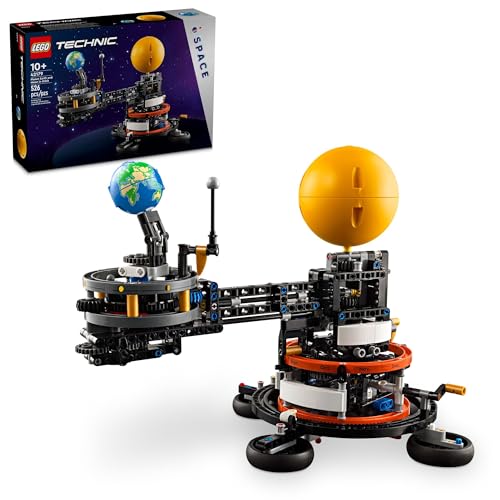
For ages 10 and up, the Earth and Moon in Orbit model, Mars Rover Perseverance, and Lunar Outpost Moon Rover move toward technical learning. The Earth-and-Moon set is especially direct: turning its crank shows orbital movement, while printed months and moon phases provide context. Perseverance adds steering, suspension, movable arms, and a buildable Ingenuity helicopter. Lunar Outpost adds rocker suspension, four-wheel steering, solar panels, a rotating arm, and multiple rover types.
Choose the right kind of space subject
A rocket is the natural fit for builders who like launch systems and vertical display models. The adult LEGO Icons NASA Artemis Space Launch System includes boosters, an Orion capsule, a mobile launch tower, retractable umbilicals, and separating stages.
Rovers suit builders who prefer vehicles and mechanisms. The Apollo Lunar Roving Vehicle focuses on the historic Apollo 17 mission and includes scientific tools and equipment attachments. The Mars Perseverance model adds a helicopter and articulated suspension, while Lunar Outpost presents a future-facing system with mining and reconnaissance rovers. Consider whether the recipient prefers historical replicas, current-style robotic exploration, or imaginative lunar construction.
The Hubble Space Telescope and Milky Way Galaxy provide alternatives to vehicles. Hubble includes an opening aperture door, posable arrays, antennas, and a visible instrument bay. The Milky Way set is wall art made from five panels, with a layered 3D effect and an included frame. These are better choices when the completed build is expected to function as room decor.
Compare mechanisms, not just piece counts
A larger piece count can indicate a longer or more detailed project, but it does not by itself explain how the model behaves. Look for the specific functions that match the intended use. Artemis has detachable boosters and launch-tower elements. The Shuttle Carrier Aircraft has a dial-operated landing system and a shuttle that can be configured for transport. The Apollo rover documents steering and suspension, while the planetary model uses a crank to show orbital relationships.
For imaginative play, transformation and posability can matter more than technical scale. The Creator astronaut set has three build options, and the Interstellar Spaceship includes a converting drone bot. For display, removable panels, stands, plaques, and movable antennas may be more useful than a play feature. Hubble, the Apollo rover, Milky Way Galaxy, and Shuttle Carrier Aircraft all document display-oriented details.
Plan for size and display space
Check the completed-model dimensions before choosing a large set. The Artemis rocket is over 27.5 inches high, the Shuttle Carrier Aircraft is over 25 inches long, and the Milky Way Galaxy artwork is over 25.5 inches wide. The Hubble model reaches over 15 inches long and wide with its aperture open. These dimensions can exceed the footprint of an ordinary shelf.
The smaller vehicle-focused choices are easier to place, but even they may need room for play. The Lunar Outpost rover measures over 12 inches long, while the Earth-and-Moon model measures over 12.5 inches long. If the set will be built in a shared room, a compact play model or a wall-mounted format may be more practical than a wide display piece.
Consider build style and age guidance
Adult sets in this comparison include the Artemis launch system, Shuttle Carrier Aircraft, Apollo Lunar Roving Vehicle, Hubble Space Telescope, and Milky Way Galaxy. Their listings emphasize detailed construction, display, or astronomy and space-history themes. They are appropriate for adults according to the supplied age guidance, but the information does not establish a specific completion time or difficulty beyond those stated specifications.
Technic models use mechanisms such as steering, suspension, cranks, arms, and staged movement. They can be a strong fit for builders who enjoy understanding how a model works. Creator and City models generally emphasize rebuilding, figures, transformation, and open-ended scenarios. The LEGO Builder app is documented for many of these sets, offering tools such as zooming, rotating, saving sets, or tracking progress; it should be treated as an instruction aid rather than evidence of a particular learning outcome.
Final recommendation
LEGO Icons NASA Artemis Space Launch System ranks first overall in this specification-based comparison under the published weighted criteria.
LEGO Icons NASA Artemis Space Launch System is the first overall specification-based choice among the best lego space building sets. Its 3,601 pieces, multistage rocket, mobile launch tower, detachable boosters, and 27.5-inch height give it a notably complete combination of documented subject authenticity, build scope, and display presence in this comparison.
The top lego space building sets for specialized needs are different. Choose Shuttle Carrier Aircraft for a dual aviation-and-space display, Apollo Lunar Roving Vehicle for Apollo detail, or Lunar Outpost Moon Rover for a mechanism-heavy lunar vehicle. Hubble is a well-documented telescope option, while Milky Way Galaxy is suitable for wall decor. For younger builders, Interstellar Spaceship offers powered thrusters and character play; Creator Space Astronaut is the flexible rebuilding choice. Earth and Moon in Orbit is a clear educational model for orbital movement, and Mars Rover Perseverance is a strong Mars-focused engineering option based on the supplied specifications.
The best lego space building sets therefore depend on the intended experience. Prioritize age guidance and accessible play for children, mechanisms and mission context for STEM-minded builders, and dimensions, stands, plaques, or wall format for display projects. These specifications provide a practical way to narrow the choice without treating marketplace metrics as evidence of product performance.
Frequently Asked Questions
Which LEGO space set is best for an adult display?
The LEGO Icons NASA Artemis Space Launch System is a leading display choice because the listing documents a 3,601-piece rocket, mobile launch tower, detachable boosters, separating stages, and a height of more than 27.5 inches. The Shuttle Carrier Aircraft and Apollo Lunar Roving Vehicle are also adult-focused alternatives with stands or information plaques and substantial physical detail.
Which best lego space building sets are suitable for younger builders?
The LEGO City Interstellar Spaceship is listed for ages 6 and up and includes a spaceship, drone bot, astronaut figure, and playset. The LEGO Creator 3 in 1 Space Astronaut is listed for ages 9 and up and offers three rebuildable models. These sets emphasize imaginative play and flexible models rather than the advanced mechanisms found in the adult and Technic selections.
Which set demonstrates how planets move?
LEGO Technic Planet Earth and Moon in Orbit is a suitable choice for demonstrating orbital movement. Its hand-operated crank moves the Earth and Moon around the Sun, and printed months and moon phases are included. The listing describes it as an educational space toy for ages 10 and up, so it can work as both a building project and a physical display of orbital relationships.
Are these sets better for play or display?
Both formats are represented. Interstellar Spaceship and Creator Space Astronaut are oriented toward imaginative play, figures, transformation, and rebuilding. Artemis, Hubble, Apollo Lunar Roving Vehicle, Shuttle Carrier Aircraft, and Milky Way Galaxy document stands, plaques, wall mounting, or display-focused designs. Technic rover models sit between the two, offering movable mechanisms for play while also providing substantial completed models.
What should I check before buying a large space set?
Review the stated completed dimensions, age guidance, piece count when provided, and the type of interaction. Artemis exceeds 27.5 inches in height, Shuttle Carrier Aircraft exceeds 25 inches in length, and Milky Way Galaxy exceeds 25.5 inches in width. Also check whether the intended recipient prefers a rocket, rover, telescope, astronomy artwork, or a rebuildable play model; the subject and format can matter as much as the number of pieces.