Buying Guide
Choosing among the best large home printer stands starts with the printer’s footprint, but the surrounding workflow matters just as much. A stand should leave room for paper handling, ventilation, cable routing, and access to drawers or lower shelves. The products here are compared from supplied listing specifications and feature descriptions. They were not physically tested, and no customer-opinion data was used.
Measure the printer and the available floor space
Measure the printer’s width and depth, including paper trays that extend during use. Then compare those dimensions with the stand’s stated top or desktop size. A nominally large stand can still be too shallow for a laser printer, copier, or all-in-one machine.
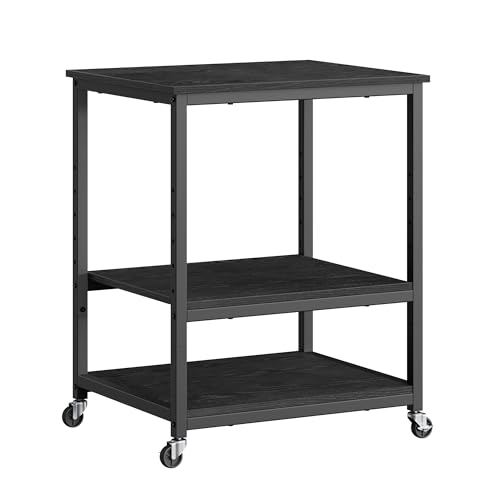
The VASAGLE model has a 23.6-by-19.7-inch footprint, making it one of the roomiest choices for a deep machine or a printer paired with supplies. The BOHDK stand measures 23.6 by 15.7 inches, while the YAOHUOO three-tier model measures 22 by 15 inches. The GYIIYUO cabinet is 24 inches wide and is specifically described for large office printers. These dimensions are useful comparison points, but they do not replace measuring your own equipment.
A low-profile design may be preferable when the stand needs to slide beneath a desk. The YAOHUOO two-tier drawer cart is listed at 15.8 inches tall, and the Gewudraw model is 24.09 inches tall with a compact 15.35-by-11.02-inch footprint. Check both height and depth under the desk, especially if the desk has a crossbar or modesty panel.
Match the storage layout to your supplies
Open shelves are convenient for frequently used paper, folders, and spare cartridges. Adjustable shelves are more useful when equipment heights vary. The VASAGLE stand has six middle-shelf height levels, while the YAOHUOO three-tier stand offers four positions.
For concealed storage, the VENNQD stand uses two fabric drawers, the YAOHUOO two-tier cart has a hidden drawer, and the Gewudraw stand combines a drawer with open tiers. The GYIIYUO cabinet goes further with two drawers and an open shelf, making it a particularly relevant format for document-heavy work. Drawer construction and access are not hands-on tested here, so treat the supplied material descriptions as the available evidence.
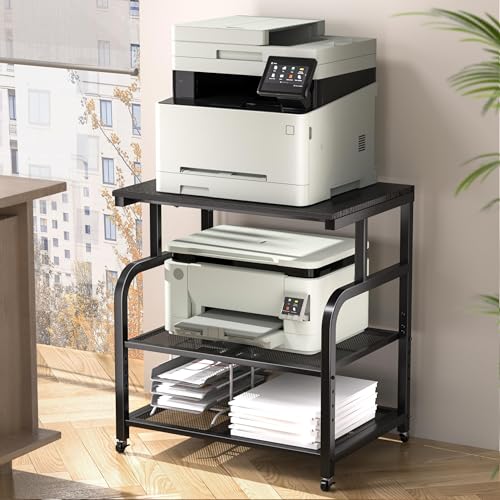
A three-tier cart is often the most balanced format for a printer on top, paper or a scanner in the middle, and supplies below. Two-tier stands can be better under desks or in tighter spaces, while a cabinet format is useful when filing capacity matters more than open access.
Decide between rolling and stationary placement
Many of the best large home printer stands offer both mobility and stability. Locking casters let you move the unit for cleaning or repositioning, then hold it in place. Optional adjustable feet can provide a more stationary setup and may help on uneven floors.
The BOHDK cart includes four wheels, two lockable, plus stabilizing feet. The VASAGLE design uses industrial casters with two locking wheels and offers adjustable feet as an alternative. The GYIIYUO cabinet also combines casters with leveling feet. These options are useful, but a locked wheel is not a substitute for checking that the printer is centered and stable before operation.
If you expect to move a loaded stand often, consider the full setup weight and doorway clearance. The listing data documents wheel features but does not provide a hands-on assessment of rolling smoothness under load.
Load limits are among the most useful specifications because “heavy duty” is not a standardized measurement. The YAOHUOO three-tier model states that each shelf supports up to the current price, and the BOHDK and YAOHUOO drawer models state up to the current price per shelf. The GYIIYUO desktop is listed for up to the current price.
Other models have lower or more specific limits. MAHANCRIS lists the current price for the top and each mesh shelf, while HOOBRO lists the current price for the top and the current price for each mesh shelf. Gewudraw lists a total support capacity of the current price. Use the most restrictive applicable limit, and account for paper stacks or other equipment placed on lower levels.
Steel frames, engineered wood, particle board, and metal mesh appear across the selection. Material alone does not establish a product’s real-world strength, so prioritize a documented capacity and a top that is wider and deeper than the printer’s footprint.
Consider outlets and cable convenience
Integrated power can reduce cable clutter when the stand is positioned away from a wall socket. The YAOHUOO three-tier cart has two outlets, USB, and USB-C ports. MAHANCRIS provides two outlets and two USB ports, while HOOBRO includes one standard outlet and two USB ports. The Gewudraw model lists two AC sockets and two USB ports.
Power features should be treated as a convenience, not proof that every device can safely run simultaneously. Check your printer and accessory requirements, keep cords clear of moving wheels, and follow the product’s installation and electrical-use instructions.
Prioritize the feature that solves your main problem
For the broadest feature set, the YAOHUOO three-tier model combines adjustable storage, charging, mobility, and high stated shelf support. For a large footprint and strong shelf specification, BOHDK is a practical alternative. VASAGLE is better suited to buyers who need extra depth and many shelf-position options. If concealed organization is the priority, consider VENNQD or the low-profile YAOHUOO drawer cart.
Final Recommendation
YAOHUOO 3-Tier Large Printer Stand ranks first overall in this specification-based comparison under the published weighted criteria.
YAOHUOO 3-Tier Large Printer Stand is the highest-scoring first overall specification-based choice among these best large home printer stands. Its 22-by-15-inch footprint, adjustable shelf, lockable casters, replacement feet, documented shelf support, and integrated charging provide the most complete feature combination in this comparison.
The top large home printer stands should still be chosen around your actual printer dimensions. Select BOHDK when shelf support and a larger industrial cart matter most, VASAGLE when depth and adjustability are key, or GYIIYUO when a wide desktop and filing storage are more useful than open shelving. For low-clearance installations, the YAOHUOO two-tier drawer cart is the more targeted option.
Frequently Asked Questions
What size printer stand should I buy for a large printer?
Choose a top that exceeds the printer’s width and depth, including trays that extend during use. Among the selected products, VASAGLE offers a 23.6-by-19.7-inch footprint, BOHDK measures 23.6 by 15.7 inches, and GYIIYUO provides a 24-inch-wide desktop. Always compare those figures with your printer’s complete operating footprint.
Are rolling printer stands stable enough for home use?
Rolling stands can be suitable when they have locking wheels and the printer is centered. Several selected models also include adjustable feet, including BOHDK, VASAGLE, and the YAOHUOO carts. Lock the casters before printing and avoid moving a loaded stand unless the listing and your setup support that use.
Which of the best large home printer stands has the most storage flexibility?
The YAOHUOO three-tier stand offers four shelf-height positions, while VASAGLE provides six middle-shelf levels. For concealed storage, VENNQD has two fabric drawers, and GYIIYUO provides two drawers plus an open shelf. The best choice depends on whether you need adjustable clearance, open access, or document storage.
Do printer stands with outlets power the printer safely?
The supplied listings document outlets or USB ports on several models, but they do not provide a complete electrical-safety assessment for every device combination. Check the printer’s power requirements, keep cables away from wheels, and follow the stand’s instructions. An integrated outlet is a convenience feature, not a guarantee of compatibility.
Can a printer stand also hold a scanner or office supplies?
Many selected listings describe space for scanners, fax machines, paper, folders, or cartridges. Three-tier designs generally offer the most separation, while drawer models help contain smaller supplies. Confirm each shelf’s stated capacity and dimensions before adding a second device.