Buying Guide
The best lightweight marine dry bags are not all built for the same load. A 2L-to-5L sack can protect a phone, wallet, documents, or a spare layer, while a 10L-to-20L bag is more practical for clothing, towels, food, or several small dry bundles. Larger duffels and expedition backpacks were not selected here because their listed weights and capacities move them away from the lightweight focus.
Start with the closure and water conditions
A roll-top closure is the dominant design in this comparison. It works by folding the opening several times and fastening the buckle. The number of rolls matters because several listings specify three to five folds for a seal. A bag that is not closed correctly should not be treated as waterproof simply because its fabric is coated.
Protection language also varies. Osprey specifies IPX5 and explicitly describes the sack as non-submersible. Frelaxy says to avoid full submersion. Other listings describe welded or seamless construction, floating behavior, or waterproof use around kayaking and boating without giving a formal rating for the main bag. Treat those distinctions seriously: splash protection, rain protection, floating when sealed, and prolonged submersion are different use cases.
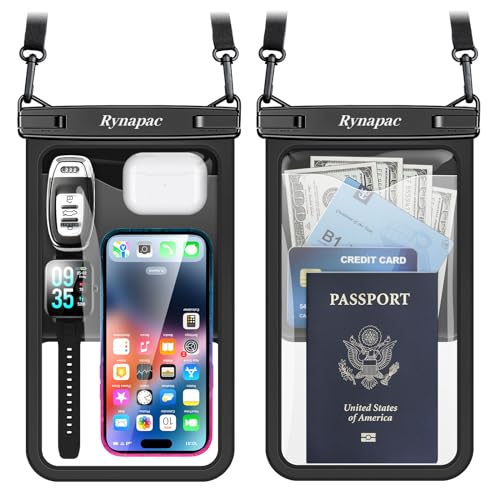
Phone cases included with some products have their own ratings. The Earth Pak bundle lists an IPX8 phone case, while STOVER lists an IP58 phone case. Those technical ratings apply to the separate cases, not automatically to the dry bags. Keep phones and other sensitive electronics in an additional protective layer when the consequences of water exposure are high.
Match material and seams to the trip
PVC and vinyl constructions appear on several marine-oriented bags. Unigear and Earth Pak document 500D PVC, while HEETA specifies 0.5 mm PVC and STOVER lists reinforced vinyl. These materials are positioned for abrasion resistance, welded seams, and water-sport use, but they can weigh more than thin nylon.
The Sea to Summit set uses PU-coated 70D nylon with a DWR finish, and Frelaxy uses 210T tear-resistant polyester with taped seams. These lighter fabrics are attractive when every ounce matters and when the bags will mainly be packed inside a larger boat, backpack, or travel case. They may be less appropriate for repeated scraping against rough surfaces than a heavier PVC-style construction; the supplied listings do not provide comparable abrasion test results.
Look for how seams are described. High-frequency welding, thermal welding, fully welded seams, taped seams, and seamless construction all provide useful specification clues. They do not eliminate the need to inspect the closure, avoid overfilling, and keep the roll top clear of debris.
Choose a carry system that fits the capacity
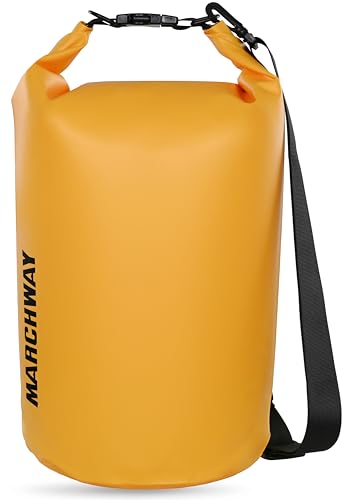
Compact sacks commonly use a single adjustable shoulder strap. The Unigear 5L, MARCHWAY 10L, Earth Pak 20L, and HEETA models follow this pattern. A removable strap is useful when the bag will be lashed inside a kayak or placed inside another pack.
Backpack-style straps become more useful as capacity increases. SHENDU’s 20L model has padded removable straps and can also be carried by shoulder or hand. The listings for some product families specify backpack straps on larger sizes, but the exact selected size should always be checked before purchase. A larger capacity can hold more gear, but it also encourages heavier loading, which changes how comfortable the bag is to carry.
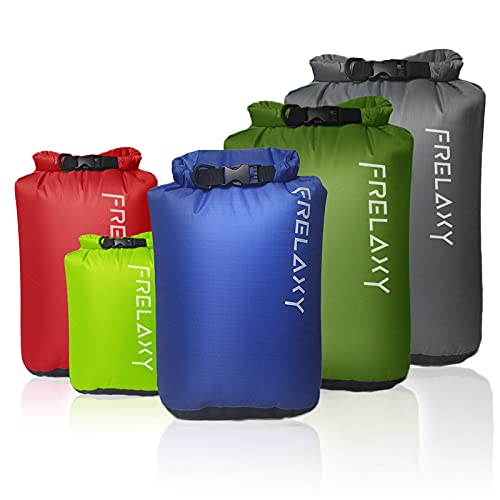
The Osprey sack is the clearest minimalist choice because its listed weight is only the current price. Frelaxy also provides individual weights in grams, ranging from 35g to 60g across its five sizes. By contrast, PVC bags may offer a more rugged construction profile without being the lightest option. Compare the empty bag weight with the intended contents rather than choosing by material alone.
Use capacity and shape strategically
Capacity is only part of usable storage. The Sea to Summit set gives three smaller compartments, which can separate clothing, food, and electronics. Frelaxy covers five sizes from 3L to 20L, making it suitable for modular packing. A single 10L or 20L bag is simpler when the contents are irregular or when one waterproof compartment is preferred.
Shape affects how the bag fits in a boat or pack. Osprey and Frelaxy document rectangular shapes or bases for efficient packing. MARCHWAY uses a round bottom designed to capture air and provide buoyancy when properly sealed. An oval base, as on the Sea to Summit set, is intended to resist rolling. These differences are practical rather than universally better: a flat or rectangular base may pack neatly, while a rounded base may help a sealed bag stay visible on water.
Look for useful secondary storage
Extra pockets can improve access but may create another water-management point. HEETA’s 10L model has a splash-proof front zippered pocket for small essentials. STOVER adds an inner pocket, and SHENDU includes a front mesh pocket intended for wet items. These are helpful for organization, but the listings do not describe them as equivalent to the main dry compartment.
Attachment points also matter on a boat. Unigear and Osprey document D-rings, while Sea to Summit adds a D-ring and base lash loop. Frelaxy includes a D-ring for clipping to a backpack. These points can help secure a bag, but use appropriate straps or clips and avoid treating a small attachment point as a lifting handle for a heavy load.
Final recommendation
Earth Pak 20L Waterproof Marine Dry Bag ranks first overall in this specification-based comparison under the published weighted criteria.
Osprey Ultralight 3L Waterproof Dry Sack is the highest-scoring returned product and the first overall specification-based choice for shoppers prioritizing minimal empty weight and compact organization. The best lightweight marine dry bags for broader day-trip use include the Sea to Summit Lightweight Dry Bag 3-Piece Set for modular packing, Frelaxy Dry Bag 5 Pack for measured low-weight organization, and MARCHWAY Floating Waterproof Dry Bag 10L for a more marine-oriented floating design.
For a medium load, Earth Pak 20L adds 500D PVC construction and a separate IPX8 phone case, while SHENDU 20L offers more carrying flexibility through its convertible straps. The HEETA 10L is a sensible choice when a splash-proof quick-access pocket matters. Before ordering, confirm the selected capacity, strap arrangement, closure instructions, and whether the listing’s water claim applies to splashes, rain, floating, or submersion. These details separate the top lightweight marine dry bags from one another more reliably than color or branding.
Frequently Asked Questions
Among the best lightweight marine dry bags, what capacity should I choose for a marine dry bag?
Choose 3L to 5L for phones, documents, snacks, or a spare small layer. A 10L bag provides more room for day-trip essentials, while 20L is better for clothing, towels, and multiple personal items. Multi-bag sets such as the Sea to Summit 3-piece set or Frelaxy 5 pack can divide a total load into easier-to-manage sections.
Are lightweight dry bags safe to submerge?
Not automatically. Osprey specifies IPX5 non-submersible protection, and Frelaxy advises avoiding full submersion. Some other listings describe floating or waterproof use but do not provide a formal submersion rating for the main bag. Follow the specific product instructions, roll the top correctly, and use an additional protective layer for critical electronics.
Is PVC or coated nylon better for marine use?
The answer depends on the use. PVC and vinyl bags such as Unigear and Earth Pak document thicker or 500D constructions and welded seams, which may suit abrasion-prone boating environments. Coated nylon and polyester options such as Sea to Summit and Frelaxy emphasize lower weight. The supplied evidence does not establish a universal winner, so weigh surface durability against the empty-bag weight you are willing to carry.
Extra pockets are useful for access but should not automatically be treated as dry compartments. HEETA’s front pocket is described as splash-proof, while SHENDU’s front pocket is mesh for wet items. Keep water-sensitive belongings in the main sealed compartment unless the pocket is specifically documented for waterproof storage.
How do I carry a 20L marine dry bag?
A shoulder strap is adequate for a moderate load, while padded backpack straps can distribute weight more comfortably. Earth Pak’s 20L model uses an adjustable shoulder strap, and SHENDU’s 20L model provides backpack, shoulder, and handheld carry modes. The right choice depends on how far the bag must be carried and whether the load will be heavy once filled.