Buying Guide
The best floating marine dry bags should be judged by more than the word “waterproof” in a title. A useful comparison starts with the main chamber, how it closes, what creates flotation, and how the bag is carried when loaded. The products above are selected from public listing evidence rather than hands-on testing or customer-opinion summaries.
Start with the closure and seam construction
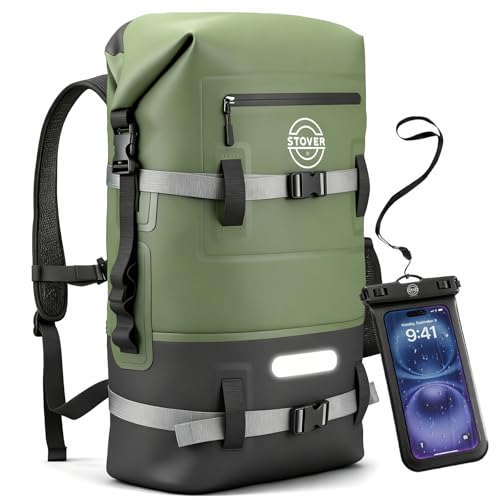
A roll-top closure is the dominant design in this group. MARCHWAY, Piscifun, Lamicall, STOVER, Baitoo, and Earth Pak all describe folding or rolling the opening before buckling it. This matters because flotation is generally tied to trapping air in the sealed main compartment. The closure is not a substitute for following the maker’s instructions: the listings commonly qualify flotation or water protection with proper sealing, and some distinguish surface exposure from extended underwater use.
Seam construction is another useful specification. Piscifun lists fully welded construction and 500D PVC, while Earth Pak lists commercial-grade 500D PVC with thermowelded seams. Lamicall documents airtight welded seams in high-density 500D PVC, and MARCHWAY describes welded seams with reinforced construction. These details provide more decision-making information than a broad waterproof claim alone.
Match capacity to the load
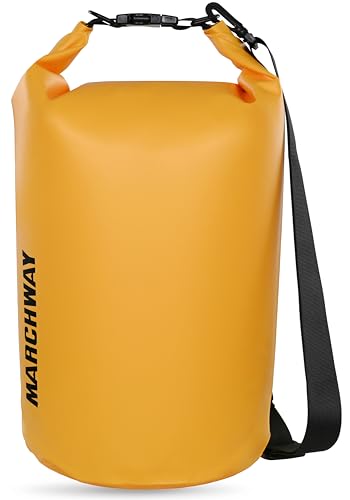
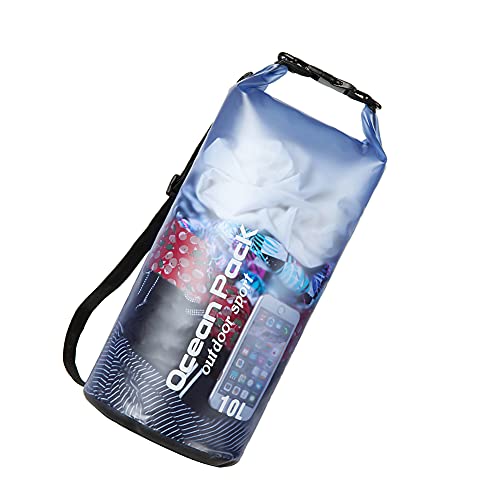
Small bags are useful when the goal is to isolate a phone, wallet, clothing layer, or other essentials. MARCHWAY, Baitoo, and Lamicall list smaller formats, while the broader size ranges from MARCHWAY and STOVER allow the same product family to cover different outings. A 10L bag can suit compact personal gear, but it may not leave room for bulky towels or multiple clothing layers.
For day trips, 25L to 35L options create more room without automatically moving into expedition-sized luggage. The STOVER 25L, YakAttack 28L, STOVER 30L listing, DRYSAFE 35L, and ProCase 35L each occupy this middle range. Capacity alone does not describe usable space: the ProCase separates dry storage from an inflatable chamber, while backpacks such as YakAttack and STOVER use a conventional main compartment.
A 40L option is better when the bag must carry more clothing, tackle, or shared supplies. Piscifun and Earth Pak list 40L versions, and STOVER lists larger formats up to 55L. Larger capacity can also increase the importance of padded straps, sternum clips, waist belts, or back support.
Choose the carry system deliberately
A shoulder strap is compact and appropriate for lighter loads. MARCHWAY’s 10L listing uses a removable adjustable strap, and the Baitoo listing gives limited carry-system information. Backpack straps distribute weight more evenly across the shoulders. Piscifun specifies adjustable double shoulder straps, while YakAttack adds padding, a breathable back panel, and a sternum strap.
For extended carrying, DRYSAFE documents a padded back panel, contoured shoulder straps, sternum strap, and waist belt. STOVER’s larger model includes padded back support and a sternum clip. The STOVER 25L adds flexibility by documenting backpack, cross-body, and top-handle carry. These features do not prove comfort for every person, but they are relevant design signals when comparing loaded bags.
The ProCase is a different design type. It is an inflatable swim buoy with a separate dry compartment, detachable shoulder straps, and waist-belt use. That makes it relevant for open-water swimming and visibility-focused activities, but less directly comparable to a conventional cargo backpack.
Separate waterproof storage from quick access
An exterior pocket can be convenient, but it may not have the same water protection as the main roll-top compartment. Earth Pak documents a zippered front pocket, Piscifun includes an outer mesh pocket, and Lamicall and STOVER describe splash-resistant or wet/dry front storage. Keep electronics and other water-sensitive items in the sealed chamber unless the listing specifically identifies another compartment as waterproof.
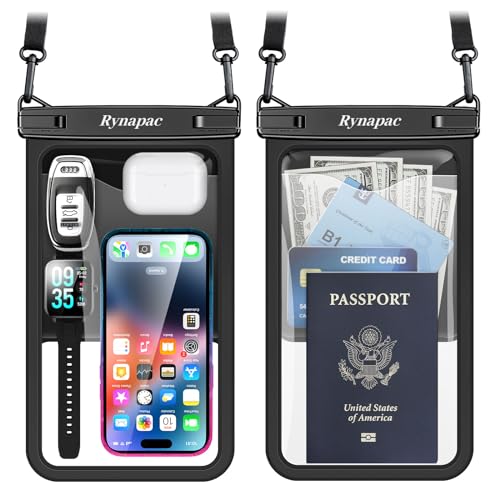
Phone cases are common extras in this category. Piscifun and Earth Pak list IPX8 cases, Lamicall lists an IPX8 pouch, and STOVER documents an IP58 case. These technical ratings apply to the accessory as described; they do not automatically change the rating of the bag’s exterior pocket or prove protection in every situation.
Consider visibility and attachment points
Bright colors can help locate a bag on the water. ProCase emphasizes a highly visible orange swim buoy, while MARCHWAY documents a D-ring and strap for securing the bag to a boat or kayak. STOVER includes reflective details, and DRYSAFE lists D-rings and MOLLE loops. These features are useful when tying down equipment, improving visibility, or keeping a bag within reach, but they should not be treated as a replacement for appropriate on-water practices.
Final recommendation
Earth Pak 40L Waterproof Dry Bag Backpack ranks first overall in this specification-based comparison under the published weighted criteria.
YakAttack 28L DryPak Waterproof Backpack is the first overall specification-based choice among these best floating marine dry bags. Its combination of sealed 210D nylon, explicit flotation, useful day-trip capacity, padded harness, breathable back panel, and sternum strap gives it the most specification-aligned balance for general kayaking and boating use. Earth Pak is a better fit when a zippered front pocket and 40L capacity matter more, while STOVER’s larger model suits heavier loads. For open-water swimming, ProCase’s separated air chamber and visibility-focused design are more purpose-specific. These are also among the top floating marine dry bags for clearly differentiated use cases, not interchangeable claims of tested performance.
Frequently Asked Questions
What makes the best floating marine dry bags float?
The listed designs generally rely on air trapped inside a properly sealed roll-top main compartment or, in ProCase’s case, a dedicated inflatable air chamber. MARCHWAY, Baitoo, Lamicall, YakAttack, and Earth Pak explicitly connect their designs with flotation. Do not overload a bag or assume that an unsealed or damaged closure will remain buoyant.
Are floating dry bags fully waterproof underwater?
The supplied listings support water protection when the bags are properly sealed, but they do not establish a universal guarantee for prolonged submersion. Follow the product’s own closure instructions and keep sensitive items in the main sealed chamber.
What size dry bag should I choose for kayaking?
Choose based on the gear rather than the activity name alone. A 10L bag can suit compact essentials, 25L to 35L bags work for many day-trip loads, and 40L or larger models provide more room for clothing and shared equipment. Remember that specialized designs such as ProCase reserve part of their stated capacity for an inflatable air chamber.
Are exterior pockets safe for phones and electronics?
Not necessarily. Several selected products describe exterior storage as mesh, splash-proof, or separate from the waterproof main compartment. Put phones, cameras, and other sensitive electronics inside the sealed roll-top chamber or a documented waterproof phone case. An exterior pocket is best treated as quick-access storage unless the listing states otherwise.
Which design is best for open-water swimming?
ProCase is the most specialized option in this comparison because it is designed as a swim buoy with a separate dry storage compartment, inflatable air chamber, detachable straps, and high-visibility coloring. Conventional backpacks such as YakAttack or Piscifun are more appropriate when the priority is carrying gear on land or in a boat rather than towing a buoy while swimming.