Buying Guide
The best low-profile bottle jacks are selected by matching the jack’s retracted height and capacity to the load point, then checking how much adjustment is available above that starting point. A jack is a lifting tool, not a substitute for properly rated support stands. Confirm the vehicle or equipment manufacturer’s lifting points, use a firm and level surface, and follow the product instructions before beginning work.
Start with minimum height
Minimum or retracted height is the first specification to compare when clearance is limited. The BIG RED ATH810002R and TCE ATH810002U-1 both list a 4.92-inch retracted height, making them the most clearance-focused selections here. Their double-ram designs also provide a higher extended height than the starting point alone suggests. That combination may suit lowered vehicles or equipment with restricted access, but the available maximum height remains limited compared with taller conventional models.
The BIG RED ATH92007AR and YELLOW JACKET AS92007A list 6.5-inch minimum heights, while the BIG RED TQ20006D-1 and AQYL20R begin at 7.06 inches. The VEVOR model lists 6.69 inches, and the Pro-LifT B-S12W lists 6.38 inches. Measure the actual clearance at the intended lift point rather than relying on a general vehicle height. Suspension position, tire condition, and the shape of the lifting point can all affect whether the jack fits.
Match capacity to the application
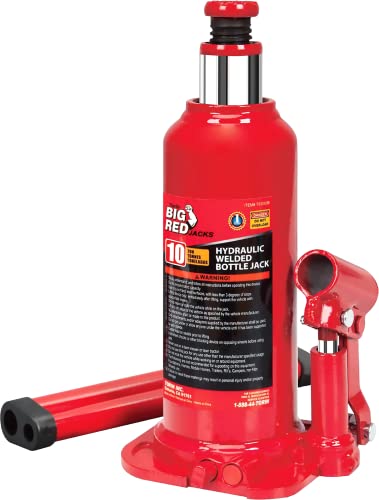
Capacity should exceed the load the jack is expected to lift, but a higher rating does not automatically make a jack suitable for every vehicle. The 20-ton models provide the largest documented capacity in this comparison, including the BIG RED ATH92007AR, YELLOW JACKET AS92007A, BIG RED TQ20006D-1, BIG RED AQYL20R, and VEVOR jack. The 12-ton models offer substantial capacity for many automotive, truck, farm, and RV tasks, while the two double-ram models are rated at 10 tons.
Do not calculate a vehicle’s full weight as the direct load on one jack without considering the manufacturer’s lifting procedure and load distribution. The rating is one part of fit; the contact point, surface, saddle, and support equipment matter as well. For commercial or industrial work, compare the stated capacity with the equipment documentation and workplace requirements.
Compare lift range and adjustment
A low starting height is useful only if the jack can raise the load high enough for the intended task. The BIG RED ATH92007AR reaches 11.25 inches, the YELLOW JACKET AS92007A reaches 11.25 inches, and the BIG RED TQ20006D-1 and AQYL20R reach 12.63 inches. The VEVOR model lists a maximum of 12.6 inches and a 2.4-inch screw adjustment. The BIG RED T91207A lists the tallest range in this group, from 7.5 to 13.81 inches.
An adjustable screw top helps close the gap between the saddle and the lifting point and can provide additional working height. It does not mean the jack should be used beyond its specified range. The Performance Tool W1643 and Pro-LifT B-S12W also document screw-top adjustment, while the double-ram models rely on their ram design for additional travel.
Choose manual or air-assisted operation
Manual hydraulic jacks are generally the simpler choice when portability, storage, and independence from shop equipment are priorities. The BIG RED ATH92007AR, BIG RED T91207A, YELLOW JACKET AS92007A, Pro-LifT B-S12W, and Performance Tool W1643 use conventional manual hydraulic operation as described in their listings. Features such as glide-action pumps may reduce pumping effort, but the supplied evidence does not establish a comparative performance result.
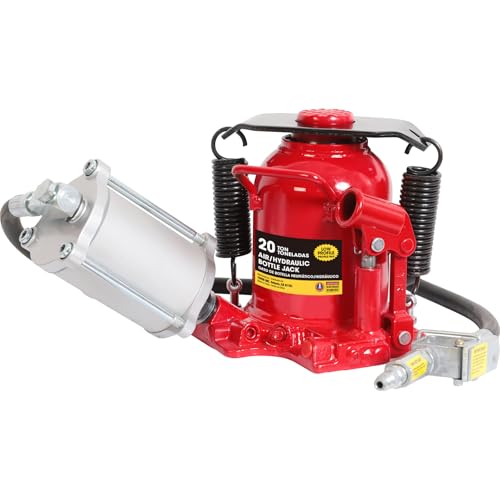
Air-assisted models can add a pneumatic lifting mode where a compatible compressor is available. The BIG RED TQ20006D-1 and BIG RED AQYL20R provide air and manual operation, so manual control remains available when compressed air is not. That flexibility comes with additional equipment and typically a larger, heavier format. Check hose fittings, compressor requirements, storage space, and the working environment before choosing an air-hydraulic design.
Inspect construction and safety specifications
Construction details help distinguish these products beyond capacity labels. Welded bodies appear across several selections, including the BIG RED, YELLOW JACKET, VEVOR, and Pro-LifT models. Drop-forged or alloy-steel construction is documented for several of them, while the Performance Tool W1643 lists a one-piece cast-steel base. A serrated, heat-treated saddle is specified for the BIG RED ATH92007AR, BIG RED T91207A, YELLOW JACKET AS92007A, and Pro-LifT B-S12W.
Overload valves, bypass systems, and safety valves are documented on many of the selected jacks. These features are intended to help prevent hydraulic overextension or overloading, but they do not eliminate the need to stay within the rated capacity. A broad or rugged base may help positioning, yet the jack should still be placed on a stable surface and centered correctly under the approved lifting point.
Consider storage and handling
Weight and handle design affect how easily a bottle jack can be positioned. The TCE ATH810002U-1 lists a weight of the current price, while the Performance Tool W1643 lists the current price and the BIG RED ATH92007AR lists the current price. Air-hydraulic models list heavier weights, and their hoses or compressor connections add equipment to manage. The VEVOR model’s three-section handle may improve leverage and storage flexibility, but its longer handle arrangement should fit the available space.
Before buying, verify that the jack’s footprint, handle clearance, and storage dimensions work with your vehicle, service cart, or roadside kit. A compact body is useful only when it can be safely positioned and operated without interference.
Final Recommendation
BIG RED ATH92007AR 20-Ton Stubby Bottle Jack ranks first overall in this specification-based comparison under the published weighted criteria.
BIG RED ATH92007AR is the highest-scoring returned product and the first overall specification-based choice among the best low-profile bottle jacks. Its 20-ton capacity, 6.5-inch minimum height, adjustable screw top, welded alloy-steel body, serrated saddle, and documented overload protection create a well-rounded specification profile in this comparison.
Choose the BIG RED ATH810002R or TCE ATH810002U-1 when a 4.92-inch starting height is the deciding requirement. Select the BIG RED TQ20006D-1 or BIG RED AQYL20R when air-assisted lifting and manual backup are important. For a conventional 12-ton design, the BIG RED T91207A and Pro-LifT B-S12W offer a useful balance of capacity, adjustment, and construction features. The VEVOR model is worth considering for its three-section handle and 2.4-inch screw adjustment, while the Performance Tool W1643 keeps the design relatively straightforward.
These are the top low-profile bottle jacks based on the supplied specifications, not hands-on test results. Confirm clearance, capacity, lift points, operating requirements, and safety procedures for the specific job before purchase or use.
Frequently Asked Questions
Among the best low-profile bottle jacks, what minimum height should I look for in a low-profile bottle jack?
Measure the clearance at the approved lifting point, then choose a jack whose retracted height is below that measurement with a practical margin. The BIG RED ATH810002R and TCE ATH810002U-1 list a 4.92-inch starting height. A vehicle’s advertised ride height may not equal the clearance available at the actual lift point.
Are 20-ton bottle jacks better than 10-ton models?
Not automatically. A 20-ton jack provides a higher documented capacity, but a 10-ton model may be easier to position or may offer the required low starting height. The BIG RED ATH810002R and TCE ATH810002U-1 combine 10-ton ratings with 4.92-inch retracted heights. Select a rating that fits the manufacturer’s lifting procedure and the intended load rather than choosing solely by the largest number.
Do air-hydraulic bottle jacks require a compressor?
Air operation requires a compatible compressed-air supply. The BIG RED TQ20006D-1 and BIG RED AQYL20R also document manual operation, which provides an alternative when air is unavailable. Review the connection and operating requirements before relying on pneumatic lifting at a roadside or remote location.
Is an adjustable screw top important?
It can be useful for reducing the gap between the saddle and lifting point and for accommodating different working heights. Models such as the BIG RED ATH92007AR, BIG RED T91207A, VEVOR jack, and Pro-LifT B-S12W document adjustable screw features. The screw does not increase the jack beyond its stated safe operating range.
Can I work under a vehicle supported only by a bottle jack?
No. A bottle jack is intended to lift, not serve as the sole support while someone works beneath a vehicle. Follow the vehicle and jack instructions, use appropriately rated support stands at approved points, and ensure the surface and setup are stable before starting maintenance.