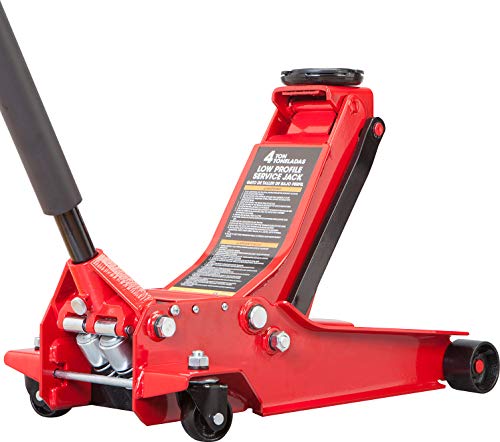
Buying Guide
Choosing among the best low profile car floor jacks starts with the saddle entry height, because that number decides whether the jack will physically fit under the lowest point on the car. After clearance, lifting range and capacity determine whether the jack can actually raise the vehicle to a useful working height. Materials, pump design, mobility, and safety hardware round out the practical differences between models.
Measure Ground Clearance Before Anything Else
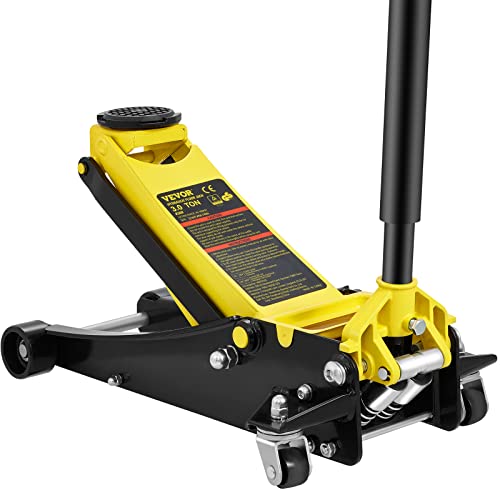
The minimum height listed for each jack is the dimension from the floor to the underside of the saddle when fully lowered. If the lowest point of the vehicle sits lower than that number, the jack will not slide underneath. The VEVOR 3 Ton Low Profile Floor Jack with foot pedal posts a 2.95-inch minimum, the SATA 3-Ton Steel Low Profile Floor Jack (Ultra-Low) sits at 2-11/16 inches, and the AV Steel 3 Ton Low Profile Floor Jack comes in at 3-1/8 inches. For most modern sports sedans and lowered cars, a sub-3.5-inch entry is a safe starting point, while lifted trucks and SUVs usually do not need that level of clearance.
Match Capacity to the Heaviest Vehicle in the Garage
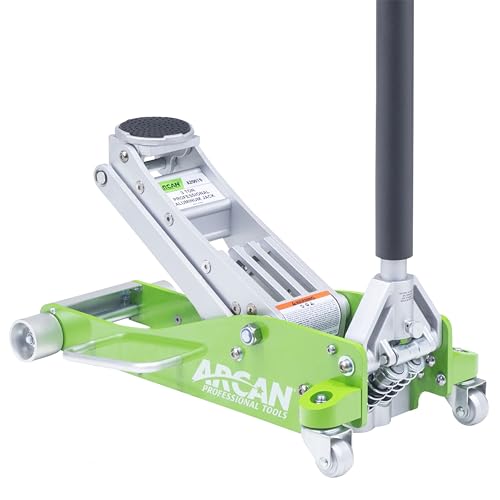
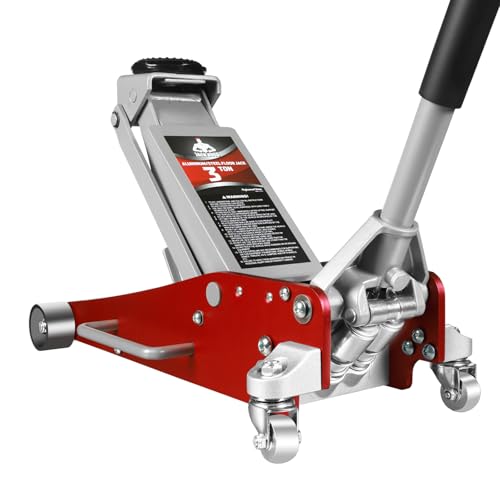
A 2-ton jack handles most passenger cars and small crossovers. A 2.5-ton model covers heavier sedans, minivans, and lighter SUVs. A 3-ton jack, like the VEVOR 3 Ton Aluminum and Steel Racing Floor Jack, the Jack Boss 3 Ton Low Profile Aluminum and Steel Racing Jack, the Hantec HGP96, or the ARCAN A20019, is the safer choice for SUVs, light trucks, and any future-proofing. When in doubt, go up one capacity class.
Check the Maximum Lift, Not Just the Minimum
A very low entry does little good if the jack cannot raise the vehicle high enough to swing a wheel off the ground or place jack stands. Look at both ends of the range. The VEVOR 3 Ton Low Profile Floor Jack (Steel), the VEVOR 3 Ton Aluminum and Steel Racing Floor Jack, the AV Steel 3 Ton, and the SATA Ultra-Low all reach 19 inches or more, which helps with taller ride heights and gives more clearance for stands. Shorter maximums, like the Hantec HGP96 at 17.7 inches, are fine for cars but may feel tight on higher vehicles.
Single-Piston vs Dual-Piston Pumps
Dual-piston quick lift pumps, found on the AV Steel 3 Ton, the SATA 3-Ton Steel, the VEVOR 3 Ton models, the Jack Boss 3 Ton, and the Hantec HGP96, cut the number of strokes significantly, which is helpful in a busy shop. The Hantec HGP96 even advertises a full-height express lift in about 10 strokes.
Frame Materials and Weight
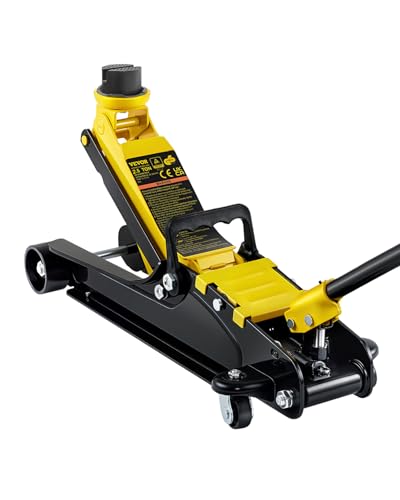
Steel frames, such as on the ARCAN A20003 and the VEVOR 2.5 Ton Steel, are heavier but often more rigid for daily shop abuse. Weight matters because a 70+ pound jack is harder to carry out to a driveway than a 30 to 60 pound hybrid.
Mobility, Saddle, and Safety Hardware
Universal rear wheels, swivel front casters, and side-mount or top handles all change how easy a jack is to position under a car. Look for a rubber or padded 360-degree saddle to protect frame rails, plus a built-in overload or bypass valve. Most models in this list, including the VEVOR 3 Ton Low Profile Floor Jack with foot pedal and the SATA Ultra-Low, meet ANSI/ASME, CE, or UKCA standards. Use jack stands anytime the vehicle will be off the ground for any period.
Final Recommendation
VEVOR Low Profile Floor Jack, 3 Ton ranks first overall in this specification-based comparison under the published weighted criteria.
The final choice among the best low profile car floor jacks depends on the documented features that match your intended use.
After weighing low-profile entry, lifting range, capacity, pump design, and frame materials side by side, the VEVOR Low Profile Floor Jack with foot pedal earns the first overall specification-based choice because it pairs the lowest saddle entry in the group at 2.95 inches with a 19.7-inch maximum lift and a 3-ton capacity. For workshops that want speed and warranty coverage, the Hantec HGP96 stands out with its 10-stroke express lift and 2-year warranty. These are the top low profile car floor jacks in this comparison when measured purely on specification fit.
Frequently Asked Questions
Among the best low profile car floor jacks, what minimum saddle height do I need for a low profile car floor jack?
Measure the lowest point of the vehicle, usually a side skirt, splitter, or factory jacking point, and choose a jack whose minimum height is at least 0.25 to 0.5 inches lower than that. For heavily lowered sports cars, a sub-3-inch entry like the VEVOR 3 Ton Low Profile Floor Jack with foot pedal (2.95 inches) or the SATA 3-Ton Steel Ultra-Low (2-11/16 inches) is a safer pick than 3.5 inch models.
How much capacity is enough for most cars and SUVs?
A 2-ton jack is adequate for most compact and midsize passenger cars, while a 2.5-ton jack covers heavier sedans and small SUVs. For light trucks and heavier SUVs, a 3-ton model such as the VEVOR 3 Ton Aluminum and Steel Racing Floor Jack or the ARCAN A20019 is the safer long-term option.
Are aluminum low profile floor jacks strong enough for daily use?
Yes, in the context of normal passenger and light truck lifting. They trade some rigidity for easier maneuvering.
Do dual-piston pumps really matter on a low profile car floor jack?
Dual-piston pumps reduce the number of handle strokes needed to reach maximum height, which matters in a working shop or for anyone who lifts cars frequently.
Can a low profile floor jack also serve as a jack stand?
No. Every low profile car floor jack in this comparison is designed for lifting only. After raising the vehicle, place appropriately rated jack stands under the factory support points before working underneath. The selected models document this requirement explicitly, and the best low profile car floor jacks pair with jack stands for any service that requires time under the vehicle.