Buying Guide
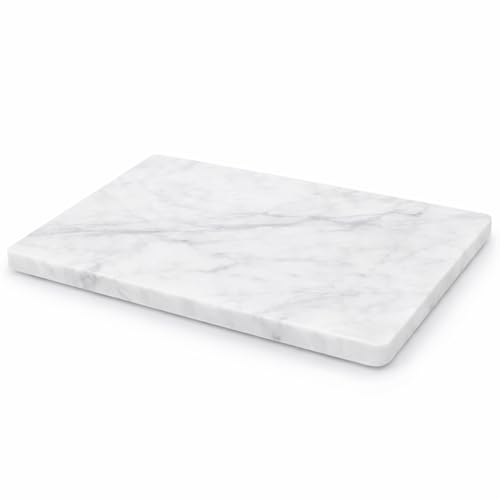
A marble tray is more than a slab of stone — the cut, finish, base, and proportions determine how well it handles real use. When evaluating the best marble serving trays, focus on documented specifications rather than marketing language, since marble grades, thicknesses, and finishes vary widely between brands.
Material authenticity
The first decision is whether the tray is solid natural marble or a composite imitation. Listings in this comparison explicitly state when products are made from 100 percent natural stone such as Carrara, Calacatta Viola, Italian-sourced white marble, or travertine. Solid marble trays are heavier, more durable, and develop a unique vein pattern per piece, while resin or ceramic alternatives are lighter but less heat-tolerant.
Surface area dictates how the tray will actually be used. Rectangular trays around 12 by 8 inches, like the FutureStone, Zilukar, and DUANYAN pieces, handle perfume bottles, candles, and small serveware. Larger 14-by-10-inch boards from Santa Barbara Design Studio or Creative Co-Op suit charcuterie spreads. Narrow 12-by-6-inch trays from Bloomingville fit tight counters and narrow dining tables.
Stability and base design
Heavier stone trays resist tipping and sliding during use, which matters for entertaining. Non-slip pads or rubber feet are documented on the FutureStone, YMXYJM, Zilukar, DUANYAN, and KC KULLICRAFT products. Footed designs from Santa Barbara Design Studio elevate the surface but trade some sliding mobility for visual presence.
Finishing and craftsmanship
Polished finishes highlight veining and make wiping easy, while hand-carved details such as the YMXYJM fluted edge and the Creative Co-Op scalloped edge add visible character. Spec sheets confirm hand-polished and polished-finish surfaces on most entries, with unique vein patterns expected per piece.
Functional versatility
Some trays are built for one job — a pedestal cake stand or a rotating lazy susan — while others cross between vanity, kitchen, and dining use. The KC KULLICRAFT board is documented for cheese, charcuterie, pastry prep, and food service.
Care and durability
Natural marble requires mild care: most listings recommend wiping with a soft damp cloth and drying immediately. Hand-wash-only instructions on Creative Co-Op, Bloomingville, and KC KULLICRAFT pieces preserve the polished surface, while pedestal trays from Santa Barbara Design Studio accept similar wipe-clean routines. Avoid soaking or acidic cleaners to maintain the finish.
Matching tray type to room
Bathroom and vanity counters benefit from rectangular trays with non-slip pads and contained footprints, such as the YMXYJM Calacatta Viola or the Zilukar Italian-style tray. Dining tables favor larger boards or footed risers like the Santa Barbara Design Studio Waterfall Marble Tray. Kitchens used for baking benefit from cool, solid marble slabs like the KC KULLICRAFT board for pastry work.
Final recommendation
Santa Barbara Design Studio Waterfall Marble Tray, 14" x 10" ranks first overall in this specification-based comparison under the published weighted criteria.
The final choice among the best marble serving trays depends on the documented features that match your intended use.
The FutureStone 12" x 8" Natural Carrara Marble Tray is the most specification-aligned specification-based choice in this lineup for a versatile rectangular marble serving tray. It pairs 100 percent natural marble with documented non-slip padding, a manageable 1600-gram weight, and a polished surface that wipes clean. For shoppers prioritizing statement craftsmanship, the YMXYJM Calacatta Viola Marble Tray delivers a hand-carved fluted edge with four-corner stability pads. Larger tables should consider the Santa Barbara Design Studio Waterfall Marble Tray for its 14-by-10-inch surface and 2.5-inch pedestal elevation. Together, these three represent the top marble serving trays for a balance of material quality, functional design, and care practicality across the most common entertaining and organization scenarios.
Frequently Asked Questions
Among the best marble serving trays, what size marble serving tray works best for a vanity?
For most vanities, a rectangular tray between 11 and 12 inches long and 6 to 8 inches wide offers enough surface for perfume bottles, candles, or daily essentials without overwhelming the counter. The FutureStone, YMXYJM, and Zilukar trays all sit in this footprint range and document non-slip pads suitable for vanity tops.
Are solid marble trays heavy to move around?
Solid marble trays are noticeably heavier than resin, wood, or metal alternatives. The entries in this comparison range from about 2.5 pounds for the YMXYJM Calacatta Viola tray up to 7.27 pounds for the Santa Barbara Design Studio 12-inch square footed board. Higher weights can add stability but may be cumbersome to reposition frequently.
How should I clean a marble serving tray?
Most manufacturers recommend wiping with a soft damp cloth and drying immediately, avoiding acidic cleaners or prolonged soaking. Hand-wash-only instructions are listed on the Creative Co-Op, Bloomingville, and KC KULLICRAFT boards to preserve the polished surface.
Can marble trays be used for food and charcuterie?
Yes, marble is a traditional serving surface for cheese, charcuterie, and pastries. The KC KULLICRAFT and Santa Barbara Design Studio boards are documented specifically for food service, while the Bloomingville 12" x 6" Marble Food Serving Tray and Creative Co-Op 14" board also serve food on solid marble surfaces.
What is the difference between a marble tray and a marble lazy susan?
A marble tray is a static surface, while a marble lazy susan adds a rotating base for shared dining. Choosing between them depends on whether you need spin-to-share functionality or a fixed presentation platform.