Buying Guide
Choosing the best marble mosaic tiles starts with separating the visual idea from the installation conditions. The products in this comparison are not hands-on tested, and the rankings use supplied listing descriptions and specifications. Natural marble sheets, marble-and-glass blends, and marble-look adhesive products can all create a mosaic surface, but they do not have the same material or installation requirements.
Start with the material
Natural stone is the defining feature of the most specification-aligned traditional options here. The Diflart Carrara selections, Adolif Carrara and Calacatta Gold products, Midcard mosaic, Tenedos floral sheet, SUNWINGS stone sheets, and Blujellyfish linear tile all describe marble or natural stone in their supplied evidence. That means the color, veining, and tonal variation are part of the material character rather than a printed imitation. The listings for several products recommend ordering a sample or checking color before a larger commitment, which is sensible when the stone appearance matters across a broad surface.
The Vamos Tile long-hexagon product is different. It is described as a PVC composite laminate with a glossy white marble look. It may be useful for a faster backsplash update, but it should not be compared with natural marble on stone authenticity. Treating it as a DIY alternative helps clarify the trade-off: easier handling and broad package coverage in exchange for a synthetic construction.
Match the pattern to the room
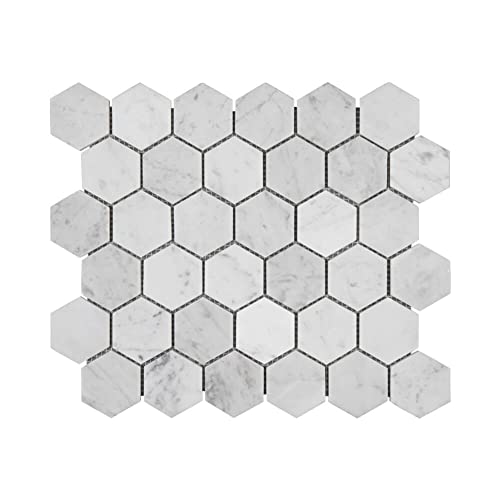
Pattern affects both the visual scale and the amount of grout in the finished surface. Two-inch hexagons, such as the Diflart and Adolif Carrara options, are flexible choices for backsplashes, shower walls, and floors. They provide a recognizable geometric look without the more directional movement of herringbone. The honed Diflart version is matte, while the Adolif listing describes Carrara White without specifying a finish in the supplied points; compare the actual sample before ordering if surface sheen is important.
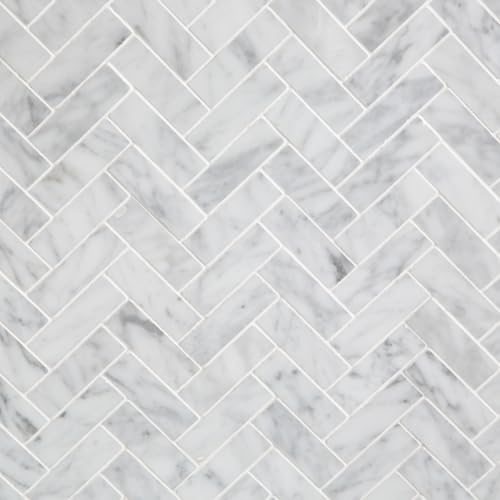
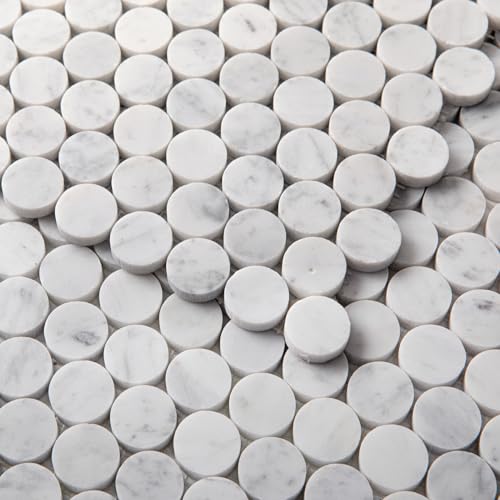
The Diflart 1-by-3-inch herringbone is more directional. Its polished finish and repeated angled layout can make a backsplash or accent wall more prominent. The 1-inch penny-round sheets from Diflart and Adolif create a softer, repeated curve. They also use many small pieces, so grout lines become a larger part of the overall appearance.
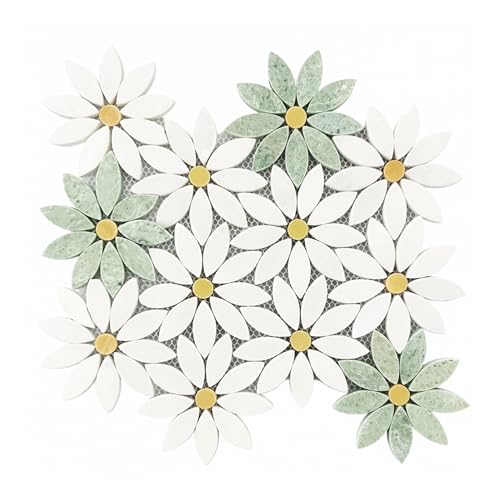
For a stronger color statement, Midcard combines Emerald Green and Carrara White marble in a square pattern. Tenedos uses Thassos White and Ming Green in a daisy design with golden center details. These are feature-oriented choices rather than anonymous neutral backdrops. Blujellyfish adds blue glass to gray marble in a linear arrangement, making it another option when a cool accent is wanted.
Check sheet size and coverage
Package count alone does not tell you how much material a product covers. The listing data gives useful differences: the Diflart hexagon covers 3.5 square feet per five-sheet box, the Adolif hexagon covers 4.1 square feet, the Diflart penny round covers 4.4 square feet, and the Blujellyfish linear tile covers 5 square feet per five sheets. SUNWINGS lists 4.3 square feet for five sheets. The Vamos Tile PVC option lists about 10 square feet for ten sheets.
Measure the installation area, then account for cuts, corners, and pattern alignment. One listing recommends adding 10% for cuts, waste, or future replacement needs, while another suggests ordering all required material in one order because slight variation can occur between orders. Those instructions are especially relevant to natural stone, where matching pieces may be less predictable than matching synthetic sheets.
Consider the installation method
Mesh backing is common across the natural-stone products and can help hold the mosaic layout while the sheets are positioned. The Diflart herringbone and penny-round listings mention cutting with a wet saw. Adolif describes a back mesh that can be cut and positioned, and Midcard and Tenedos also describe mesh-mounted formats. These products still require a conventional tile installation approach; the Blujellyfish listing specifically says to use mortar and unsanded grout.
Peel-and-stick products follow a different process. SUNWINGS uses adhesive-backed natural stone and is described for clean, flat surfaces, including some existing smooth materials. However, the listing says it is not recommended for constantly wet or submerged areas. Vamos Tile also requires a clean, flat surface and describes cutting with a sharp utility knife or sturdy scissors. In either case, the substrate and moisture conditions should control the choice rather than the promise of fast installation alone.
Choose the finish deliberately
Honed finishes, such as those documented for the Diflart 2-inch hexagon, Diflart 1-inch penny round, and Adolif Gold Calacatta, have a subdued matte appearance. Polished options, including the Diflart herringbone, Tenedos daisy, and Blujellyfish linear tile, are described as glossy or reflective. A polished surface can emphasize light and color, while a honed surface gives the design a quieter appearance. The supplied evidence does not establish cleaning or slip performance beyond individual listing claims, so do not assume that a finish is suitable for every surface without confirming project requirements.
Plan for wet and high-use areas
The listings identify many of these products for shower walls, bathroom walls, backsplashes, and floors, but application language is not a substitute for project-specific installation instructions. Blujellyfish provides explicit mortar and grout guidance. SUNWINGS limits its use in constantly wet or submerged locations. The natural marble options list floors and shower applications, while the PVC product is positioned mainly around backsplashes and clean, flat walls. Verify substrate preparation, adhesive compatibility, sealing needs, and local installation requirements before beginning work.
Final recommendation
Diflart Carrara Herringbone Marble Mosaic ranks first overall in this specification-based comparison under the published weighted criteria.
Diflart Carrara Herringbone Marble Mosaic is the first overall specification-based choice among these selections. It combines genuine Italian Carrara marble, a clearly defined 1-by-3-inch herringbone pattern, polished finish, sturdy mesh backing, wet-saw cutting guidance, and 4-square-foot box coverage. It is a particularly strong fit for a backsplash or decorative wall where the pattern should be visible.
For a quieter matte look, the Diflart 2-inch Carrara hexagon and Diflart 1-inch penny round are practical alternatives. Adolif Gold Calacatta brings warmer color, while Midcard and Tenedos are better suited to feature designs. Blujellyfish is the choice for blue linear contrast and explicit mortar-and-grout direction. SUNWINGS can simplify a flat-wall update with natural stone adhesive sheets, but its wet-area restriction matters. Vamos Tile is among the top marble mosaic tiles only as a marble-look PVC alternative: its large stated coverage and self-adhesive installation are useful, but it is not natural marble.
The best marble mosaic tiles for your project therefore depend on whether authentic stone, pattern, coverage, or installation speed is the main constraint. Order samples where suggested, calculate waste, and compare the substrate and moisture conditions with the product’s documented application limits.
Frequently Asked Questions
What are the best marble mosaic tiles for a kitchen backsplash?
The Diflart Carrara herringbone, Diflart 2-inch hexagon, Diflart penny round, and Adolif Gold Calacatta are strong documented options for backsplashes. The herringbone is more directional, the hexagon is geometric, and the penny rounds are softer and more repetitive. For a faster synthetic update, Vamos Tile lists a glossy marble-look PVC composite with self-adhesive backing.
Are mesh-mounted marble mosaic sheets easier to install?
Mesh mounting can help keep mosaic pieces in a sheet layout and is documented on many of the natural-stone selections. It does not eliminate surface preparation, mortar, grout, cutting, or layout work. Diflart mentions wet-saw cutting for two products, and Blujellyfish specifically calls for mortar and unsanded grout.
Can these marble mosaic tiles be used on shower floors?
Several listings identify their products for shower floors or bathroom floors, including the Diflart Carrara hexagon, Diflart penny round, Midcard, Tenedos, and Blujellyfish selections. The supplied data does not independently verify installation performance, so confirm the product’s technical suitability, substrate requirements, and local code requirements before using any tile in a shower floor.
What is the difference between honed and polished marble mosaic?
Honed marble is described as matte on the Diflart hexagon, Diflart penny round, and Adolif Gold Calacatta listings. Polished surfaces are documented for the Diflart herringbone, Tenedos daisy, and Blujellyfish linear tile. Honed and polished choices create different visual effects; use a sample to compare sheen and color with grout and surrounding materials.
Is a peel-and-stick marble-look tile real marble?
Not always. SUNWINGS describes natural stone with peel-and-stick backing, while Vamos Tile describes a PVC composite laminate with a marble look. The latter can be convenient for a clean, flat backsplash or wall, but it should be evaluated as a synthetic alternative rather than as a natural-marble mosaic.