Buying Guide
Choosing among the best microwave-safe egg cookers starts with the type of breakfast you actually prepare. A compact single-serving cup may be enough for one fried or scrambled egg, while a two-cavity tray is more useful for sandwiches or cooking two portions together. Larger omelet makers can accept more eggs and mix-ins, but they may occupy more cabinet space.
Match the cooker to your egg style
Poached-egg specialists usually provide shaped cavities that help form round portions. The Dependable Essentials two-cavity poacher is the clearest focused option in this group, while the Micro Grill Egg Mate emphasizes shaped sunny-side-up eggs for English muffins, bagels, toast, and buns. These designs are appropriate when presentation and sandwich fit matter more than recipe range.
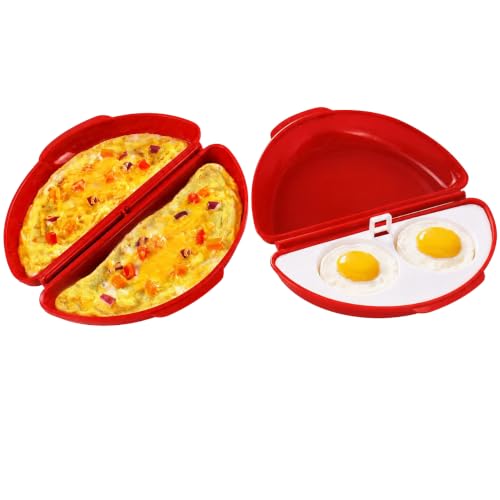
For broader use, look for a listing that specifically names more than one preparation. The Cuisinart model lists poached eggs, omelets, scrambled eggs, and egg bites. The Dependable Essentials sandwich and omelet cooker lists omelets, scrambled, fried, and poached eggs for two to three eggs. The removable insert in the other Dependable Essentials model changes between a divided tray and round egg cups, giving it two documented formats.
Consider capacity and portion size
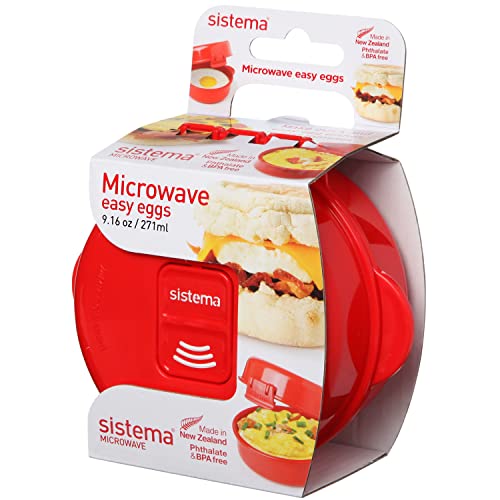
Capacity is one of the most important differences between the best microwave-safe egg cookers. The OXO is presented as a focused individual cooker, while Sistema identifies a 270 ml size. Two-cavity models are suited to two eggs or a pair of sandwich portions. Culinary Elements documents capacity for up to three eggs, making it more appropriate for a larger omelet with additions.
The Anyday set takes a different approach: each unit is a 2-cup glass cooker, and the package includes two units. That can be useful when preparing separate portions or when one dish is being used for cooking while another is available for storage or reheating. Capacity does not automatically indicate better results, so consider the amount you normally eat and the room needed for vegetables, cheese, meat, or other additions.
Check material and microwave instructions
The supplied products use several material approaches. Plastic models commonly document BPA-free construction and microwave safety, while the Anyday cooker uses borosilicate glass with a glass lid and silicone rim. Ceramic options also appear in the candidate pool, but this comparison favors products with clearer combined evidence for microwave use and everyday operation.
Follow the product’s own instructions rather than assuming every cooker works the same way. The Sistema listing says to use the cooker with the vent open. Some listings advise piercing yolks or scrambling first, and microwave wattage can affect cooking time. The Dependable Essentials two-piece model explicitly notes that timing varies with microwave wattage and ingredients. Eggs can build pressure, so venting or piercing guidance should not be ignored.
Look for steam and splatter control
A lid with a vent can help manage steam and reduce splatter, but it does not remove the need to follow instructions. Sistema documents a steam-release vent, Micro Grill describes a steam-vented lid, and KMJILS lists a vented lid with a non-slip base. The Li and Zhao four-cavity model also lists a vented cover and recommends piercing the yolk.
A cooker without detailed venting information may still be suitable, but the evidence gives less guidance for comparing its steam management. When reviewing any design, check whether the lid is intended to be closed during heating, whether a vent should remain open, and whether the manufacturer provides instructions for yolks and water.
Prioritize release and cleanup
Nonstick surfaces and dishwasher compatibility are recurring convenience features. Culinary Elements, the Dependable Essentials models, Micro Grill, and KMJILS all document dishwasher-safe or nonstick features. OXO lists both a removable base and dishwasher safety, which can simplify transferring and cleaning a single egg. Anyday lists dishwasher compatibility and uses a glass bowl that can also serve for storage or reheating.
Do not treat “nonstick” as a promise that no preparation is needed. Some listings recommend a small amount of oil or cooking spray to help release eggs. That is a design consideration rather than a flaw, especially for omelets or recipes containing sticky ingredients.
Think about handling and storage
Cool-touch handles, side tabs, compact dimensions, and removable parts can matter in a busy kitchen. OXO and Cuisinart list cool or stay-cool handles. Sistema includes side tabs for transport, while several two-egg designs are described as compact for dorms, offices, RVs, or small kitchens. The Anyday glass set offers broad use but may be less lightweight than plastic alternatives.
Final Recommendation
Anyday 2-Pack Glass Microwave Egg Cooker ranks first overall in this specification-based comparison under the published weighted criteria.
Anyday 2-Pack Glass Microwave Egg Cooker is the highest-scoring returned product and the first overall specification-based choice among these best microwave-safe egg cookers. Its borosilicate glass, glass lid, two-cup format, and microwave, oven, freezer, refrigerator, and dishwasher compatibility give it the broadest documented utility.
For a focused single serving, OXO is the stronger fit because its curved base, removable bottom, wide opening, and cool-touch handle address fried eggs and breakfast sandwiches directly. Cuisinart is the better broad-style branded option, while Culinary Elements is the practical choice for up to three-egg omelets. Among the top microwave-safe egg cookers for two portions, Micro Grill, Sistema, KMJILS, and the Dependable Essentials models offer useful combinations of cavities, venting, nonstick surfaces, and dishwasher cleanup.
Because this is a specification-based comparison rather than a hands-on test, the rankings reflect documented features only. Microwave wattage, ingredients, egg size, and personal texture preferences can change the cooking process. Read the included instructions, use the stated venting method, and monitor the first few cooking cycles.
Frequently Asked Questions
What should I look for in the best microwave-safe egg cookers?
Look for explicit microwave compatibility, material information, clear capacity, venting guidance, and cleanup details. Then match the cavity design to your preferred preparation. A single cup suits one serving, while two-cavity and three-egg designs are better for multiple eggs or larger omelets.
Can these cookers make more than poached eggs?
Several selected products document multiple preparations. Cuisinart lists poached eggs, omelets, scrambled eggs, and egg bites. The Dependable Essentials sandwich and omelet model lists fried, poached, scrambled, and omelet use. Anyday lists scrambled, poached, and frittata-style cooking. Other models are more specifically shaped for poached or sunny-side-up eggs.
Do microwave egg cookers need a vent?
A vent can help release steam and manage splatter, but the exact method depends on the product. Sistema says to operate with its vent open, and Micro Grill and KMJILS list vented lids. Always follow the product instructions, and do not seal a cooker in a way the listing does not support.
Are glass egg cookers better than plastic ones?
They offer a different set of trade-offs. Anyday documents borosilicate glass, broad appliance compatibility, and plastic-free construction. Plastic models are often lighter and may offer shaped cavities, removable inserts, or compact storage. The better choice depends on whether material preference, portability, capacity, or egg shape is most important to you.
How should I choose between a one- and two-egg cooker?
Choose a one-egg format for individual breakfasts and a two-cavity model when you regularly prepare two eggs or a sandwich portion. If you want omelets with several mix-ins, consider a model that explicitly states a larger capacity, such as the Culinary Elements three-egg design. Microwave wattage and ingredient volume still affect cooking time, so use the supplied instructions.