Buying Guide
The best boys’ moccasin loafers are easier to compare when you separate appearance from construction. A polished upper may suit a ceremony, but the closure, lining, footbed, and outsole determine whether the shoe also fits a school routine. The products above are ranked from supplied listing evidence only. They were not physically tested, and the comparison does not interpret customer opinions.
Start with the intended setting
For weddings, church services, graduations, and other dress occasions, begin with the upper finish and silhouette. The French Toast pair uses a black patent finish and a classic penny-loafer shape, making its styling particularly formal. The Florsheim Croquet Penny Loafer Jr. uses a smooth leather upper for a traditional presentation. Josmo’s cognac color provides a warmer alternative to black while retaining a penny-loafer profile.
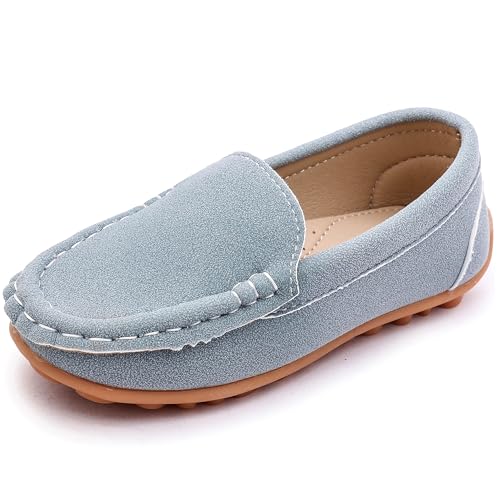
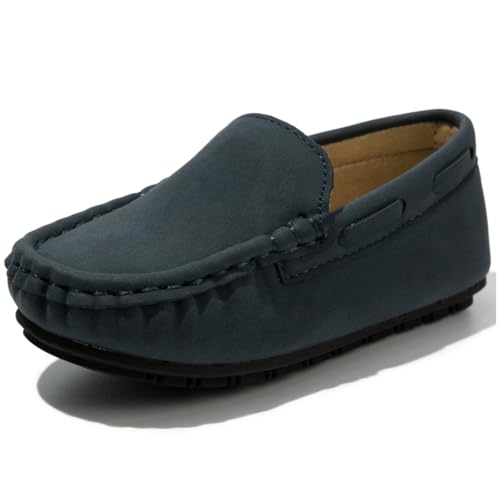
For school uniforms and mixed wardrobes, a simpler finish can be easier to coordinate. DADAWEN, Moceen, Cubufly, and Femizee all document uses that extend from school or uniforms to casual or family occasions. That broader positioning matters when one pair needs to work with chinos, jeans, khakis, or dress clothing. Color still matters: black styles such as French Toast, Florsheim, Uineky, and GINNI present the most formal visual direction based on their listed colors and finishes, while navy, cognac, and mist blue create more casual styling possibilities.
Check the closure and child independence
Every selected product uses a slip-on or laceless format, but the details differ. Deer Stags describes a no-lace shoe that children can put on and remove themselves. Uineky similarly emphasizes easy entry for younger children. French Toast and Moceen provide the familiar no-lace penny-loafer format, while GINNI adds hidden elastic gores that may make entry more adaptable.
A slip-on should still be assessed for how it is intended to stay in place. Femizee documents a gently fitted heel, and GINNI lists a padded collar and elastic gores. Those details are more useful than simply seeing “slip-on” in a title because they describe how the upper is shaped around the foot. Fit cannot be confirmed from listing data alone, so use the seller’s size chart and compare it with the child’s foot measurements where the listing recommends doing so.
Compare upper materials
Natural leather appears in the Florsheim listing, while several other products specify synthetic leather, faux leather, or faux suede. Material choice affects the visual character and care routine, but the supplied evidence does not establish a hands-on durability ranking. Smooth synthetic uppers, such as those described by DADAWEN, Uineky, and GINNI, present a clean dress-shoe appearance. Suede-style choices from Cubufly and Femizee offer a softer texture and less conventional finish.
The listing for GINNI specifically describes a water-resistant faux leather upper and recommends wiping it with a damp cloth. That is a product-specific care instruction, not a general claim about every synthetic loafer. For suede or faux suede, the supplied listings identify the material but do not provide a complete cleaning method, so check the product instructions before treating the surface.
Look at cushioning and interior details
Footbed information varies considerably. Josmo and Moceen list padded footbeds. French Toast specifies a cushioned insole. Florsheim identifies a fully cushioned Memory Foam footbed. These descriptions support comparing underfoot cushioning, but they do not prove how any shoe feels during wear.
GINNI gives detailed interior specifications, naming a high-density foam insole, deep heel cup, padded collar, and a layered cushioning structure. Femizee also documents a cushioned footbed, rounded toe box, and gently fitted heel. DADAWEN and Deer Stags describe soft linings, with Deer Stags additionally noting a lining intended to wick moisture. These features may be useful when choosing between a basic dress shoe and a more extensively described comfort build.
Toe shape is another consideration. Femizee specifies a roomy rounded toe box, Uineky identifies a round toe, and GINNI uses a square toe with a smooth interior. A listing description cannot determine whether a particular shape will fit a child’s foot, so compare the stated design with the child’s measured length and width needs.
Evaluate the outsole
The selected shoes use rubber, PU, or flexible outsole constructions. Josmo, DADAWEN, Uineky, Moceen, and Florsheim specifically mention rubber soles or rubber outsoles. Their listings connect those soles with traction, flexibility, durability, or non-marking use. Femizee describes a rubber nub driving sole that bends with each step, while GINNI identifies a flexible PU bottom with anti-slip traction.
Outsole wording should be read carefully. “Non-slip,” “traction,” and “grip” are listing claims about the product design; they are not independent test results. Deer Stags documents a lightweight PU outsole but provides less specific traction language than the rubber-soled options. French Toast documents a flexible sole without a detailed grip specification. If indoor floors, sidewalks, or playground areas are part of the intended routine, prioritize the products whose listings explicitly mention the type of outsole and its traction purpose.
Match the loafer to age and routine
The selected products cover toddler, little-kid, and big-kid sizing, but each displayed listing represents one size and color variant. Josmo is shown in big-kid size 4, Deer Stags in big-kid size 6, Florsheim in big-kid size 7, and Femizee in toddler size 9. These examples do not establish a universal size range for every color or parent product.
For toddlers, self-dressing features can be especially practical: Uineky and DADAWEN document easy slip-on entry, while Femizee adds heel and toe-box details. For older children, Florsheim and Deer Stags offer more traditional dress-loafer profiles. Always verify the current size chart, width information, and the selected color’s available sizes before making a decision.
Methodology
The editorial criteria are category-specific: moccasin-loafer design, slip-on convenience, comfort and foot support, traction and sole design, and occasion versatility. Each product receives a 0.0-to-10.0 score on every criterion using its supplied title, features, and specifications. The weighted editorial score uses the displayed weights: 20%, 15%, 25%, 20%, and 20%. Products were selected only when the supplied evidence supported a weighted editorial average of at least 7.0. No hands-on testing or customer-opinion summary is represented.
Final Recommendation
Femizee Suede Driving Moc Loafers ranks first overall in this specification-based comparison under the published weighted criteria.
Josmo Boys Moccasin Driving Loafers is the first overall specification-based choice among these best boys’ moccasin loafers. Its combination of penny styling, slip-on construction, padded footbed, gripper outsole, and formal-to-casual use cases gives it a balanced profile in this comparison.
Choose Florsheim if a smooth leather upper and Memory Foam footbed are the priorities. Choose Femizee for the most detailed flexible driving-sole, toe-box, and heel information. GINNI is the better fit to investigate when insole support and elastic gores matter. For school uniforms and formal dress, French Toast provides a clearly documented patent penny-loafer look, while DADAWEN offers a rubber-sole design with broad occasion coverage.
The top boys’ moccasin loafers are not interchangeable in styling or construction. Review the child’s measured foot length, the required dress code, and the outsole and interior details before selecting a size and finish. The best boys’ moccasin loafers for one routine may be too formal, too casual, or insufficiently detailed for another.
Frequently Asked Questions
Among the best boys’ moccasin loafers, what makes a boys’ shoe a moccasin loafer?
A moccasin loafer generally combines a slip-on closure with moccasin-inspired stitching or a driving-moc shape and a loafer upper. In this comparison, Josmo, Deer Stags, French Toast, Cubufly, Moceen, Femizee, and GINNI use direct moccasin, moc toe, driving moc, or penny-loafer language. Product terminology varies, so review the documented construction rather than relying on one exact phrase.
Several selected products explicitly mention school or uniform use, including Josmo, DADAWEN, Cubufly, Moceen, French Toast, Femizee, and GINNI. Black styles such as French Toast, Florsheim, Uineky, and GINNI generally present a formal visual direction based on their listed colors and finishes. Confirm the school’s requirements for color, finish, and sole before choosing.
Which selected loafers document the most cushioning?
GINNI provides detailed cushioning and support description, including a high-density foam insole, deep heel cup, padded collar, and layered cushioning structure. Florsheim lists a fully cushioned Memory Foam footbed, while Josmo, Moceen, French Toast, and Femizee document padded or cushioned footbeds. These are specification claims, not results from hands-on testing.
What should parents check before choosing a size?
Check the product’s current size chart and compare it with the child’s measured foot length. Femizee specifically recommends measuring heel to toe and considering the stated toe-box design. GINNI documents hidden elastic gores, while Femizee documents a rounded toe box, but neither feature replaces measuring. Also confirm that the selected color and size are associated with the same parent product.
Which outsole details deserve attention?
Look for the outsole material and the function the listing assigns to it. Rubber options from DADAWEN, Uineky, Moceen, and Florsheim are described with traction, flexibility, or non-marking properties. Femizee documents a rubber nub driving sole, while GINNI lists a flexible PU bottom with anti-slip traction. These descriptions help organize the comparison but are not independent performance tests.