Buying Guide
Choosing the best mosaic ceramic tiles starts with the surface and pattern you want to create. A small frame, flowerpot, or coaster needs a different format from a backsplash, pool surround, or broad wall accent. The listings in this comparison range from tiny handmade squares to broken Talavera pieces, so package weight alone does not tell you how easily a set will fit your project.
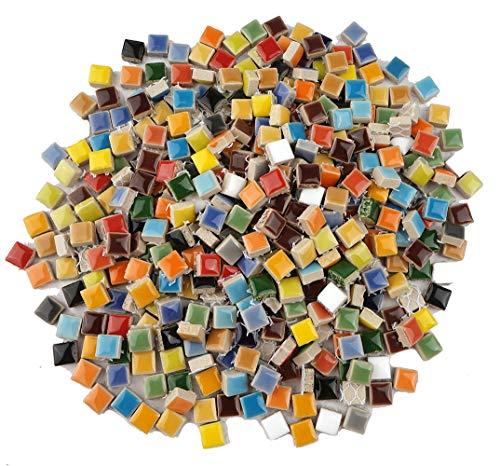
Square pieces are the most predictable option for geometric arrangements. Lanyani’s mesh-backed squares and Samjobroad’s 12-mm squares both offer defined dimensions, while the BTMIEY square assortment uses 1-by-1-cm pieces. These formats can make spacing, borders, and repeated color blocks easier to plan. Honeydak also uses small square pieces, with a stated 0.4-by-0.4-inch size and a large multicolor quantity.
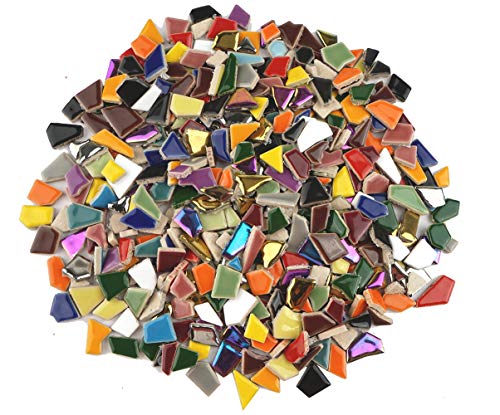
Irregular pieces create a looser, more organic result. Lanyani’s polished scraps range from 20 to 42 mm and include different textures. Mextiles takes the broadest approach: the listing describes whole broken Mexican Talavera tiles that can be trimmed or broken as needed. That can be useful when you want variation, but it also means more decisions during layout.
Decorative silhouettes are useful when the shape is part of the design. Ricytnig’s raindrops can form flowing lines or flower-like arrangements. Yoption and Artspac offer petal and leaf forms, while Artspac’s set also includes circular glass pieces. These options are less about uniform grids and more about recognizable motifs.
Check dimensions and thickness
Tile dimensions affect both visual scale and handling. ALEA’s 5-by-5-by-3-mm pieces are suited to fine detail, miniature work, and small color transitions. By contrast, Yoption lists leaf lengths from about 0.98 to 1.9 inches, making those pieces visually prominent. Ricytnig’s 18-by-28-mm raindrops sit between miniature tesserae and large decorative fragments.
Thickness matters when pieces will share a surface. Several listings provide thickness information, including the current listing information-inch BTMIEY squares, the 1/8-inch Lanyani mesh-backed squares, and the current listing information-inch Samjobroad squares. Uniform thickness may help create a more even finished plane, but the supplied evidence does not establish installation results for any product. Plan the substrate and adhesive separately, and confirm that the product is appropriate for the intended surface.
Consider backing and installation supplies
Mesh backing can speed up the initial arrangement. Lanyani’s 784-piece set comes in a sheet with mesh backing, and the listing says the pieces can be taken off the mesh. That gives you a choice between using a sheet for wall decoration and separating pieces for a custom composition.
Most loose-piece sets are not self-adhesive. A buyer should therefore budget for an adhesive compatible with the substrate, plus any grout or sealing products needed for the project. Do not assume that a craft assortment includes installation materials simply because it is described as a mosaic supply.
Handling also varies by size and edge treatment. Several listings describe smooth or polished surfaces and edges, but that does not remove the need for ordinary care when arranging, cutting, or breaking pieces. Mextiles arrives whole according to its listing, so creating smaller fragments requires an additional preparation step. ALEA’s very small pieces may be easier to place with a tool such as tweezers, as the listing indicates.
Evaluate quantity by piece count, weight, and coverage
Piece count is most informative when the pieces are uniform. Honeydak lists about 1,500 pieces, ALEA lists 1,000, and BTMIEY lists about 420 square pieces. Those counts can help with repeated patterns, but they do not directly translate into finished coverage because piece sizes differ.
Weight is more useful for mixed or broken material. Mextiles provides the current price, Lanyani’s irregular assortment provides two pounds, and several decorative sets provide 200 grams, 454 grams, or about the current price. For an expansive surface, a larger package may reduce the risk of running short. For a small accent, a smaller mixed assortment may provide enough variety without leaving a large surplus.
The one listing that directly states coverage is BTMIEY’s iridescent leaves, which is not among the ten selected products here. For the selected products, avoid treating package weight as a precise coverage promise. Measure your project, estimate the layout, and allow for gaps, trimming, breakage, and the visual spacing your design requires.
Choose finish and environment deliberately
Glazed or polished surfaces appear throughout the selected products. Lanyani’s mesh-backed tiles are described as highly glazed with polished edges, and its irregular assortment is described as high-fired, polished, waterproof, and UV-resistant. Samjobroad also describes glazed porcelain, smooth edges, and water and outdoor suitability. Mextiles is listed as water-resistant, outdoor-suitable, and heat-resistant near flame.
Those statements are product-specific, not universal properties of all ceramic mosaic tiles. ALEA’s listing specifically says its pieces are not frost-proof and are better suited to warmer outdoor climates. Yoption’s evidence documents smooth clay pieces and outdoor decorative applications but does not provide the same freeze-resistance statement. If your project will face freezing temperatures, standing water, strong sun, or heat, use the product’s own stated limitations rather than assuming that every glazed piece has the same performance profile.
Plan color and visual consistency
Random mixes offer creative variety but reduce exact color control. Honeydak lists multiple colors, while Lanyani’s irregular set adds several textures. Artspac uses a random multicolor mix, whereas Yoption focuses on green and Samjobroad focuses on teal. A coordinated set is easier to plan around a specific palette; a mixed set is more flexible for exploratory designs.
For detailed multicolor work, ALEA’s division into 20 colors is unusually specific. For nature-inspired projects, Yoption’s green leaves and petals provide a narrower palette, while Artspac adds more color variety and combines ceramic and glass. Decide whether you want a controlled color field, a varied assortment, or a dedicated accent color before ordering.
Final Recommendation
Lanyani 784-Piece Tiny Square Mosaic Tiles ranks first overall in this specification-based comparison under the published weighted criteria.
Lanyani’s 784-Piece Colorful Tiny Square Ceramic Mosaic Tiles is the highest-scoring specification-based choice among these best mosaic ceramic tiles. Its documented combination of small square dimensions, mesh backing, glazed finish, polished edges, and stated water, weather, and freeze resistance makes it the most balanced option for shoppers who want an organized format with broad stated use. Choose Mextiles when the project is large and architectural, Honeydak when piece count and color variety matter most, or ALEA when fine detail and many small color units are the priority.
Among the top mosaic ceramic tiles for decorative shapes, Artspac, Yoption, and Ricytnig offer the clearest alternatives to ordinary squares. Artspac is the more varied floral assortment, Yoption is the more focused green botanical set, and Ricytnig supplies a defined raindrop silhouette. For outdoor work, compare the exact environmental claims: Lanyani’s irregular pieces, Lanyani’s mesh-backed set, Samjobroad, and Mextiles provide more explicit exterior-related evidence than every other selection.
Frequently Asked Questions
Are the best mosaic ceramic tiles self-adhesive?
The selected listings generally do not include self-adhesive backing. BTMIEY’s square assortment explicitly says the back is not self-adhesive, and its irregular set likewise requires separately purchased glue. Lanyani’s mesh-backed product is a sheet format, not a statement that adhesive is included. Check the package details and select an adhesive appropriate for the substrate.
Which selected tiles are best for a geometric pattern?
Uniform squares are the most straightforward choice. Lanyani’s mesh-backed squares, Samjobroad’s 12-mm squares, BTMIEY’s 1-by-1-cm squares, Honeydak’s 0.4-inch squares, and ALEA’s 5-mm squares all document square formats. Choose based on the detail level and project scale: ALEA is the smallest, while the other square options are more practical for larger repeated units.
Can these mosaic ceramic tiles be used outdoors?
Some listings specifically describe outdoor suitability, but the claims differ. Lanyani’s mesh-backed set is listed as water, weather, and freeze proof; Lanyani’s irregular set is described as waterproof and UV-resistant; Samjobroad and Mextiles also include outdoor-related claims. ALEA’s listing says its tiles are not frost-proof. Review the exact product evidence and local conditions before choosing a set for exterior installation.
What is the best option for floral or leaf designs?
Artspac, Yoption, and Ricytnig are the most design-specific selections. Artspac includes pre-cut leaf shapes in three sizes and circular glass pieces. Yoption supplies green petal and leaf forms in three sizes. Ricytnig uses a raindrop shape that can support flowing botanical accents, but it is not a leaf-shaped set.
Is a heavier package always better for a large mosaic?
Not necessarily. Weight does not account for tile dimensions, thickness, gaps, shape, or breakage. Mextiles supplies the current price and is positioned for broad surfaces, while Honeydak and ALEA provide high piece counts in smaller formats. Measure the project and compare the package format, not weight alone. For mixed pieces, allow extra material because irregular shapes are harder to estimate precisely.