Buying Guide
Choosing among the best natural ceiling fans starts with the room, not the finish. “Natural” can describe real wood blades, a light wood pattern, a brown blade set, or a rattan-inspired enclosure. The supplied listings vary considerably, so compare construction and fit separately from appearance. This guide uses public specifications and feature descriptions only; it does not report hands-on testing or customer sentiment.
Match the fan diameter to the room
A 52-inch fan is the dominant size in this comparison. TCL documents coverage up to an 18-by-18-foot room, while Revoici describes suitability for rooms from 100 to 300 square feet. Those statements provide useful starting points, but they are listing claims rather than a universal sizing rule. A 52-inch model may be a sensible choice for a larger bedroom, living room, dining room, or covered patio, while a 42-inch option can be easier to place in a smaller room.
The cumilo, addlon, and other 42-inch choices are worth considering when a full 52-inch span would overwhelm the room. Their smaller formats can also help with visual proportion. Do not assume that a smaller fan is automatically quieter or weaker; check the documented motor, airflow, and speed information for the exact model.
Decide between flush mount and downrod installation
Flush-mount or hugger designs keep the fan closer to the ceiling. TimBreeze, Hoenofly, Sofucor, Depuley, ShineMuse, addlon, and Passky all emphasize low-profile or flush-mount formats. These are especially relevant for bedrooms, offices, and rooms where vertical clearance is limited. Hoenofly lists a height of 7.87 inches, while Depuley lists 8.27 inches, although installation clearance should always be checked against the manufacturer’s instructions.
Downrod designs provide more placement flexibility where ceilings are high. TCL includes 5-, 10-, and 24-inch downrods, and Revoici includes 5- and 10-inch options. TCL and Revoici also document compatibility with sloped ceilings up to 15 degrees. These details make them more adaptable for vaulted or angled rooms than a flat-ceiling-only design. TimBreeze is described primarily as flush mount, so verify the installation method before ordering if your ceiling is angled.
Compare blade construction and appearance
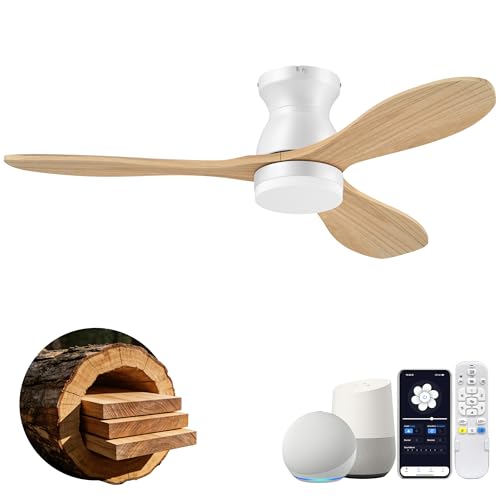
The most specification-aligned construction claims come from listings that explicitly identify solid or real wood. TCL describes real wooden blades, TimBreeze claims 100% solid paulownia wood, Sofucor uses a white-and-natural wood blade design, and Revoici describes a natural solid-wood fan. ShineMuse identifies natural wood blades. These products are the clearest choices when material is central to the buying decision.
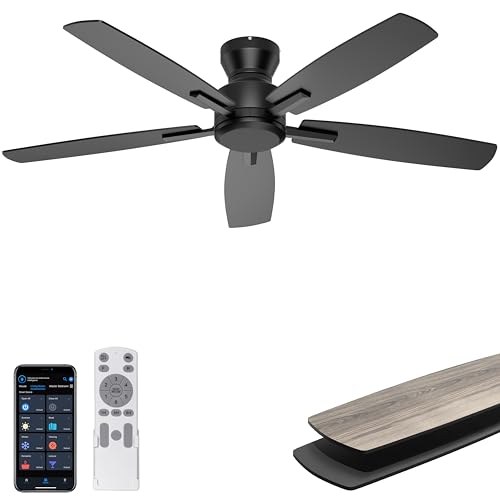
Other listings use wood-colored finishes or double-sided blades without clearly documenting solid wood. Depuley identifies durable plastic and ABS blades, while addlon and Passky describe double-sided designs. Those can still provide a natural visual style, but they should not be treated as equivalent to a confirmed solid-wood construction. Look for the exact material wording rather than relying only on a product title.
Check airflow and seasonal operation
Six-speed control appears across most selected products, giving you more adjustment than a simple low, medium, and high switch. Reversible motors are also widely documented. Forward rotation is described for summer cooling, while reverse operation circulates warmer air near the ceiling during colder periods. That makes reversal a practical year-round feature rather than merely a decorative specification.
Some listings provide numerical airflow claims. Numerical claims should be compared cautiously because the supplied evidence does not provide a common testing method. A dedicated breeze or natural-wind mode, such as the one listed for ShineMuse, may matter more if you prefer changing airflow rather than maximum output.
Several products provide stated noise figures, but these are listing specifications, not independent measurements. TCL lists a 25dB sleep mode. Sofucor and Hoenofly state operation under 30dB, while Depuley lists up to 30dB. Revoici and ShineMuse list 35dB or less and add quiet DC motor language. These details can help narrow choices for nurseries, bedrooms, and home offices, but the real experience may depend on installation, ceiling structure, and speed selection.
A reversible DC motor is a recurring feature in the selected group. It supports multiple speed settings and seasonal direction changes. If quiet operation is especially important, prioritize a model with a specific stated noise figure and use the lowest suitable speed rather than assuming every DC motor will perform identically.
Review the integrated lighting
Integrated LEDs offer more consistent built-in lighting than a fan-only design, but flexibility differs. TCL, TimBreeze, Hoenofly, Sofucor, Revoici, Depuley, ShineMuse, addlon, and Passky document dimming and multiple color temperatures. TimBreeze lists 2,000 lumens, Revoici lists a 22W LED source, and ShineMuse lists a 22W LED. These details help distinguish lighting capacity from simple color selection.
Memory functions can restore brightness and color temperature after power is switched off, although the listings attach different timing or switch conditions to that feature. Hoenofly specifically warns against connecting to dimmer or fan-speed switches. Read the wiring instructions before installation, especially when replacing an existing fixture.
Choose the control method you will actually use
A handheld remote is standard among the selected products. Some add timers, wall mounting, or separate fan and light controls. TimBreeze includes remote and wall-control operation, while ShineMuse specifies a wall mount for its remote. Hoenofly and cumilo add Wi-Fi, app, Alexa, and Google Assistant compatibility. Smart functions are useful when the fan is difficult to reach, but they introduce setup considerations that do not apply to a basic remote.
Memory, timer, and independent fan-and-light operation are practical extras. Confirm whether the wall switch cuts power to the unit, because that can affect memory behavior and smart connectivity. For a simpler installation, a conventional remote-controlled model may be preferable.
Final Recommendation
TCL 52-Inch Natural Wood Downrod Ceiling Fan ranks first overall in this specification-based comparison under the published weighted criteria.
The final choice among the best natural ceiling fans depends on the documented features that match your intended use.
TCL 52-Inch Natural Wood Downrod Ceiling Fan is the highest-scoring returned product and the first overall specification-based choice. It combines documented real wooden blades, six speeds, a quiet 25dB mode, reversible airflow, adjustable LED lighting, multiple downrods, and sloped-ceiling compatibility. Among the top natural ceiling fans, it has the clearest evidence for large-room coverage and varied ceiling heights.
Choose TimBreeze if a flush mount and stated solid paulownia construction are more important. Choose Hoenofly for app and voice control, Sofucor for a quiet three-blade design, or cumilo for a smaller smart fan. Revoici and ShineMuse provide useful lighting and breeze-control options, while Depuley, addlon, and Passky offer practical low-profile alternatives. Always verify ceiling clearance, wiring, room size, and outdoor exposure requirements before installation.
Frequently Asked Questions
What makes the best natural ceiling fans different from ordinary ceiling fans?
The defining difference is usually the documented design: real or solid wood blades, a natural wood finish, or another organic material such as rattan. The best natural ceiling fans should also match the room’s size and ceiling height. A natural finish alone does not confirm solid wood, so check the material description carefully.
Are natural wood ceiling fans suitable for low ceilings?
Yes, several selected models are explicitly flush mount or low profile. TimBreeze, Hoenofly, Sofucor, Depuley, ShineMuse, addlon, and Passky all describe low-profile installation. Check the listed height and the installation manual, because the final clearance can depend on the junction box, trim, and ceiling structure.
Should I choose a 42-inch or 52-inch fan?
The 42-inch cumilo and addlon models are positioned for medium or small rooms, while the 52-inch TCL, TimBreeze, Hoenofly, Sofucor, Revoici, Depuley, ShineMuse, and Passky models are better starting points for larger spaces. Use each listing’s stated room guidance and dimensions, then confirm the manufacturer’s sizing recommendations.
Do these ceiling fans work in covered outdoor areas?
Several listings describe indoor/outdoor or covered-patio use, including TCL, Hoenofly, Depuley, cumilo, and addlon. That wording does not mean exposure to rain is acceptable. Verify the exact damp-location rating and keep the fan protected from direct water unless the installation instructions explicitly permit otherwise.
Is a smart ceiling fan better than a remote-controlled model?
It depends on your priorities. Hoenofly and cumilo document app, Wi-Fi, Alexa, and Google Assistant compatibility in addition to remotes. A basic remote model may be simpler when you only need speed, lighting, reversal, and timer controls. Check network requirements and switch compatibility before choosing smart control.