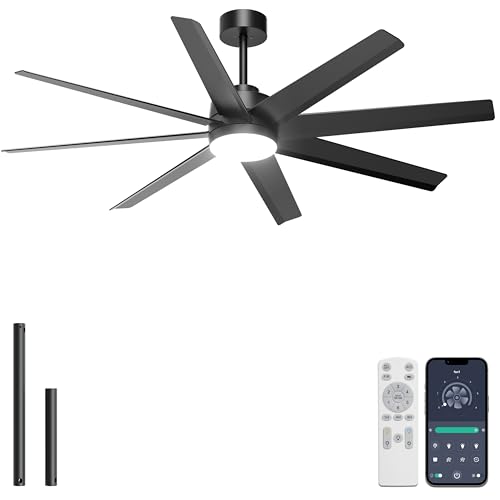
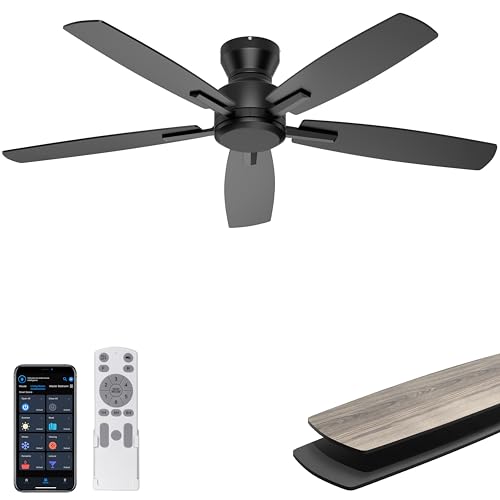
Buying Guide
Choosing among the best reversible airflow ceiling fans starts with the room, not the finish. A reversible fan changes between downdraft and updraft: the former is used for a cooling breeze, while the latter circulates warmer air during colder weather. The listings in this comparison consistently describe that two-direction function, but they differ considerably in blade span, mounting format, controls, lighting, and the amount of airflow information provided.
Match fan diameter to the room
Diameter is one of the clearest specification differences. The selected models range from 42 to 72 inches. A 52-inch fan is a versatile middle category represented by LEDIARY, CINOTON, addlon, ZMISHIBO, Ohniyou, and Obabala. These models are generally easier to consider for bedrooms, offices, living rooms, and covered patios than the very largest designs.
Large rooms need more careful clearance planning. The 60-inch Ohniyou, 65-inch Phylluz, and 72-inch Fanbulous models are aimed at broad coverage. Fanbulous specifically states coverage for spaces up to 650 square feet. That is useful listing evidence, but it is not a universal room-size rule: ceiling height, furniture, layout, and the desired air pattern still matter. The 72-inch span also needs more open ceiling area than a 52-inch fan. Measure the room and check blade clearance before focusing on lighting or smart functions.
Choose flush mount or downrod installation
Flush-mount and low-profile designs are practical when the ceiling is low. LEDIARY lists a total height of 10 inches, ZMISHIBO lists an 8-inch height, and Ohniyou 52-Inch lists 10.63 inches. The Amico 42-Inch model is also explicitly described as a low-profile flush mount. These designs keep the fan close to the ceiling and avoid adding a long hanging rod, but buyers should still verify the manufacturer’s installation instructions and the actual ceiling-box requirements.
Downrods are more useful when the ceiling is high or vaulted. Fanbulous includes 5-, 10-, and 20-inch rods, while Phylluz includes 8- and 16-inch rods. The larger Ohniyou model includes 6- and 10-inch rods. CINOTON includes 5- and 8-inch rods and states support for slopes up to 15 degrees. Obabala includes 5- and 10-inch rods and also lists support for slopes no greater than 15 degrees. These details make the installation fit easier to assess, although a listing does not replace checking the electrical box, ceiling angle, and local installation requirements.
Consider airflow evidence carefully
Six speeds appear across nearly all selected products, giving more adjustment than a basic three-speed layout. That does not mean every fan produces the same airflow. Where available, numeric figures are more useful than general language: the Ohniyou 60-Inch listing states 6,200 CFM, Ohniyou 52-Inch states 4,580 CFM, CINOTON lists up to 4,500 CFM and a 3,996 CFM average, LEDIARY states 4,042 CFM, and ZMISHIBO 52-Inch lists an average 3,057 CFM.
Treat these figures as manufacturer-provided listing data rather than independent measurements. Several selected fans, including Phylluz, addlon, Amico, and Obabala, do not provide a numeric airflow figure in the supplied evidence. They can still be useful choices because they document reversible operation and speed control, but a buyer who needs a specific airflow target should prioritize models with a stated figure and confirm the current product documentation.
Blade count and blade material also vary. The large Ohniyou uses eight ABS blades, Fanbulous uses eight wooden blades described as warp-resistant, CINOTON uses dual-sided plywood blades, and Obabala uses five composite-wood-material blades. More blades alone do not prove better performance. Use blade span, the manufacturer’s airflow information, motor design, and room size together.
Decide whether integrated lighting is needed
Most selected fans include LED lighting. LEDIARY lists a 25W panel and 2,500 lumens, CINOTON lists a 2,600-lumen main LED, ZMISHIBO lists a 20W, 2,000-lumen light, and Ohniyou 52-Inch lists an 18W LED source. Many also offer dimming and three color temperatures, commonly warm, neutral, and cool white. This can simplify a room’s fixture plan, but it also means the fan and light share one product and may require more attention during installation or future replacement.
The Obabala 52-Inch is the selected no-light alternative. Its streamlined format is appropriate when the room already has adequate lighting or when a separate fixture is preferred. The addlon, Amico, and Phylluz models provide more conventional lighted-fan functionality, while CINOTON adds RGB ambient lighting for buyers who want decorative color effects. Choose only the lighting functions you will actually use; a simpler remote can be easier for households that do not need an app.
Compare remote, app, and wall controls
Remote controls are common in this category and typically operate speed, direction, timers, and lighting. App control appears on LEDIARY, CINOTON, Ohniyou 60-Inch, Ohniyou 52-Inch, Phylluz, and Fanbulous. CINOTON additionally lists Alexa and Google Assistant compatibility. Bluetooth app control is specified for some models, so do not assume that every app-connected fan works through a home Wi-Fi network or smart-home hub.
The addlon model is distinctive because it includes both a handheld remote and a wall-switch remote. That may be convenient at an entryway or beside a bed. Obabala keeps the setup focused on a multifunction remote, while Amico uses remote control for separate fan and light operation. Timers differ by model, ranging from one-hour increments to longer two-, four-, or eight-hour settings. Check the exact timer choices if automatic shutoff is important.
Use noise and efficiency claims as documented features
Several listings describe quiet DC motors. Ohniyou 52-Inch states noise as low as 20dB, CINOTON states 24dB, and LEDIARY states operation under 30dB. Ohniyou 60-Inch and addlon list 35dB figures, while Obabala states less than 35dB. These are manufacturer claims, not independent measurements, so use them for comparison rather than as a guarantee of a particular sound level in your room.
DC motors are documented across the selected range and are commonly paired with six speeds and reversible direction. Some listings also make energy-efficiency claims, but the evidence differs in wording and detail. Avoid treating a general efficiency statement as a precise operating-cost forecast.
Final recommendation
LEDIARY 52-Inch Flush Mount Ceiling Fan ranks first overall in this specification-based comparison under the published weighted criteria. Among the best reversible airflow ceiling fans, it combines a compact listed height with stated airflow, app and remote control, six speeds, adjustable lighting, and reversible operation.
The final choice depends on the documented features that match your intended use. Ohniyou 60-Inch Ceiling Fan with Light is a strong alternative for buyers who prioritize a large diameter and the largest stated airflow figure in this selection. It combines six speeds, reversible DC operation, app and remote control, dimmable lighting, memory, and covered-outdoor compatibility. Among the top reversible airflow ceiling fans, it is suited to buyers with a large room or open covered area and enough ceiling clearance.
For a low ceiling, LEDIARY 52-Inch Flush Mount Ceiling Fan is the more practical recommendation because its compact height is paired with stated airflow, smart controls, and adaptable lighting. CINOTON is a suitable fit for Alexa or Google Assistant households, while Fanbulous 72-Inch is aimed at the broadest documented coverage. Phylluz offers another large-room option with multiple downrods.
For smaller rooms, Amico’s 42-inch format is easier to size than a large-span fan. Buyers who want wall access should look at addlon. ZMISHIBO 52-Inch emphasizes support coverage and a low-profile format, and Ohniyou 52-Inch combines a stated airflow figure with a quiet-operation claim. Finally, Obabala is the focused choice when a no-light fan is preferred. All rankings are specification-based and do not represent hands-on testing or customer-opinion analysis.
Frequently Asked Questions
Among the best reversible airflow ceiling fans, what does reversible airflow mean in a ceiling fan?
It means the motor can rotate in two directions. The selected best reversible airflow ceiling fans describe downdraft operation for summer cooling and updraft operation for winter air circulation. Direction is usually changed with the remote, app, or a dedicated control, depending on the model. The fan should still be installed and operated according to its instructions.
Is a 52-inch fan suitable for every bedroom?
No. A 52-inch span is a common middle size, but suitability depends on the room’s dimensions, ceiling height, furniture arrangement, and required clearance. The selected 52-inch models are positioned for medium rooms, while Amico’s 42-inch model is aimed at smaller spaces. For a large open room, a 60-, 65-, or 72-inch model may be more appropriate if the ceiling provides enough clearance.
Should I choose a flush-mount fan or a downrod model?
Choose a flush mount when reducing hanging height is the priority. LEDIARY, ZMISHIBO 52-Inch, and Amico document low-profile or flush-mount formats. Choose a downrod model when you need to position the fan lower on a high or vaulted ceiling. Fanbulous, Phylluz, and the larger Ohniyou include multiple rod lengths. Check slope limits and electrical-box requirements before installation.
Are app-controlled ceiling fans better than remote-only models?
Not automatically. App control can add scheduling, phone access, and smart-home integration, as shown by CINOTON and several other selected products. A remote-only design may be simpler for households that do not need connectivity. The addlon model offers a middle ground with handheld and wall-switch remotes, while Obabala keeps operation centered on a multifunction remote.
Which of the top reversible airflow ceiling fans includes no light?
Obabala 52-Inch Ceiling Fan Without Light is the selected no-light design. It documents a reversible DC motor, six speeds, a remote timer, dual-finish blades, moisture-proof construction, and sheltered outdoor use. It is a suitable match for a room with separate lighting or for buyers who prefer a minimalist fan. It does not provide integrated illumination, so confirm that the existing room lighting is sufficient.
This is a specification-based comparison, not a hands-on product test. Editorial scores use a published weighted formula: reversible airflow control (25.0%), airflow range and room fit (25.0%), controls and lighting (20.0%), installation and mounting fit (15.0%), motor, noise, and efficiency features (15.0%). A limited non-published marketplace adjustment is applied internally after the editorial formula; its underlying values are not reproduced. The combined result determines rank. Potential limitations are editorial inferences based on documented category-relevant attributes; they are not observations from hands-on testing.