Buying Guide
The best navigation car stereos are not defined by screen size alone. A useful comparison should separate the navigation source, the way the unit fits the vehicle, phone connectivity, display controls, and audio outputs. The products above include vehicle-specific Android replacements and universal receivers, so the correct choice depends first on the dashboard and factory equipment.
Start with vehicle fitment
Vehicle-specific receivers are shaped around a stated model range. The Rimoody unit is listed for 2005–2010 Honda Odyssey models, the B4U unit for 2012–2015 Honda Civic models, and the podofo unit for seventh-generation Honda Accord vehicles from 2003 through 2007. Similar listings cover Toyota Sienna, Toyota Tacoma, Ford Focus, and several Chevrolet and GMC vehicles. This design can simplify the physical installation, but it does not remove the need to verify the center-console shape, opening dimensions, wiring, and factory audio equipment.
Factory amplifiers deserve special attention. The Toyota Sienna listing specifically notes that vehicles with the original JBL system may need an additional harness. The Tacoma listing also identifies JBL and factory-camera considerations. The Prius candidate that was not selected states that original JBL or amplified systems are not supported, illustrating why a vehicle match in the title is not enough. Before ordering, compare the existing radio, connectors, amplifier arrangement, and camera type with the supplied fitment notes.
Universal receivers require a different checklist. The Kissound model is described as a universal double-DIN design, while the maXpeedingrods model lists several compatible radio-opening dimensions. A universal installation may need a dash kit, wiring harness adapter, or antenna adapter. The included parts and required accessories vary, so treat “double-DIN” as an opening reference rather than a guarantee of a direct installation.
Compare navigation sources
Navigation can come from a built-in GPS module, downloaded offline maps, or a phone connected through CarPlay or Android Auto. The maXpeedingrods listing explicitly describes built-in GPS that does not require a phone or network and also supports offline map downloads. The Honda Accord, Honda Odyssey, Toyota Sienna, and Toyota Prius listings similarly document online and offline map functions. These are the most relevant options when navigation independence is a priority.
Other units focus on smartphone navigation. The Ford Focus and Kissound listings emphasize CarPlay and Android Auto access to maps, while the phone supplies the navigation app and connected data. This approach can be convenient if your preferred maps already live on your phone, but it is different from a receiver with its own GPS and offline map workflow. Check whether the listing says “built-in GPS,” “offline maps,” or only “navigation through CarPlay or Android Auto.” Those descriptions should not be treated as interchangeable.
Choose the right display and controls
A larger screen can make maps and split-screen layouts easier to view, but the available dashboard space matters. The llboiti, Fortdows, Rimoody, and Haudio single-DIN models list screens around 10 inches.
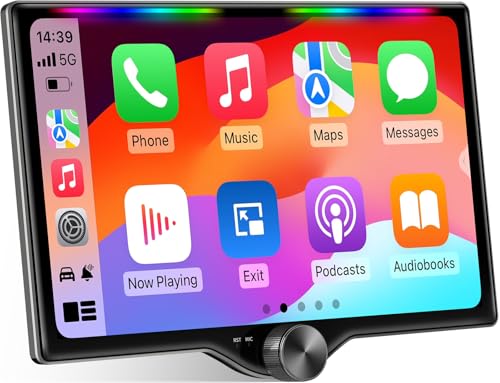
The interface also varies. The llboiti unit documents split-screen operation, and the Rimoody model lists customizable dashboard themes and adjustable windows. The Haudio single-DIN receiver adds a rotatable display, giving a documented way to adjust the screen angle in a single-DIN opening. These controls provide an alternative to reaching for an on-screen slider.
Check phone integration and vehicle controls
Wireless CarPlay and Android Auto appear across many of the selected products, including the llboiti, Inexaccessories Sienna, Zeminba Tacoma, and B4U Civic units. Wired operation is also documented on several models. If you use both iPhone and Android devices in the vehicle, confirm that both platforms are supported rather than assuming that one wireless connection covers both.
Steering-wheel control support is documented on many vehicle-specific models and on the Kissound universal receiver. Retaining those controls may require an interface module, especially in a universal installation. The Kissound listing explicitly says an interface module is sold separately. Camera integration also needs checking: some selected units include a camera, while others provide an input or do not document camera support. Look for automatic reverse switching, camera resolution, connection type, and whether the original camera can be retained.
Review audio and connection hardware
Navigation receivers also serve as audio systems. The Rimoody lists a 32-band EQ and DSP features, the Toyota Sienna receiver lists DSP and EQ settings, and the Kissound model lists a 10-band EQ with dual subwoofer output. The Haudio single-DIN unit lists a 10-band EQ and three RCA pre-outs. These details matter if you plan to connect external amplifiers, subwoofers, or additional speakers.
Bluetooth, AM/FM or FM/RDS radio, Wi-Fi, USB ports, mirror link, and RCA outputs vary by model. The llboiti receiver documents Wi-Fi 6 and Bluetooth 5.4, while the B4U Civic model lists Bluetooth 5.2 and an external microphone jack. Compare the connection list with the equipment already in your vehicle instead of choosing solely by operating-system version or screen size.
Installation and evidence limits
This is a specification-based comparison, not a hands-on test. Listing claims such as “plug and play,” camera quality, or smooth operation should therefore be read as supplied product information rather than independently verified results. Confirm the exact model year, trim, factory amplifier, camera, steering-wheel interface, and dashboard dimensions before installation. For universal units, plan for any required mounting or wiring adapters. For Android receivers, also determine whether you want onboard apps and offline maps or primarily a phone-projection interface.
Final Recommendation
llboiti 10.2-Inch QLED Android 13 Head Unit ranks first overall in this specification-based comparison under the published weighted criteria.
The final choice among the best navigation car stereos depends on the documented features that match your intended use.
The llboiti 10.2-Inch QLED Android 13 Head Unit is the first overall specification-based choice because its evidence combines built-in GPS, wireless and wired phone integration, a large QLED display, split-screen use, current connectivity, and a supplied camera. Among the top navigation car stereos, the Inexaccessories Toyota Sienna receiver is the better fit for owners who prioritize high onboard memory and offline maps, while the Zeminba Tacoma model is a practical match for drivers who want physical volume controls.
The podofo Accord, Rimoody Odyssey, and B4U Civic units make more sense when a vehicle-specific fit is the deciding factor. The Fortdows Ford Focus receiver adds a large screen for its listed Ford application. For non-factory installations, the Haudio single-DIN model offers a rotatable display, the Kissound receiver emphasizes DSP and subwoofer connectivity, and the maXpeedingrods model offers compact sizing with built-in GPS. These top navigation car stereos should still be matched to the vehicle’s opening and wiring before installation.
Frequently Asked Questions
Do all of the best navigation car stereos include standalone GPS?
No. Several selected models document built-in GPS and offline maps, including the maXpeedingrods, Rimoody, and Toyota Sienna receivers. Others emphasize navigation through CarPlay or Android Auto. Read the navigation section carefully to identify whether the receiver itself provides GPS or whether the connected phone supplies the map application and data.
Is a vehicle-specific receiver easier to install than a universal model?
It may be, because its shape and wiring are intended for a stated vehicle range. However, factory amplifiers, cameras, trim levels, and steering-wheel systems can change the installation requirements. The Tacoma and Sienna listings specifically call out JBL-related harness considerations. Universal double-DIN models may require a dash kit, harness adapter, or antenna adapter.
What does wireless CarPlay or Android Auto provide?
It lets a compatible phone connect without a routine USB cable and provides access to supported navigation, calls, messages, music, and voice-assistant functions. Some units also support wired operation. Wireless phone projection is not the same as a receiver having its own GPS, so confirm both features separately.
Should I choose a 10-inch display over a 7-inch model?
Choose based on dashboard space, viewing preference, and installation style. The larger units can provide more room for maps or split-screen layouts, while 7-inch receivers may better suit compact openings. The Haudio single-DIN receiver adds a rotatable screen, and the maXpeedingrods model lists multiple opening sizes. Always compare the stated dimensions with the vehicle opening.
Which specification matters for adding an amplifier or subwoofer?
Look for RCA pre-outs, subwoofer outputs, and audio-processing controls such as DSP or an equalizer. The Kissound model lists dual subwoofer output and DSP, while the Haudio single-DIN unit lists three RCA pre-outs. These specifications describe connection options; they do not independently establish sound quality or output performance.