Buying Guide
The best oak wine cabinets in this comparison are furniture pieces first and beverage organizers second. Listings use oak to describe a finish or color in many cases, while the documented construction commonly includes MDF, engineered wood, particleboard, metal, or rattan. If solid oak is essential, verify the material wording before ordering; do not assume an oak-colored cabinet is made from solid oak.
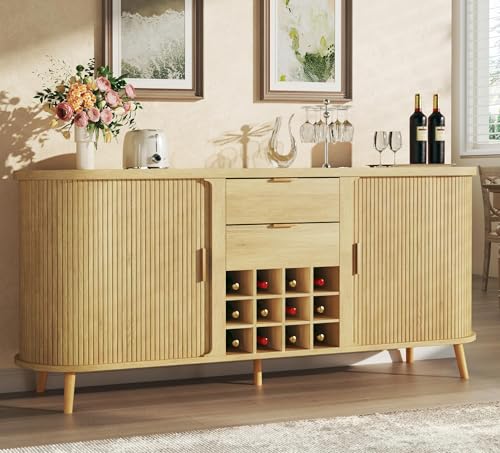
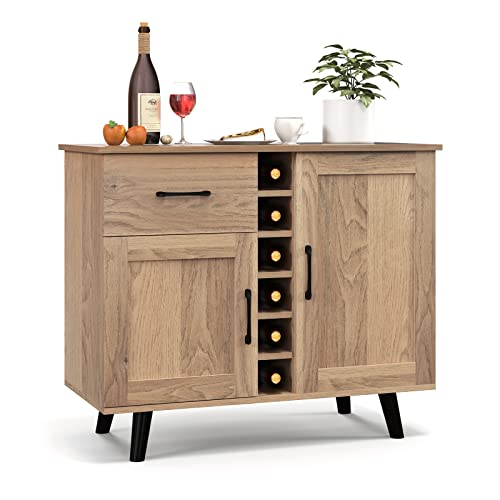
A low sideboard works well beneath wall art, along a dining-room wall, or beside a coffee station. The Giantex is only 35.5 inches wide and includes a six-bottle rack, drawer, enclosed cabinets, and adjustable shelves. The WAMPAT is much wider at 61.5 inches and emphasizes four-door, six-compartment storage. These formats are easier to use as serving surfaces, but they generally provide less vertical storage than towers.
Tall cabinets use height to increase organization without consuming as much floor width. The OKD 72-Inch Tall Coffee Bar Cabinet has six upper shelves, four lower shelves, three drawers, and a 42-inch countertop. The ONBRILL 71-Inch Tall Fluted Wine Bar Cabinet documents nine bottle spaces, twelve glass spaces, and nine storage cabinets. The ZKIODV Arched Wine Bar Cabinet uses open shelves, hanging glass racks, and a removable wine rack. Measure ceiling clearance and account for installation space before choosing a tall design.
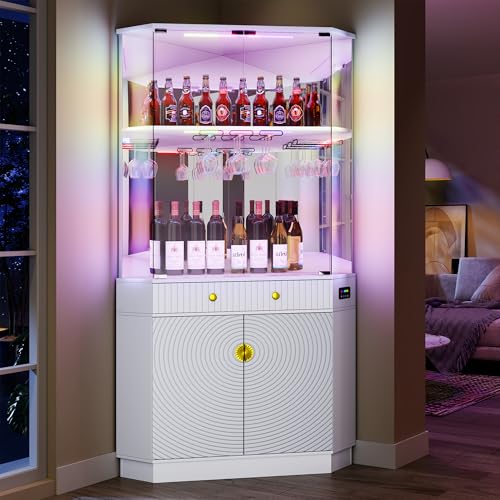
A corner unit can preserve central wall space, but the selected corner cabinet has a deeper footprint than a narrow standard cabinet. The corner format is not included in the final ten because the most specification-aligned alternatives provide clearer wine-specific capacity or more useful general storage evidence. That does not make corner storage unsuitable; it simply reflects this comparison’s documented specifications.
Match storage to your collection
Start with bottle count, then consider how much glassware and barware must remain inside. The Festisoul Farmhouse Coffee Bar Cabinet states a 16-bottle wine and glass rack, while the OTUTUMUS lists holders for twelve stemware glasses and racks for nine bottles. The ONBRILL lists nine bottles and twelve glasses. These explicit capacities make planning easier than relying on broad phrases such as ample storage.
For mixed storage, adjustable shelving is more useful than a fixed rack alone. The HUAHUU offers three shelf heights and removable wine slots, allowing the cabinet to shift toward dinnerware or serving supplies. The Varello uses two drawers and two closed cabinets, while the Ludatido adds adjustable side storage around a designated beverage-fridge opening. Check whether shelves are adjustable, removable, or simply described as storage; those terms imply different levels of flexibility.
Consider power and lighting
Integrated power can make a cabinet a practical coffee-and-wine station. The Varello includes AC and USB outlets, and the ONBRILL includes two AC outlets and two USB ports. The Ludatido also has a charging station and is designed around an appliance opening. These features may reduce the need for a separate power strip, but placement still depends on the room’s outlet position and the equipment’s cord length.
Lighting is primarily a display and atmosphere feature in the supplied listings. The OKD tall cabinet has adjustable RGB lighting with 16 color options, while the ZKIODV uses three-color lighting with a motion sensor. The Varello provides an LED display shelf, and the Festisoul does not document built-in lighting. If lighting is important, distinguish between a lit display shelf, a light strip, and motion-sensor operation rather than treating all LED features as identical.
Check dimensions and surface needs
Width and depth affect traffic flow. The HUAHUU is 58 inches wide and 15.75 inches deep; the OKD tall unit is 42 inches wide and 15.6 inches deep; and the Ludatido is 53.1 inches wide and 20.9 inches deep. A deeper cabinet may offer room for appliances, but it can project farther into a walkway. Measure baseboards, nearby doors, outlet locations, and the clearance needed to open doors or slide doors.
Surface capacity is useful when the cabinet will hold a coffee maker, microwave, decor, or serving equipment. The OKD 60-Inch Fluted Wine Bar Cabinet, which was not selected, documents a 150-pound countertop, but it is not one of the ten returned products and should not be used as a recommendation here. Among the selected products, the Ludatido states a 220-pound tabletop capacity, the WAMPAT states up to the current price, and the Giantex states the current price. These are listing specifications, not independent load tests.
Review stability and installation
Tall and heavily loaded furniture deserves a stability plan. The ONBRILL includes a wall-mounting kit, the Giantex includes anti-toppling devices, the WAMPAT includes an anti-tip device, and the Ludatido includes an anti-tip kit. The ZKIODV uses solid wood legs, while the HUAHUU uses metal legs and adjustable foot caps. Use the supplied hardware as directed and confirm that the wall and installation location are appropriate.
Assembly is part of the buying decision. The OKD tall cabinet lists labeled parts, pre-drilled holes, and included tools. The ONBRILL lists a guide video and labeled parts. Festisoul states that parts and instructions are included. These details can make setup more organized, but they do not establish a specific assembly time or guarantee an easy installation.
Final recommendation
Festisoul Farmhouse Coffee Bar Cabinet ranks first overall in this specification-based comparison under the published weighted criteria.
The OKD 72-Inch Tall Coffee Bar Cabinet is the first overall specification-based choice among these best oak wine cabinets because it combines extensive shelving, drawers, a countertop, adjustable lighting, and documented construction details. The ONBRILL is a close alternative when stated bottle and glass capacities plus integrated outlets matter more than a broader shelf layout.
For dedicated wine presentation, choose the OTUTUMUS, ZKIODV, or Festisoul according to whether you prefer rattan texture, an arched display, or a stated 16-bottle rack. The Giantex is better suited to smaller rooms, while the WAMPAT and HUAHUU emphasize wide concealed storage. For beverage appliances, the Ludatido offers a designated opening, but remember that its fridge is not included. These are the top oak wine cabinets here based on supplied specifications, not customer opinions or hands-on testing.
Frequently Asked Questions
Are these best oak wine cabinets made from solid oak?
Not necessarily. Several listings describe an oak or natural-oak color while specifying MDF, engineered wood, particleboard, metal, or rattan. The ZKIODV combines MDF with solid wood legs, and the OTUTUMUS combines cellular board, P2 particleboard, and rattan. Confirm the construction material if solid oak is a requirement.
How much wine storage should a cabinet have?
Choose based on your actual bottle count and whether glasses must be stored inside. The selected options range from the Giantex six-bottle rack to the Festisoul 16-bottle and glass rack. The ONBRILL and OTUTUMUS also document both bottle and stemware capacity, which can make planning more precise.
Is a tall wine cabinet better than a sideboard?
It depends on the room and storage plan. Tall cabinets such as the OKD and ONBRILL use vertical space for shelves and cabinets, while sideboards such as the Giantex, WAMPAT, and HUAHUU provide broad countertops and lower profiles. Measure ceiling height, walkway depth, and door clearance before deciding.
Do any selected cabinets include a beverage fridge?
The Ludatido provides a designated beverage-fridge opening but does not include the refrigerator. It is the selected option most directly suited to appliance-based planning. The other cabinets focus on shelving, racks, drawers, doors, display space, or countertop storage.
What safety features should I look for?
Look for an anti-tip kit, wall-mounting hardware, reinforced bases, or other documented stability features. The ONBRILL, Giantex, WAMPAT, and Ludatido listings each identify a relevant stability feature. Follow the supplied installation instructions and avoid treating a listing specification as a substitute for proper anchoring.